Get Full Government Meeting Transcripts, Videos, & Alerts Forever!
Get email alerts on the Parks And Recreation Budget topic
No spam. Unsubscribe anytime.
Mesa council pauses proposed Parks & Recreation program cuts after public concern; staff says fee increases still needed
Summary
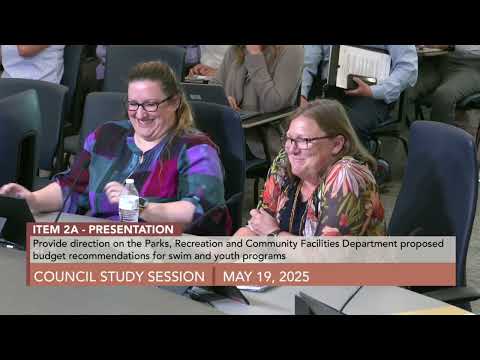
Mesa City Council members spent the May 19 study session considering Parks & Recreation budget recommendations and potential program cuts; after extended discussion council directed staff to pause proposed program eliminations and return with options while staff said fee increases are still needed to meet staffing and operational costs.
Mesa City Council members spent the bulk of their May 19 study session on Parks and Recreation’s proposed budget adjustments and program changes, including potential eliminations, fee increases and the future of Fremont Pool. After more than an hour of presentations and public-subject discussion, council directed staff to pause proposed program eliminations and return with options while continuing to pursue fee adjustments.
Parks staff (Andrea) reviewed targeted reductions in aquatics and youth-sports services that the department proposed to meet budget reduction targets with what staff described as “minimal overall impact.” Staff said the department had identified low-participation time slots and programs to scale back, and that the advisory Parks and Recreation Board had reviewed and supported fee and charge adjustments. Andrea said staff initially proposed eliminating off‑season Flowrider league sessions but, after receiving public comment, had explored reintroducing the sessions at a higher fee to achieve full cost recovery.
Staff gave several specific figures during the presentation: canceling two low-attendance swim-lesson sessions would remove roughly $21,000 in costs while those sessions produced about $8,500 in revenue (staff characterized that as a roughly $40 per‑participant subsidy); lane rental fees for affiliated groups were proposed to rise from $3 to $4 per lane per hour; field use fees for affiliated daytime users were proposed to increase from $10 to $11 per hour and to $18 per hour at night; site supervision for non-affiliated groups would be charged as $32 per day per complex; a midday field-prep fee was proposed at $85 per field; and staff estimated $120,000 in revenue tied to lane‑rental and field fee increases. For the Flowrider, staff said a user group had proposed $115 per session but staff estimated it would require about $190 per session to fully cover off‑season costs; in that scenario the department would require at least eight registrations per month to run the offering.
Staff also discussed the broader budget context: the department estimated an additional $765,300 would be required to keep programs as presented. That figure included continuing to operate Fremont Pool; staff said Fremont needs about $2.1 million in renovations to remain in service for five more years and that keeping Fremont open for a single additional year would cost roughly $430,000 in operations. Staff further noted the department had requested 26 full‑time equivalent positions (FTEs), which staff said would require roughly $1.3 million if funded.
Council members and staff discussed alternatives. Some members suggested reallocating funds from community events such as Celebrate Mesa (estimated cost discussed as $54,000) or seeking greater sponsorships for youth leagues; others warned that higher fees could reduce participation. Councilmember Duff expressed concern that raising prices might reduce participation; staff said that if a higher fee did not produce enough registrations the offering would not be scheduled.
At the end of the discussion council directed staff to pause elimination of identified programs and return with options and timing for any changes, while noting that fee adjustments already scheduled (and additional August 1 increases proposed by staff) would be part of the department’s revenue strategy. Staff repeatedly emphasized that fee increases are needed to support part‑time staffing levels and program operations; council asked staff to continue outreach with user groups and to return to council with refined options.
Two routine votes occurred during the meeting: the council approved a board appointment unanimously and unanimously acknowledged receipt of minutes from the planning and zoning board and the Sustainability and Transportation Committee.