Get Full Government Meeting Transcripts, Videos, & Alerts Forever!
Get email alerts on the Water Treatment Renovation topic
No spam. Unsubscribe anytime.
International Falls delays vote on water‑treatment project price as council awaits funding clarity
Summary
Council postponed a decision on a guaranteed maximum price for the city's water treatment plant renovation to the June 2 meeting while members seek clarity about possible state or bonding assistance and requests more detail on likely rate impacts for residents.
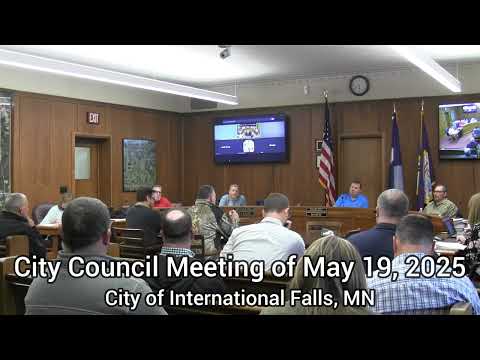
The International Falls City Council on May 19 postponed consideration of a guaranteed maximum price (GMP) for the city's water‑treatment plant renovation, directing staff to bring the item back at the June 2 regular meeting.
The council's action followed a presentation of the project's scope and costs and a discussion about potential state funding and borrowing. The construction manager at risk, Rice Lake Construction, submitted a GMP of $11,844,680; the total construction estimate, including contingency and related items, was listed in the project memo as $12,575,087. City staff said the project would include filter rehabilitation or replacement, chemical feed system replacement, numerous pump and mechanical replacements, electrical and controls upgrades, and general building rehabilitation.
Why it matters: the renovation is intended to bring the aging surface‑water treatment facility into compliance with current public‑health requirements and to replace major equipment that city staff described as beyond expected useful life. The total construction costs are material to the city's capital plan and could require borrowing if state assistance does not materialize.
Project background and funding: project history presented at the May 19 meeting traces the needs assessment to 2021 and design work to 2023. The city noted a USDA grant awarded for backup power and flood‑resilience valves tied to a prior flood event; that grant reduces the local share for those specific elements. City consultants said bidding of trade packages would follow GMP approval. Presenters estimated a roughly two‑year construction timeline because of equipment lead times.
Funding options and affordability: councilors discussed the possibility of receiving state bonding or other legislative assistance. City staff and the project consultant explained the alternative is to close a low‑interest loan from the Minnesota Public Facilities Authority (PFA) to finance the project if state assistance is unavailable; the exact loan rate had not been set at the meeting and will be known when the loan closes. Staff also summarized PFA's affordability rule: certain grants become available only when water system costs exceed approximately 1.2% of median household income for a community. Presenters estimated the city would likely need substantially more water debt (tens of millions of dollars) to cross that threshold and become eligible for affordability grants.
Council discussion and next steps: some council members said waiting briefly would allow time to learn whether the Legislature's bonding package will include support for the project. Others urged the council to proceed regardless of potential state aid to avoid delaying construction. Councilor Holden moved to postpone the vote on approving the GMP to the June 2 meeting; Councilor Wagner seconded. The motion to postpone passed unanimously (5‑0).
The council asked staff to return on June 2 with further detail, including clearer estimates of the likely debt service and the projected effect on residential water bills if borrowing is required.