Get Full Government Meeting Transcripts, Videos, & Alerts Forever!
Get email alerts on the Shelter And Resilience Sb180 topic
No spam. Unsubscribe anytime.
Senate Bill 180 would curb St. Pete Beach planning powers after named hurricanes
Summary
Planning staff told the St. Pete Beach Planning Board that Senate Bill 180, if signed, would broadly limit local land-use restrictions after recent named storms and create a rolling one-year restriction tied to future hurricanes, affecting impact fees, moratoria and permitting procedures.
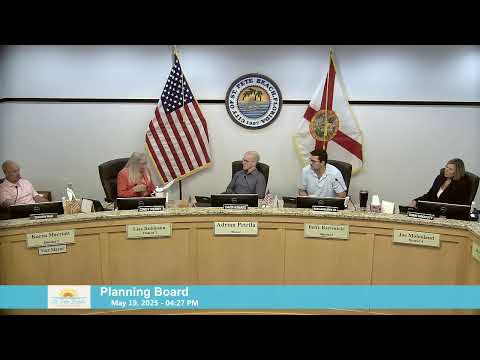
The St. Pete Beach Planning Board discussed Senate Bill 180 at its May 19, 2025 meeting, and planning staff warned the measure would preempt many local planning rules after named hurricanes and for future storms.
"It is a significant preemption on local planning," Brandon (planning staff) told the board as he summarized the bill and its likely effects.
Board members were told the bill, as presented to the legislature and now enrolled, would be retroactive to August 2024, remain in effect through October 2027 for this package of named storms, and create a separate one-year limit on new local restrictions after any future hurricane declaration within 100 miles of a storm track.
Brandon outlined specific provisions he said would affect the city: a prohibition on municipal increases to building fees for 180 days after a state-of-emergency declaration tied to a hurricane; a ban on assessing impact fees for replacement structures that do not change in use or intensity regardless of building age; a requirement that permitting offices reopen at 40 hours per week "as soon as is practicable" after a hurricane; and a prohibition on adopting multi-year cumulative substantial-improvement rules. He said some requirements would be retroactive to August 2024.
The staff summary also said the bill would bar cities from enacting more restrictive amendments to comprehensive plans or land-development regulations that would make review, approval or issuance of development permits more burdensome for properties impacted by the storms. Brandon warned that the bill’s definition of "development permit" is broad and could include building permits, fence locations, sign setbacks, site plans, conditional-use permits and other routine zoning approvals.
When asked what would happen if FEMA required a higher standard, Brandon replied that there would "probably be some kind of state application for exemption" if it were a minimum NFIP requirement. City Attorney (unnamed) added, "But we anticipate he's probably gonna sign it," referring to the governor's likely action on enrolled bills.
The bill also would give challengers a 14-day opportunity to request that a municipality revoke or void a more burdensome amendment before filing suit, and — if plaintiffs prevail — provide for attorney's fees and for the courts to void an amendment back to the date of adoption, Brandon said.
Staff identified near-term local implications: changing one design-review requirement in the Eighth Avenue District from mandatory to "strongly recommended," and no immediate changes to the pending sign ordinance amendments. Brandon said staff is exploring a code procedure to evaluate and document claims that an ordinance imposes a burden, and that staff would bring proposed procedures to the Planning Board if the bill is signed.
Board members and staff discussed the bill’s statewide reach: Brandon noted it affects every county that fell within the storm declaration area for the recent named storms and that the 100-mile rolling rule could expand the number of municipalities covered after future storms.
The board did not take formal action at the meeting. Brandon asked members to keep the legislation in mind while developing strategic priorities this year; he said the City Commission will address related strategy in an upcoming planning session.
Background: the board compared SB 180 to Senate Bill 250, enacted after Hurricane Ian, and members cited statewide planning organizations that have raised concerns about the bill’s breadth. Staff recommended continued monitoring and possible code-level procedures to document burdens and challenges should the bill become law.