Get Full Government Meeting Transcripts, Videos, & Alerts Forever!
Get email alerts on the Metroparks Trails Project Development topic
No spam. Unsubscribe anytime.
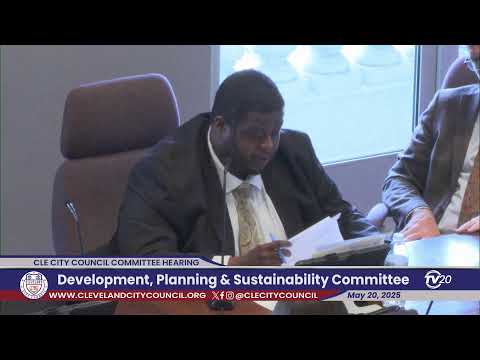
Committee approves project-development agreement enabling four Cleveland trail projects, accepts federal grant funding
Summary
A City Council committee approved Ordinance 496-2025 authorizing a project-development agreement with Cleveland Metroparks to design and build four trail segments, using federal RAISE funding and city bond proceeds.
A City Council committee approved Ordinance 496-2025, authorizing the director of capital projects to enter a project-development agreement with the Board of Park Commissioners of the Cleveland Metroparks to design, build and manage four trail projects within Cleveland.
The agreement covers four corridors: the Slavic Village Downtown Connector North, the Morgana Run/Booth Avenue extension, the Euclid Creek Greenway extension and the Opportunity Corridor Connector. City staff and Cleveland Metroparks planners told the committee the projects were developed from the countywide Cuyahoga Greenways plan and advanced through a federal RAISE planning grant. The committee was told a later RAISE construction award—around $19,500,000—targets the Slavic Village Downtown Connector North and the Morgana Run extension.
Why it matters: staff said the trail projects fill critical network gaps on the east side of the Cuyahoga River and will improve multimodal access, street tree canopy and neighborhood connectivity. Council members and staff stressed public-safety design elements such as lighting and “eyes on the trail,” and noted utility relocation and right‑of‑way coordination will lengthen construction schedules in places.
Scope and schedule: planners said the construction grant covers the Slavic Village Downtown Connector North and Morgana Run extension and that detailed design for those segments is nearly complete. The team told the committee they expect to bid the construction packages in the fall and begin construction in spring 2026, with substantial completion targeted around the end of 2027 and minor landscaping into early 2028. Work on the Euclid Creek Greenway extension is in design and feasibility phases; the Opportunity Corridor Connector requires coordination with Norfolk Southern and has no construction funding yet.
Ownership and maintenance: Cleveland Metroparks staff said the trails will primarily use public rights‑of‑way on city streets; the city will remain owner of underlying rights-of-way, while Cleveland Metroparks will maintain and police the new trail segments under the proposed partnership. Committee members discussed prior examples—such as a permanent public easement in Ohio City—when considering whether privately built segments should be dedicated to the city or built with a public easement and a maintenance agreement.
Funding and amendments: the committee considered two technical amendments supplied by the law department and special counsel clarifying bond language and the use of 2025 bond proceeds for the projects. Committee members noted some prior bond proceeds are already allocated to subfunds for these trail efforts. The committee approved the amendments and then voted to pass Ordinance 496-2025 as amended.
Next steps and constraints: staff cautioned that some segments require utility relocations and right‑of‑way work that will extend timelines, and that portions involving Norfolk Southern will need additional real-estate coordination. The committee was told construction of the grant‑funded sections depends on final federal grant agreement execution; as of the committee meeting the city had not yet received the final federal grant contract but was proceeding with design in anticipation of the award.
Public engagement and design priorities: planners described extensive public engagement that shaped project criteria—10‑foot shared-use paths with two‑foot shoulders where feasible, new street trees, lighting and safety measures, and selective conversion of some one‑way streets to create greenway character where the right‑of‑way allows. The projects were presented as part of a larger county greenways vision and as connecting links to other city and regional investments.