Get Full Government Meeting Transcripts, Videos, & Alerts Forever!
Get email alerts on the Thrive Program topic
No spam. Unsubscribe anytime.
Metro Arts staff recommends $15,000 Thrive cap; public art projects' status debated and fiscal-sponsor fee changes explored
Summary
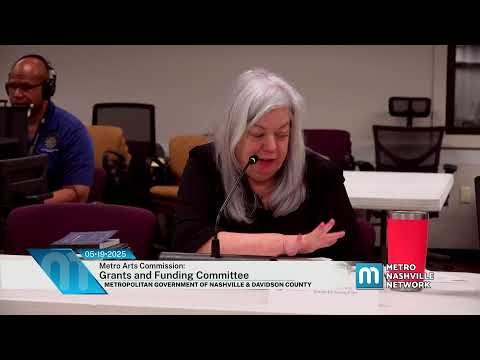
At the May 19 meeting staff proposed setting the Thrive maximum request at $15,000 for FY26, asked whether public art projects (murals and large-scale public works) should remain in Thrive, and said the office is exploring a standard flat fiscal-sponsor administrative fee to remove uneven negotiation between artists and hosts.
Staff told the Grants & Funding Committee that one option for the FY26 Thrive program is to set the maximum request at $15,000. Batchelder said that the committee's January policy to fund awards at 75% of the maximum request effectively created a $15,000 award when the previous maximum request had been $20,000, and staff recommended $15,000 as the maximum request for the coming cycle to reduce confusion.
"We are bringing for discussion the recommendation for, yeah, dollars 15,000 maximum request," Batchelder said.
The committee spent substantial time discussing whether public art projects — murals, sculptures and architectural landscape work — should remain eligible within the Thrive category. Staff said the Thrive application and review process in the last two cycles has not included the detailed requirements public-art projects typically need, such as maintenance plans and property agreements, and that lack of process support led to complications and delayed projects this year. Batchelder said the office hopes to hire a public-art manager by early fall to provide the leadership needed to develop a dedicated public-art program.
Legal counsel Tessa reminded the committee that Metro code includes a definition of public art and that some public-art funding and processes (including the percent-for-art fund and Park Advisory Committee review) may operate under different rules. "Per the Metro code public art is very clearly defined, and the public art guidelines are followed for all public art projects," Tessa said, noting that two mural projects approved this year remain delayed because public-art maintenance and property agreements were not finalized.
Staff also raised the fiscal-sponsor question. Current guidelines allowed a fiscal sponsor to charge up to 10% by negotiation; staff heard that negotiations were sometimes inequitable and proposed exploring a standard flat administrative fee added on top of the award (not taken from the artist's requested amount). Batchelder offered a hypothetical example: a flat sponsor fee added to a $15,000 award could be $607.50, but staff stressed they were still "exploring this" and had not proposed a specific final number. Staff said a sponsor could decline to accept the fee if it preferred.
Committee members asked staff to return with more concrete options and to include public-art stakeholders in planning. No vote was taken on Thrive maximums, public-art inclusion or a specific sponsor-fee schedule; staff will return with options in June.