Get Full Government Meeting Transcripts, Videos, & Alerts Forever!
Get email alerts on the Grant Guidelines topic
No spam. Unsubscribe anytime.
Metro Arts committee delays FY26 guideline votes; proposes 5-year background checks, 3-day "curing" window and end to internal appeals
Summary
Staff presented preliminary FY26 application and process proposals — including a proposed change to background-check currency, a three-day curing period after technical review, expanded first-time applicant support, and replacing the internal appeals procedure with staff meetings — and asked the committee to defer voting until legal review is complete.
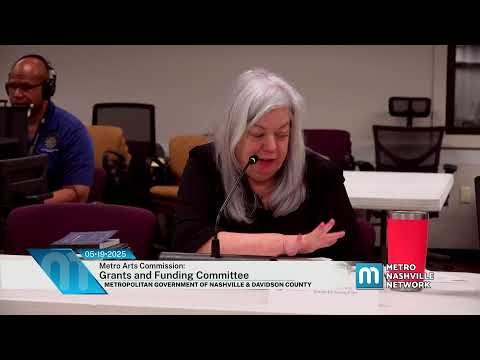
Interim Director Batchelder presented a set of preliminary FY26 criteria and process proposals to the Metro Arts Commission Grants & Funding Committee and recommended delaying any votes until the committee's next meeting to allow staff time for legal review and final drafting.
Batchelder said the office plans to formalize background-check requirements for grantees that work with youth and recommended changing the currency period for required background checks from two years to five years, reflecting what staff described as "industry best practice." Batchelder said the change would be reflected in the attestation form and that background checks would be required "if awarded" so applicants are not required to incur the cost before grant decisions are final.
Staff also proposed a short post-technical-review "curing" period to reduce preventable, technical denials. Under the proposal, staff would spend roughly one week on technical reviews as part of a two-week technical-review window. Applicants flagged for technical denial would then have a three-day curing window (staff indicated the window would be clarified as business days in the final language) to correct issues such as dead links, inaccessible video uploads or other non-scoring accessibility problems. Batchelder estimated that roughly 20% of technical denials in the last cycle might have been curable under such a policy.
The committee also discussed additional support for first-time applicants, including adding questions on the application to identify first-time applicants, offering priority office hours or after-hours clinics for new applicants, and allowing first-time applicants or first-time awardees to make a short two-minute statement to the review panel (not a Q&A) or to submit a short introductory video if they cannot attend in person.
On the appeals process, Batchelder proposed removing the internal appeals process that Metro Arts used recently and instead offering denied applicants an opportunity to meet with Metro Arts staff to review panel feedback and discuss improvements. Batchelder framed the change as aligning the commission practice with the standard legal appeal process for boards and commissions and as reducing budgetary uncertainty related to reversals of funding decisions.
Commissioners asked for additional detail. Commissioner Lefkowitz asked whether staff could return with a timeline and named partners to help define an underrepresented-council-districts policy the committee had considered previously; Batchelder agreed to present a tentative timeline and data points at a future meeting. Commissioner Jester asked staff to clarify the curing-window language and to define business days and the stage at which the curing window would begin; staff said they will make those start and end dates explicit in the draft guidelines and legal review.
No formal votes were taken; Batchelder asked staff to prepare legal review and final guideline language for the committee to consider in June.
Why it matters: These changes would alter application administration — who must submit background checks, what counts as a technical denial, and whether denied applicants have a formal appeals process. Staff framed the proposals as ways to increase equitable access and reduce avoidable technical disqualifications.