Get Full Government Meeting Transcripts, Videos, & Alerts Forever!
Get email alerts on the Tobacco Taxes topic
No spam. Unsubscribe anytime.
Legislative analysts brief senators on Oregon tobacco taxes as flavored bans and cross-border sales complicate revenue
Summary
The Legislative Revenue Office updated the Senate Committee on Finance and Revenue on state tobacco taxes, forecast declines in most product categories and noted new products and local flavor bans complicate revenue tracking and enforcement.
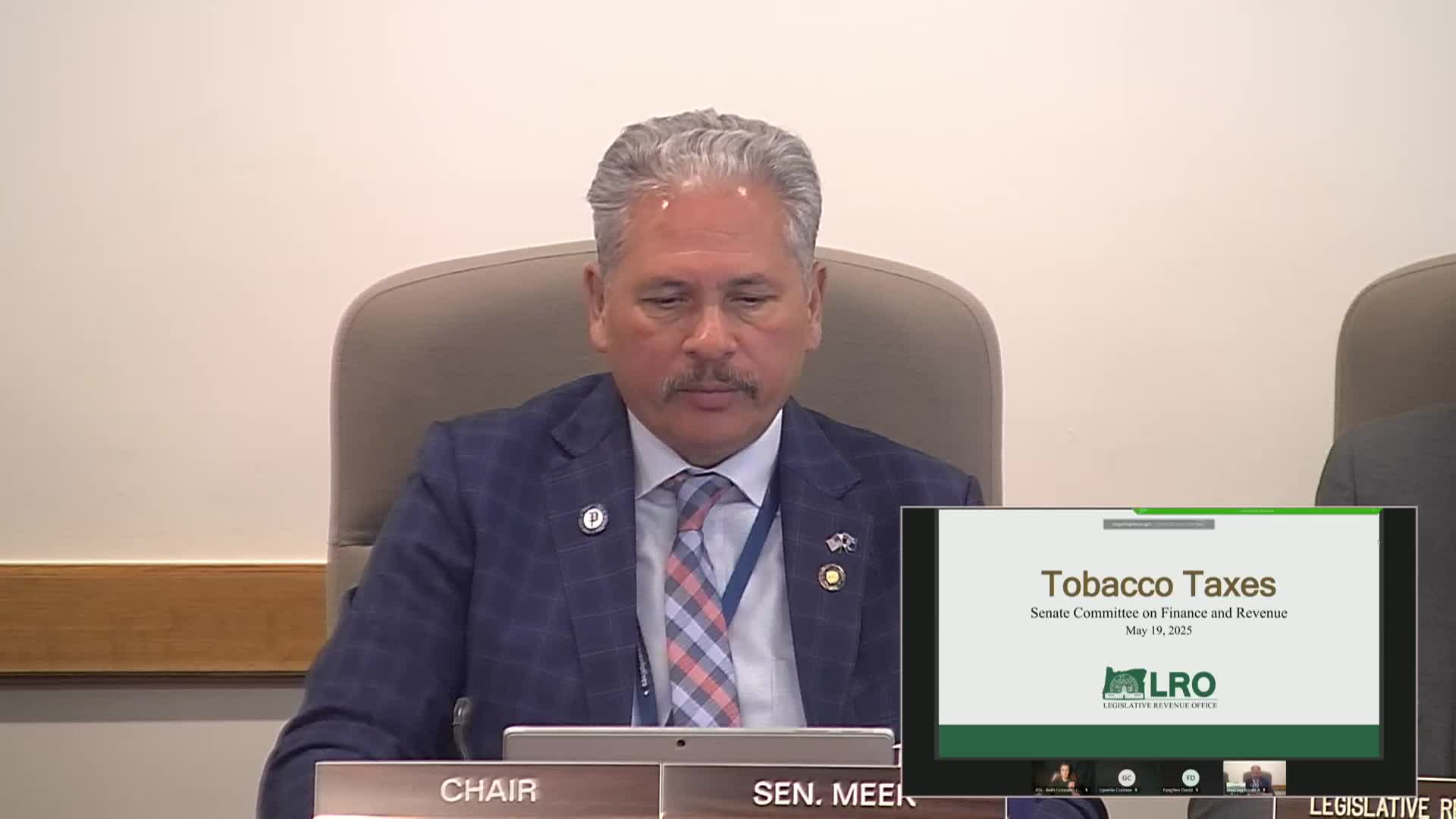
The Senate Committee on Finance and Revenue received an informational briefing May 19 from the Legislative Revenue Office on Oregon’s tobacco-tax structure, recent trends and forecasting challenges.
John Hart, an economist with the Legislative Revenue Office, summarized current law and recent revenue expectations. He said Oregon’s cigarette tax is $3.33 per pack of 20, moist snuff (a subset of other tobacco products) is taxed at $1.86 per ounce with a minimum container amount (the 2024 rate referenced in testimony was $2.24 per container), and other tobacco products—including vaping devices and associated cartridges and liquids—are taxed at 65% of wholesale price (with some caps for products such as cigars). Hart explained the cigarette tax is indexed to inflation by a fraction of the Consumer Price Index.
Hart gave revenue forecasts presented by the Office of Economic Analysis: cigarette tax receipts were expected to be roughly $242 million in fiscal 2027 with the next biennium’s total around $500 million. He said taxes on other tobacco products and vaping were smaller revenue sources—on the order of tens of millions per year (testimony noted about $45 million for other tobacco in FY26 and about $43 million in FY27, and vaping roughly $30 million in FY26 and $29 million in FY27).
Hart said taxable sales and consumption diverge when cross‑border purchases occur. He explained that when Washington raised its cigarette tax in prior years, taxed cigarette sales per capita in Oregon rose because Washington residents purchased cheaper taxed cigarettes in Oregon; when Oregon raised taxes in 2021, Oregon taxed sales fell and some purchases shifted across the border.
New products such as nicotine pouches (for example, Zyn) complicate revenue tracking. Hart said industry reporting suggests nicotine pouches are a rapidly growing market—Philip Morris reported large volumes nationally—and local flavor bans (for example in Multnomah and Washington counties) add further uncertainty to sales patterns. Hart estimated a substantial share of moist snuff and vaping products are flavored (testimony gave ranges: moist snuff perhaps 60–65% flavored; vaping frequently reported as 80–95% flavored by some vendors and stakeholders), which is relevant where jurisdictions consider flavor restrictions.
The committee was told that the LRO and Office of Economic Analysis expect declines across product tax categories over time as consumption trends change and border effects shift taxed sales. Senators noted the upcoming committee hearing on Senate Bill 702 and requested the revenue office and staff provide numbers breaking out flavored-product shares and more granular fiscal options if the committee schedules policy work sessions.
The informational session closed with the committee scheduling follow-up and a reminder that the committee will meet again for formal hearings on related bills.