Get Full Government Meeting Transcripts, Videos, & Alerts Forever!
Get email alerts on the Currency And Tax Policy topic
No spam. Unsubscribe anytime.
Senator seeks to make gold and silver legal tender in Oregon; opponents call tax exemption unfair
Summary
Senate Bill 1158 would declare gold and silver legal tender in Oregon and exempt proceeds from their exchange from state income, corporate and corporate activity taxes. Supporters framed the bill as a response to inflation and a way to give Oregonians an alternative store of value; opponents said the measure improperly exempts investment income.
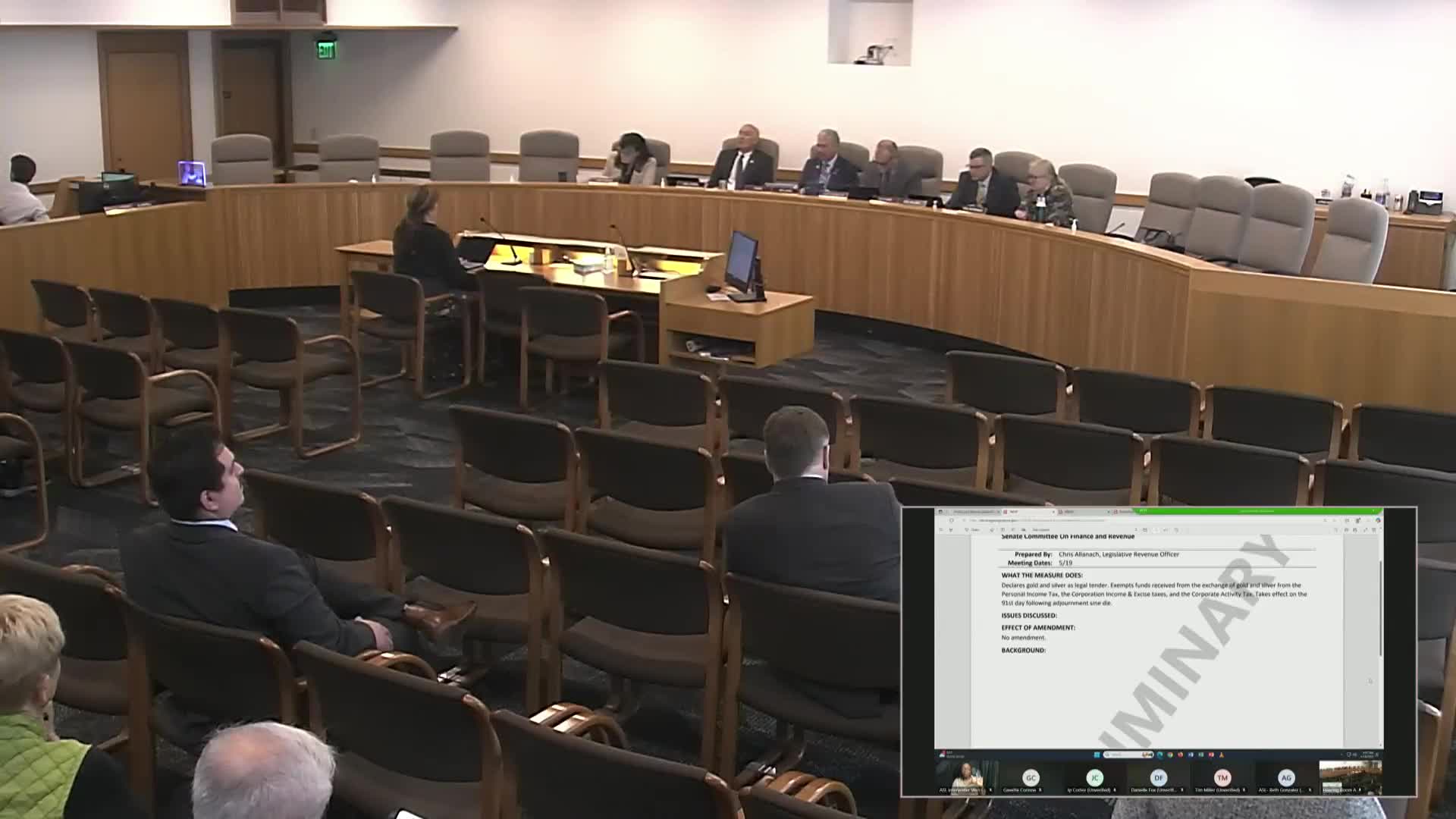
Senate Committee on Finance and Revenue members heard testimony May 19 on Senate Bill 1158, which would declare gold and silver legal tender in Oregon and exempt the proceeds from the exchange of gold and silver from personal income tax, corporate income and excise taxes, and the corporate activity tax.
Senator Kim Thatcher (R‑SD 11) introduced the bill and argued it would provide Oregonians with an option to preserve value amid inflation and federal monetary policy shifts. Thatcher said the change would "eliminate income tax on gold and silver transactions and ending the unfair taxation of inflation driven gains." She framed gold and silver as historical stores of value and said several other states have taken steps to reduce taxation barriers on precious metals.
JP Cortez of the Sound Money Defense League testified in support, saying removing tax friction on precious metals lets people adopt alternatives to fiat currency and pointing to a multi‑state trend of removing taxes on precious metals.
Opposition testimony came from Jody Weiser of Tax Fairness Oregon, who said gold is an investment and argued Oregon should not grant a tax exemption for one class of investment. "This is the biggest source of friction that's keeping people from being able to actually use the only form of money mentioned in The U.S. Constitution," Cortez said in support; Weiser countered that investment returns are already taxed and that exempting precious metals would be unfair.
No committee vote was taken during the May 19 hearing; the public hearing concluded and the committee moved on to other business.