Get Full Government Meeting Transcripts, Videos, & Alerts Forever!
Get email alerts on the Energy Wind Decommissioning topic
No spam. Unsubscribe anytime.
House adds decommissioning requirement as wind project siting cap rises to 100 MW
Summary
The Oregon House concurred in Senate amendments to House Bill 38 74, raising the county siting threshold for small-scale wind projects from 50 megawatts to 100 megawatts and requiring developers to submit end-of-life decommissioning plans and bonding before approval.
The Oregon House on the floor voted to concur with Senate amendments to House Bill 38 74, a measure that raises the county siting threshold for certain wind energy projects from 50 megawatts to 100 megawatts and requires developers to provide decommissioning plans and bonding before a county approves a project.
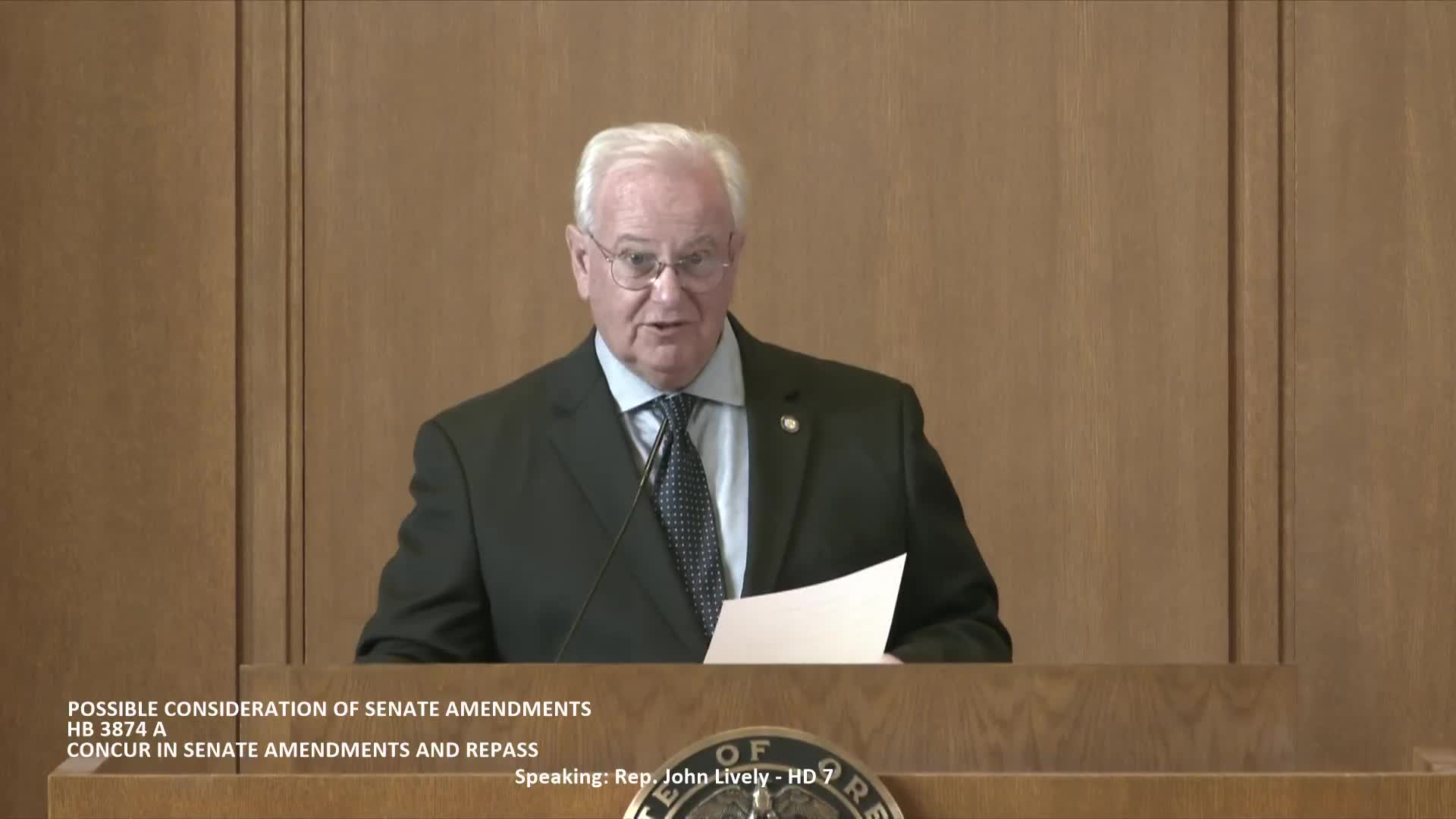
Supporters said the change reflects technological advances that have increased turbine output while the added decommissioning requirement aims to protect counties and landowners from future cleanup costs. Representative Lively, who presented the amendment, said it mandates an “end of a life decommissioning plan” be submitted before project siting approval.
The bill’s supporters told colleagues the amendment preserves local options — developers may still use state siting (FSIC) processes — while adding a required plan and financial assurance to cover removal and site restoration when turbines reach the end of their useful life. Representative Sharf thanked the sponsor and urged the Legislature to revisit bonding and cost assumptions in a future session, citing the PGE Bigelow Canyon wind farm as an example of rising future costs. Sharf noted the Bigelow Canyon facility is a 450-megawatt project with 217 towers and said current escrow figures — $18.7 million, about $86,000 per tower — may not cover full decommissioning costs.
Lawmakers debated the amendment briefly on the floor but did not propose changes to the decommissioning language. The House ultimately declared House Bill 38 74 repassed after the concurrence vote.
The bill moves the threshold for county siting authority to 100 megawatts while adding an affirmative requirement for developers to demonstrate how towers and foundations will be removed and how the site will be restored. The House’s action returns the measure to the enrolled bill process for final steps.
Lawmakers said future work could include consideration of bonding levels and mechanisms to ensure funds keep pace with decommissioning costs; no specific bonding formula or updated escrow amounts were set by the House in this action.