Get Full Government Meeting Transcripts, Videos, & Alerts Forever!
Get email alerts on the Workplace Standards topic
No spam. Unsubscribe anytime.
House committee advances amended bill making owners, contractors jointly liable for some unpaid construction wages
Summary
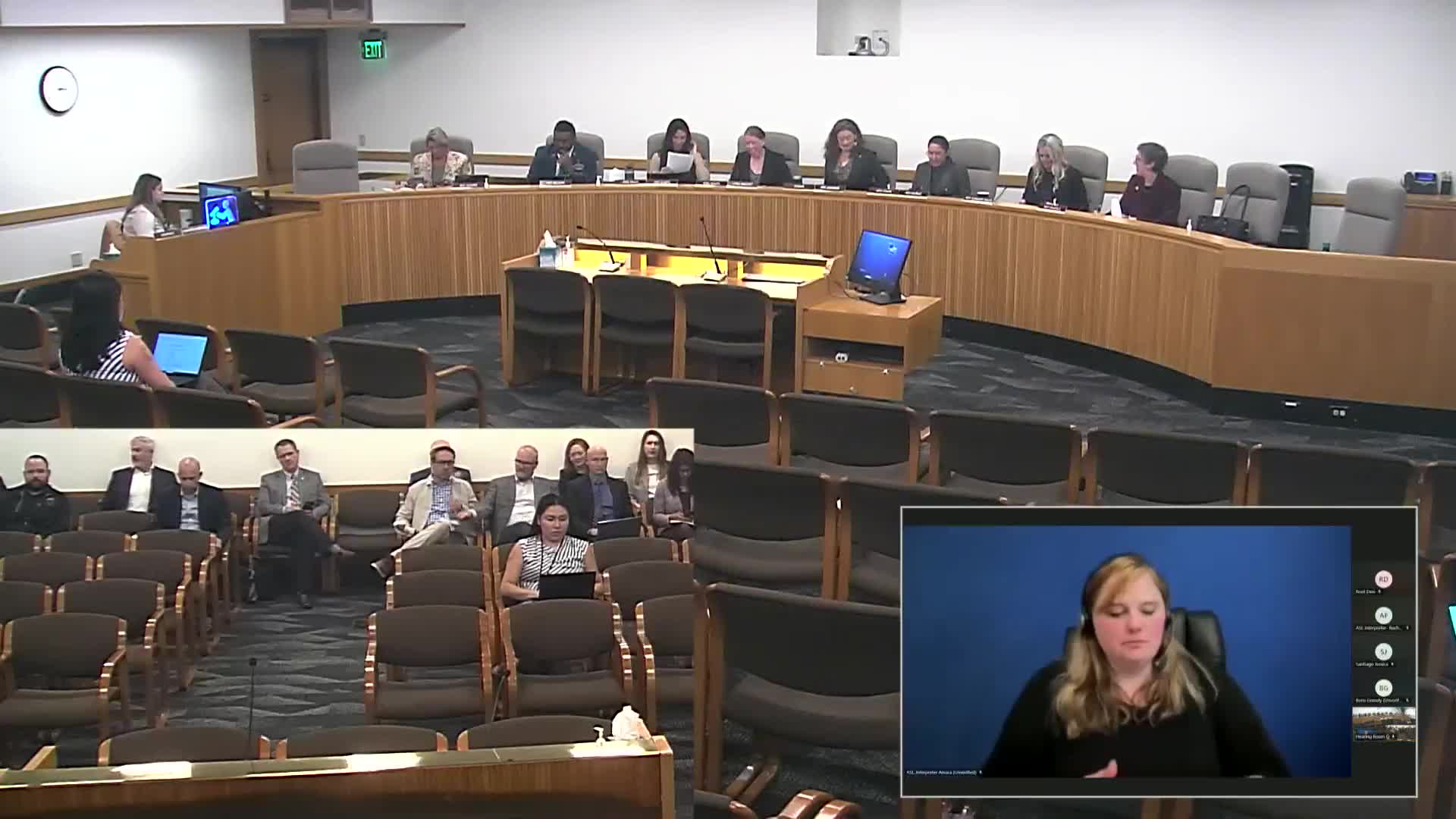
The House Committee on Labor and Workplace Standards voted to send Senate Bill 426 A, as amended, to the floor with a do-pass recommendation after adopting an amendment that narrows owner liability for certain small residential and principal-residence projects and preserves several procedural protections discussed during the work session.
The House Committee on Labor and Workplace Standards voted Monday to advance Senate Bill 426 A as amended, a measure that would allow civil actions for unpaid wages to name owners and direct contractors as jointly and severally liable for unpaid wages and fringe benefit contributions for certain construction work performed on or after Jan. 1, 2026.
The measure establishes a 21-calendar-day cure period after a written notice of alleged violation is delivered by first-class certified mail, creates a two-year statute of limitations for unpaid wage or fringe-benefit claims, and allows an employee, an authorized third-party representative, or the Oregon Department of Justice to bring a civil action seeking wages, benefits, interest, penalties, attorney fees and costs. Committee staff Erin summarized the bill and amendments for the record.
The committee adopted the A22 amendment, which clarified and narrowed the definition of "direct contractor" and created exemptions for construction, reconstruction, alteration, maintenance, moving or demolition of buildings or improvements on real property used as the owner's principal residence or real property consisting of five or fewer residential or commercial units on a single tract. Erin, committee staff, told members the A22 amendment also adjusted the definition of "unrepresented employee."
Vice Chair Elmer argued the bill must do more to target so-called labor brokers and said the change in A22 responded to feedback about clarity in the definition of direct contractor. "This would change the focus of the bill. It would go after the labor brokers who we have heard repeatedly are the bad actors," Vice Chair Elmer said, urging tools to hold labor brokers accountable.
Jessica Santiago, senior deputy legislative counsel, explained the bill’s technical edits and why one language change was made from "and" to "or" in the definition of an "unrepresented employee," saying the conjunctive wording had produced confusion in public testimony. "The 'and' meant that both conditions must occur. It should have been an 'or' to say an unrepresented employee was either someone who was not represented or someone who was represented but subject to a collective bargaining agreement that did not provide these types of grievance procedures," Santiago said.
Committee members debated several proposed substitute amendments. An A18 amendment would have required an interagency agreement between the Construction Contractors Board and the Bureau of Labor and Industries to enforce licensed construction labor contractors; it failed on a roll call. An A19 amendment would have required the Oregon Department of Justice, in consultation with its advisory committee, to study links between unpaid wages and human trafficking and report back by Sept. 15, 2026; that amendment also failed. The committee rejected an A20 amendment that would have required arbitration procedures in certain written employer–employee agreements; members who opposed the amendment said arbitration could disempower workers and limit transparency. Members discussed, but did not adopt, amendments that would narrow standing for third‑party representatives and that would affect indemnity language in commercial contracts.
Labor and construction stakeholders, agency staff and the bill’s drafter participated in the session. Boris Grusley, legal counsel for the Western States Regional Council of Carpenters, urged preserving grievance and arbitration mechanisms that unions use, saying, "The union provides that level playing field." Representative Sharp said she was concerned the base bill would not address human trafficking and urged additional enforcement resources. Representative Fragula and others said the amended bill represents work they can continue to improve.
On final action the committee approved Senate Bill 426 A as amended and moved it to the House floor with a do-pass recommendation. The vote as recorded in the transcript showed support from Representatives Fragula and Nelson, Vice Chair Munoz and Chair Graber and opposition from Representatives Bossard Davis, Sharp and Vice Chair Elmer. A motion to send the bill to the House Committee on Rules without recommendation failed earlier in the session.
The measure, as discussed in committee, would take effect for labor performed on or after Jan. 1, 2026, and contains provisions that allow owners or direct contractors to withhold payment to a subcontractor in limited circumstances (for failure to provide requested records or after the contractor paid wages on the subcontractor’s behalf). The bill requires subcontractors to provide specific records upon request and allows owners or direct contractors to pursue recovery from subcontractors for amounts paid on the subcontractor’s behalf.
Committee members and staff noted the bill’s fiscal note showed minimal fiscal impact and no revenue impact. Several sponsors and members said more work remains on issues including labor-broker enforcement, the intersection with human trafficking, arbitration and how broadly owner liability should reach.
Committee action does not finalize the policy: because the House adopted amendments the bill will go back to the Senate for concurrence, and members said further work is expected in the interim and on the floor.