Get Full Government Meeting Transcripts, Videos, & Alerts Forever!
Get email alerts on the State Budget topic
No spam. Unsubscribe anytime.
Senators Praise Ways and Means FY26 Budget, Highlight Health care, Housing, Education and Pappas Funding
Summary
Senators on the Massachusetts Senate floor delivered a series of speeches endorsing the Senate Ways and Means fiscal year 2026 budget proposal and previewing amendment debates, highlighting investments in health care, higher education, housing and services for vulnerable residents.
Senators on the Massachusetts Senate floor delivered a series of speeches endorsing the Senate Ways and Means fiscal year 2026 budget proposal and previewing amendment debates, highlighting investments in health care, higher education, housing and services for vulnerable residents.
The senators’ remarks focused on protecting MassHealth and other human services, expanding tuition-free community college and workforce-targeted tuition pilots, increasing housing and homelessness supports including funding for Home and Healthy for Good, and maintaining services at Pappas Rehabilitation Center for medically complex children. Lawmakers also noted increased state aid to libraries, regional transit authorities and local governments.
Why it matters: senators said the budget frames the chamber’s priorities amid federal funding uncertainty and rising costs—particularly for health care—and will shape local services and municipal budgets if enacted. The Senate adopted an order to adjourn and reconvene tomorrow at 10 a.m. with the general appropriation bill as the only item on the calendar; no final vote on the general appropriations bill occurred in this session.
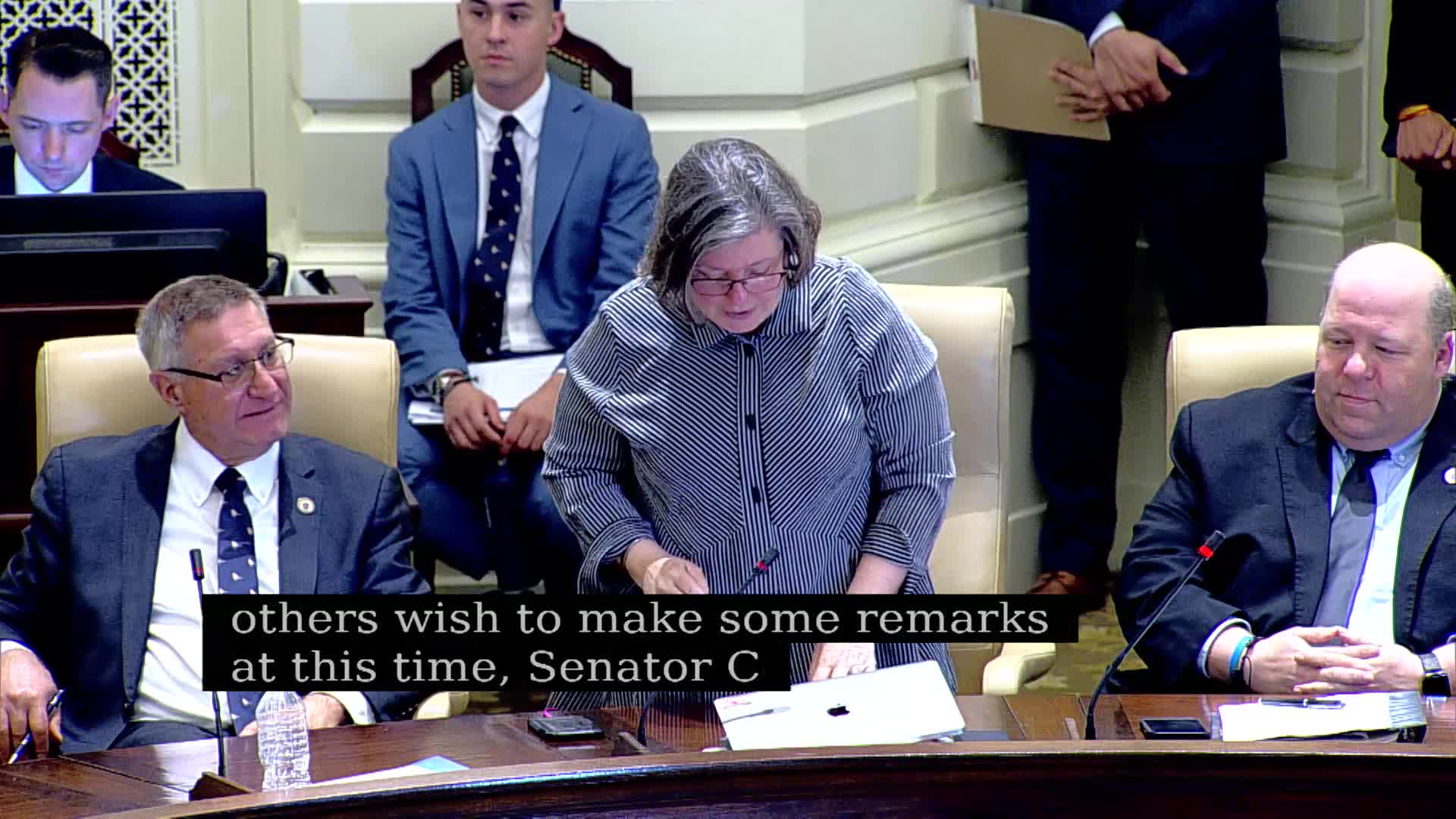
On the Senate floor, Senator Comerford said she “rises in strong support of this budget proposal,” calling budgets “moral documents” and praised the Ways and Means leadership for producing a “steadfast” plan that she said leans into health care security as the federal government debates Medicaid. Comerford noted program-level investments that the Senate budget would make, including a proposal of “more than $275,000,000 proposed for financial aid” for state colleges and the University of Massachusetts and continued funding for the SUCCESS program to help community-college and state-university students complete degrees.
Senator Comerford highlighted nutrition and anti-poverty programs in the proposal, saying the budget restores the Healthy Incentives Program and cited allocations for women, infants and children (WIC) and universal breakfast and lunch in schools. She also noted a record $214,000,000 proposed for regional transit authorities while preserving fare-free access and increased unrestricted local aid, and described a dashboard tracker for housing funding and production to support regional equity in the wake of the Affordable Homes Act.
A senator identified as the ranking minority member raised concerns about federal policy uncertainty and its fiscal impact on the Commonwealth, saying federal inaction on immigration and other issues already costs the state “about a billion dollars” and that health-insurance cost growth is consuming municipal levy capacity. That speaker stressed the role of health-care cost drivers—higher acuity and utilization—on MassHealth growth and urged the Senate to pursue policy to reduce long-term health-care costs.
Senator Feeney described the budget as “a balanced spend within our means budget” that makes no new taxes and directs resources toward health care, education, housing and child care. Feeney said MassHealth cost increases are the largest single driver of the budget, and he cited a MassHealth increase of $2,300,000,000 over FY25 as presented in hearings.
Senator Domenico underscored early‑childhood and education investments, citing $1,710,000,000 in total investments for early intervention services and a $475,000,000 line for C3 grants that support providers. Domenico listed a set of figures and line items in the proposal, including $7,300,000,000 for “chapter 78” (as described on the floor) and an increase of $150 per pupil in minimum aid for qualifying districts; he also named HIP funding and other food-security investments.
Several senators praised specific homelessness and housing investments. Senator Feeney described funding for Home and Healthy for Good (HHG) and sponsor‑based supportive permanent housing, citing $8,900,000 for HHG and $10,000,000 for sponsor‑based supportive housing to support new units and wraparound services.
Funding for Pappas Rehabilitation Center drew sustained praise. Senator Feeney said the budget “fully funds Pappas Rehabilitation Center for children, ensuring its continued operation through fiscal year 2026” after stakeholders and the delegation secured a pause on an earlier proposed closure; he called the facility uniquely suited to serve medically complex children and credited Ways and Means and the Senate leadership for preserving services.
On process and timing, the clerk read an order under Senate Rule 38(b) to adjourn today and reconvene tomorrow at 10 a.m. with the general appropriation bill as the only matter on the calendar; the chamber adopted the order by voice vote (“the ayes have it”). Senator Tarr moved to adjourn and the motion passed by voice vote. Senators said they expect an extended amendment period and further debate in the coming days.
Discussion versus formal action: the remarks reported here were floor statements in support of or offering context for the Ways and Means proposal; no final vote on the FY26 general appropriations bill occurred during this session. The only formal actions recorded in this session were procedural votes to adopt the adjourn/reconvene order and to adjourn for the day.
What’s next: senators signaled a multi‑day amendment process and a planned final vote after forthcoming debates; the Senate reconvenes tomorrow at 10 a.m. with the general appropriations bill as the sole item on the calendar.