Get Full Government Meeting Transcripts, Videos, & Alerts Forever!
Get email alerts on the State Budget topic
No spam. Unsubscribe anytime.
Senate Ways and Means unveils $61.3 billion FY26 proposal, shields MassHealth and schools
Summary
The Massachusetts Senate Committee on Ways and Means presented its FY26 budget recommendations, a $61.3 billion proposal that prioritizes K–12 funding, MassHealth, early education and free community college while relying on a mix of regular revenue, a fair-share surtax and federal funds.
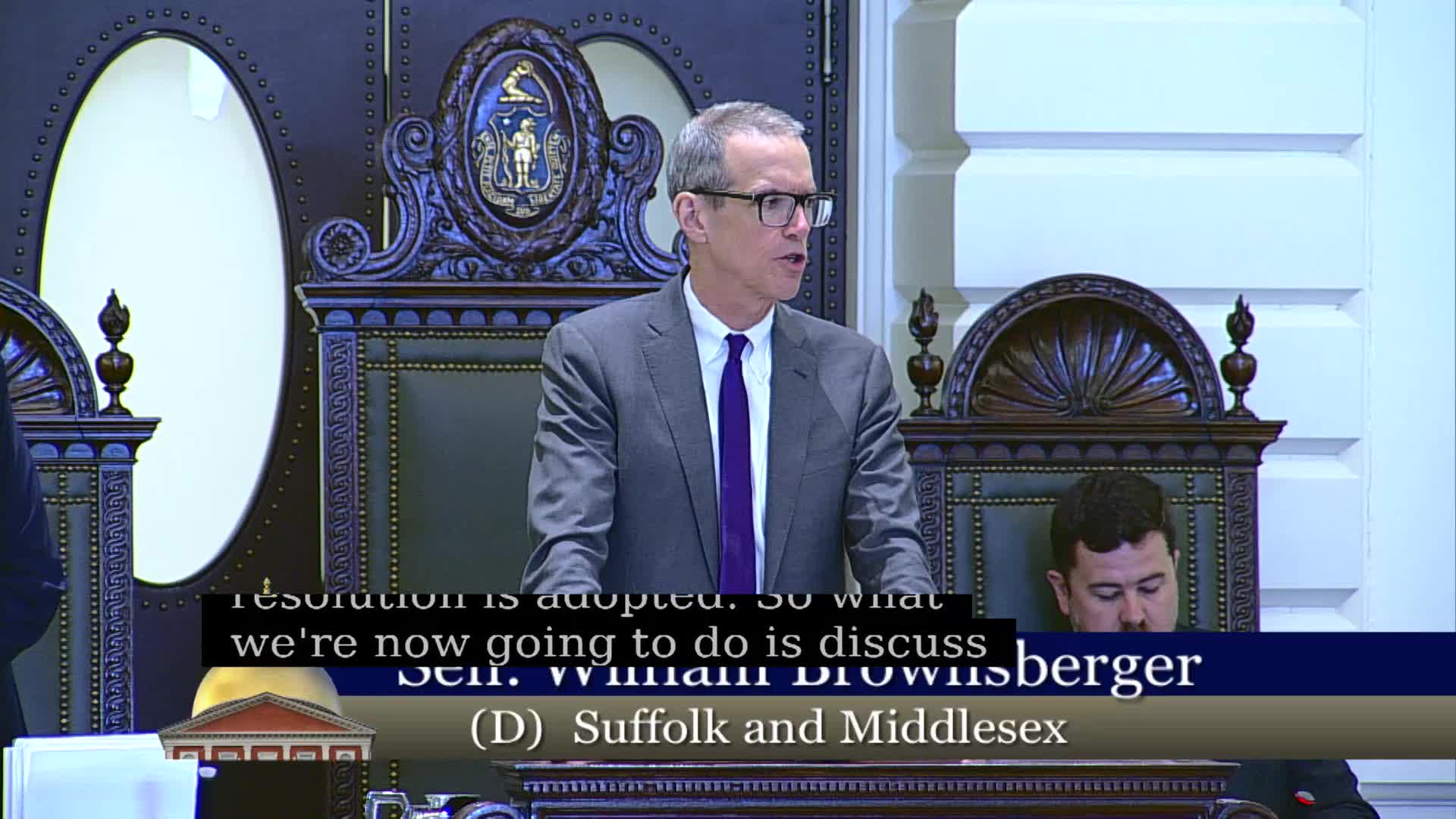
The Massachusetts Senate Committee on Ways and Means presented its FY26 budget recommendations to the full Senate, outlining a $61.3 billion proposal that protects MassHealth and increases K–12 and early-education funding while using a mix of recurring and one‑time resources.
Senator Rodericks, chair of the Senate Committee on Ways and Means, told colleagues the plan "places heavy emphasis on not only keeping our residents safe, secure, and supported, but also stays true to our responsibility to embolden, uplift, and empower our residents." He added, quoting a maxim he said guided the committee, "Don't tell me what you value. Show me your budget, and I'll tell you what you value."
The committee's proposal funds Chapter 70 at about $7.3 billion, including a stated increase in minimum aid of $150 per pupil, and sets aside approximately $682 million for increased special education reimbursements (described in the presentation as a 75 percent reimbursement rate for tuition and transportation). The Senate plan also proposes $183 million for charter school reimbursements, roughly $103.7 million for regional school transportation, and $60 million for rural school aid.
On higher education and workforce training, the recommendation would continue funding for the universal tuition- and fee-free community college program with a $120 million allocation and add $275 million for scholarships and financial aid, expanding what the presentation labeled MassGrant Plus. The committee also earmarked funding to make EMT and paramedic noncredit courses free.
Health and human services remain the largest cost drivers in the plan. The presentation shows MassHealth at $22.4 billion for FY26, an increase of about $2.34 billion over FY25; the chair said MassHealth accounts for roughly 30–37 percent of total spending and that both rising caseload and higher acuity are driving costs. The budget allocates about $1.3 billion to mental‑health services, preserves the Pappas Rehab Center for children and the Paccasset Mental Health Center, and proposes roughly $3.2 billion to supports for people with intellectual, physical and developmental disabilities (including $2.0 billion for community residential services and $288 million for community day and work programs).
The Ways and Means plan relies on the December consensus revenue estimate of roughly $41.2 billion in non‑surtax collections and assumes fair‑share surtax receipts. The presentation listed $1.95 billion in fair‑share surtax revenues proposed for appropriation while noting an estimated $2.4 billion in potential FY26 collections and stated the committee is intentionally conservative in its use of the new revenue source. The budget uses an assumed $15.76 billion in federal revenues for FY26 compared with $14.3 billion in FY25, largely federal participation in health and human services.
To close gaps without new broad tax increases, the presentation described three one‑time sources: $200 million from the Student Opportunity Act Investment Fund, $115 million from the Early Education and Care Operational Grant Fund, $10 million from a High‑Quality Early Education and Care Affordability Fund, and authority to reclaim about $350 million in unspent federal-era appropriations that are not under contract. It also described reallocating excess capital gains collections (about $599 million, described as 90 percent of that excess) to reduce unfunded pension liabilities, with the remaining 10 percent split to OPEB and the stabilization (rainy day) fund.
The committee projected the Commonwealth Stabilization Fund at about $8.1 billion today and $8.26 billion at the end of FY26 under the plan. Total debt service in the proposal is shown at about $2.66 billion, a decrease of $19.4 million from FY25.
Transportation and housing provisions include $214 million for regional transit authorities (RTAs) with $40 million dedicated to codifying year‑round fare‑free RTA service "subject to appropriation," $1.33 billion in unrestricted general government aid to cities and towns (UGA), and $225 million for RAFT housing assistance with a $7,000 cap over 12 months preserved in the proposal. The proposal also references the Affordable Homes Act bond authorization of roughly $5.1 billion for long‑term housing production, which the chairman said will be implemented through upcoming capital proposals.
Senators questioned the budget's assumptions and risks during a lengthy Q&A. One member asked whether the FY26 plan contains any new taxes; Senator Roberts responded, "This budget does not include any of the tax increases proposed by the governor or any other new tax policy." Other senators pressed for detail on federal funding risk, one‑time balances, debt service and emergency shelter costs; the chair and committee staff provided line‑item figures and fund balances in response.
The chair noted 1,058 amendments had been filed to the committee's proposal and anticipated further debate and adjustments in the coming days. The presentation itself did not adopt the budget; the session was the committee's public unveiling and review of its recommendations.
The Senate will continue debate and amendment consideration before any final passage or votes on the FY26 appropriations.