Get Full Government Meeting Transcripts, Videos, & Alerts Forever!
Get email alerts on the Dam Rehab topic
No spam. Unsubscribe anytime.
Seaman Paper outlines Otter River Dam rehabilitation; commission continues hearing pending MassDEP file number
Summary
Seaman Paper Company presented plans to rehabilitate the Otter River Dam, including vegetation removal, riprap overtopping protection and spillway repairs; the Templeton Conservation Commission continued the hearing while awaiting a MassDEP file number and federal permits.
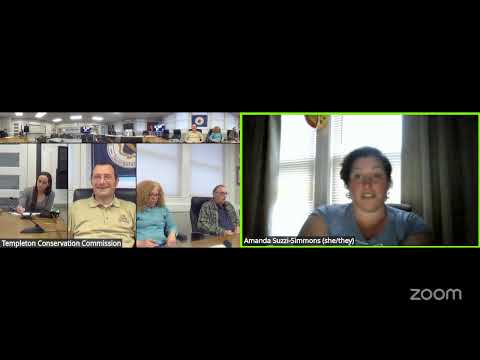
Seaman Paper Company and engineering firm Tighe & Bond presented plans on May 19 for rehabilitating the Otter River Dam on Main Street in Templeton, describing vegetation removal, embankment reinforcement with large riprap and repairs to the primary and auxiliary spillways. The Templeton Conservation Commission voted to continue the public hearing while the project awaits a MassDEP file number and related federal permits.
The project manager, Stephanie Tetrell of Tighe & Bond, told the commission the scope includes removing vegetation within about 20 feet of the dam and installing overtopping protection on the embankments using class 1 and class 2 riprap. Tetrell said the design calls for a median rock size (D50) of about 24 inches on the downstream faces and about 16 inches on upstream faces, and that contractors would use cofferdams to perform primary-spillway work "in the dry." Tetrell said the work would remove concrete flashboards and piers at the primary spillway and replace that section with concrete while keeping the existing crest elevation.
The commission’s hearing record shows the proposal will permanently impact roughly 21 square feet of bordering vegetated wetland along the embankment; the applicants proposed a 21-square-foot replication area on a nearby shelf of comparable elevation and hydrology. Tetrell said access for the south-side work would come from Main Street and staging and material laydown would use the large parking area adjacent to the Seaman Paper building; access from Route 68 would be used on the north side via an existing gravel drive that will be cleared and graded but not elevated.
Commissioners and staff asked for clarification about timing, water management and construction sequencing. Tetrell said the schedule depends on receiving state and federal approvals, including a 401 water-quality certification and any 404 permits; she said work requiring a dry site would be scheduled during lower river flows and that contractors must monitor weather and have contingency plans. Commissioners also discussed an unidentified pipe observed in the impoundment; staff confirmed the sewer department had no record of a sewer line in that location and the historical society will help investigate the pipe’s purpose.
Because the notice of intent was filed with the Conservation Commission but the project still lacks a MassDEP file number and pending federal approvals, the commission voted to continue the hearing to a later meeting. Tetrell and Seaman Paper representatives will return with the MassDEP file number and further permit documents. The commission recorded no final decision at the May 19 meeting.
For residents: the project manager said the work will require vegetation removal within 20 feet of the dam, installation of large riprap, and in-stream work staged with cofferdams intended to keep the primary work area dry. The applicants plan wetland replication to offset the permanent 21-square-foot impact to the bordering vegetated wetland.