
Commission tables storage-container ordinance and discusses vehicle storage enforcement
Get AI-powered insights, summaries, and transcripts
Subscribe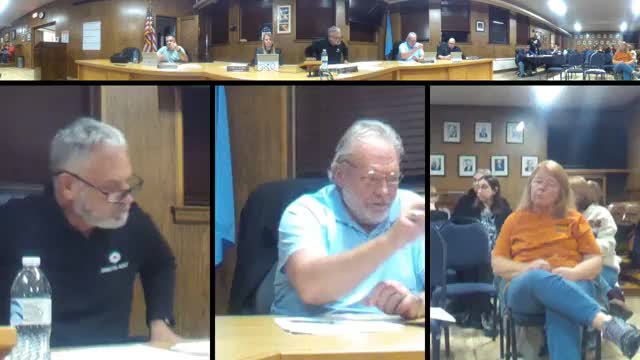
Summary
Commissioners discussed how to define "parking," "storing" and "storage" on city streets, raised enforcement and safety concerns tied to a mechanic shop and dealerships, and tabled an ordinance on portable storage containers for Planning & Zoning review.
The Lead City Commission debated how to define and enforce rules on parking, vehicle storage and portable storage containers at its Jan. 6 meeting, then voted to table second reading of the storage-container ordinance pending Planning & Zoning review.
Why it matters: Commissioners and staff said current language in city code does not clearly distinguish short-term parking from long-term storage on public streets, which complicates enforcement and raises safety and aesthetic concerns in commercial corridors.
Chief (Public Safety) led a discussion asking for clearer terminology distinguishing parking, storage and "dead storage" on city property and streets. "If I park my car or my boat on the side of the street, am I storing it there or am I parking it there? We don't have terminology to differentiate," the chief said.
The issue surfaced around a mechanic shop on East Main where staff and several commissioners said vehicles frequently remain for more than the ordinance's 72-hour threshold. Commissioners and the chief described the difficulty of enforcing a multi-day rule: officers must photograph and timestamp vehicles, but sellers or shops frequently move cars a few feet to reset the clock.
Commissioner Rob (City Commissioner) suggested the problem spans businesses and dealerships, not a single owner, and asked for an absolute and enforceable definition so staff do not spend excessive patrol time documenting vehicles. Several speakers recommended that staff compile data on hours devoted to enforcement and a vehicle count in the troubled area before proposing an ordinance.
On a separate motion, the commission moved the second reading of ordinance 11-14-24 (storage containers) to the agenda for tabling so Planning & Zoning can review. "Shouldn't they have? No. They didn't look at it," a commissioner asked, and the commission voted to table the ordinance until planning has a chance to comment.
No fine changes or new enforcement policy were adopted at the meeting. Staff were asked to gather enforcement time and vehicle counts and return with proposed language and cost estimates for enforcement efforts.
Next steps: Planning & Zoning will review the storage-container ordinance; staff will provide counts and estimated enforcement hours for the affected area.