Get Full Government Meeting Transcripts, Videos, & Alerts Forever!
Get email alerts on the Operational Canines And Ems topic
No spam. Unsubscribe anytime.
Senate committee advances ‘Rico’s Law’ to let Alaska EMS treat and transport operational canines
Summary
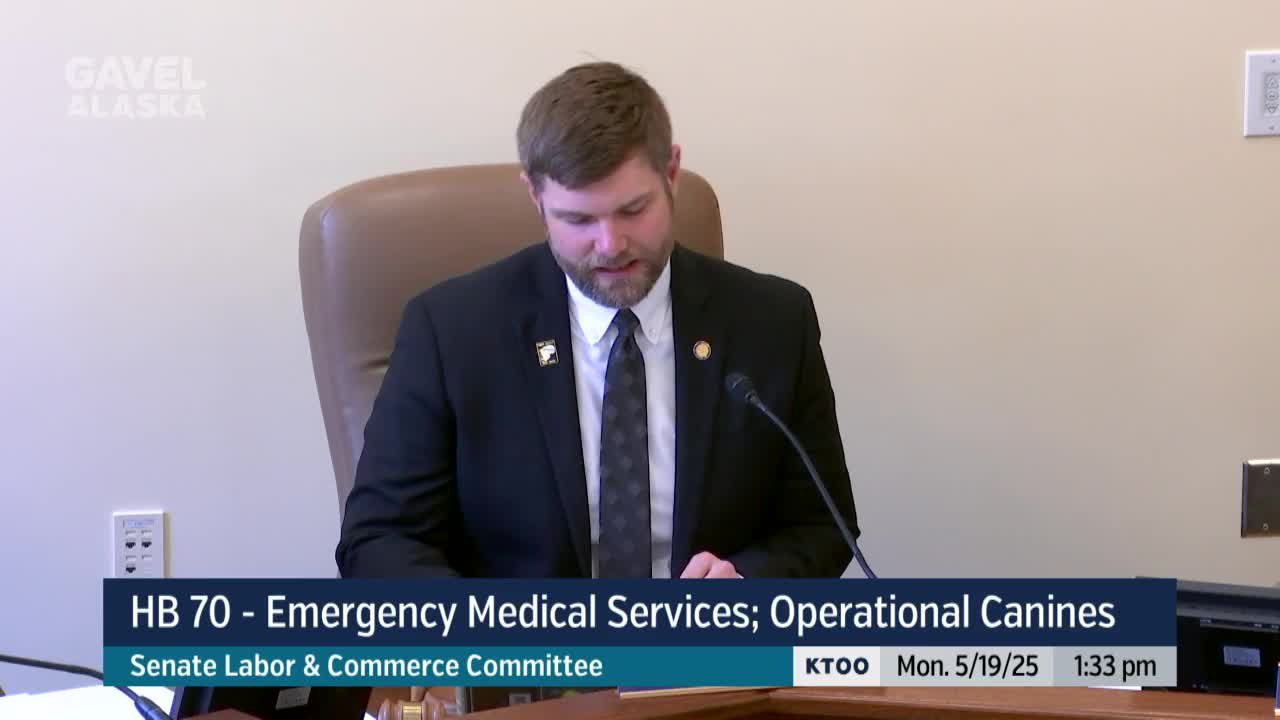
Senate Labor and Commerce on Monday moved House Bill 70, known as "Rico's Law," out of committee with individual recommendations and an attached fiscal note, clearing the way for further consideration by the full Senate.
Senate Labor and Commerce on Monday moved House Bill 70, known as "Rico's Law," out of committee with individual recommendations and an attached fiscal note, clearing the way for further consideration by the full Senate.
The bill would authorize licensed emergency medical technicians (EMTs) and mobile intensive care paramedics to provide on‑scene emergency care and transport for "operational canines" — dogs used by law enforcement, search‑and‑rescue, or other government operations — and sets out training, liability protection, transfer, and access provisions.
Supporters told the committee the change addresses a legal gap that can prevent timely care. Jeremy Houston, staff to Representative Calvin Schrage, summarized the bill’s core purpose: "House Bill 70 empowers emergency medical services personnel to deliver on scene point of injury emergency care and transport for operational canines." Brian Lipkin, an Anchorage EMS clinician and the principal author of the bill, said HB70 "brings clarity, compassion, and responsible framework" after years of field crews facing a legal and ethical gray area.
The bill’s text, as presented to the committee, would: allow EMTs and mobile intensive care paramedics to perform emergency services on an operational canine without being deemed to practice veterinary medicine under specified Alaska statutes; require transfer of the animal to a licensed veterinarian at the earliest practical opportunity; authorize EMS to enter premises to render care if there is reasonable cause to believe an operational canine has been injured; require the Department of Health to establish course or certificate prerequisites for authorization; and provide civil‑liability protection for EMS and for veterinarians who receive transferred canines under certain circumstances. The sponsor set an effective date of January 1, 2026.
Dr. Melissa Edwards, a licensed Alaska veterinarian and treasurer of the National Association of Veterinary EMS, testified in support and described existing national training and guideline efforts. "With proper evidence based veterinary directed training, medical control, and direction, EMS providers can provide resuscitative point of care injury and transport of operational canine safely and successfully," Edwards told the committee. She offered to serve on an advisory panel to help develop Alaska‑specific protocols and training.
Representatives of the Alaska Veterinary Medical Association and the Board of Veterinary Examiners said they oppose the bill as written but are open to collaboration. A representative identified in testimony as Doctor Mikaela, speaking for the Alaska Veterinary Medical Association, said the group supports "first aid and transport" and urged inclusion of veterinarians and the Board of Veterinary Examiners in implementation planning: "We are supportive of collaborative efforts and advisory panel moving forward with House Bill 70." Committee members and bill proponents described discussions already under way to create an advisory panel and training oversight to address those concerns.
Committee members asked about safeguards and implementation in Alaska’s rural settings; supporters said Alaska EMS already carries equipment and medications that could be adapted for veterinary prehospital care and noted existing courses such as canine tactical emergency casualty care (canine TECC) as training models. The bill also adds statutory language intended to limit liability for veterinarians who treat transferred canines and to allow veterinarians to share medical information with EMS in narrow circumstances for performance review and continuity of care.
On committee action, a member moved that the measure be reported from committee with individual recommendations and the attached fiscal note. There was no recorded roll‑call vote; the chair announced, "Is there any objection? Seeing and hearing none, House Bill 70 ... is reported from committee with individual recommendations and attached fiscal note." The committee also noted plans for paperwork and regulatory design and flagged continued engagement with veterinary stakeholders during implementation.
If passed by the full Legislature and signed by the governor, the bill would take effect Jan. 1, 2026. Implementation would require Department of Health rulemaking to establish training/certificate prerequisites and working protocols that include veterinary participation, according to proponents.
The Labor and Commerce Committee heard invited and public testimony from EMS practitioners, veterinarians, and veterinary association representatives during its consideration. The bill will advance to the next stage of the legislative process with committee recommendations and an attached fiscal note.