Get Full Government Meeting Transcripts, Videos, & Alerts Forever!
Get email alerts on the Economic Development topic
No spam. Unsubscribe anytime.
Council committee advances Rivergate Mile economic impact plan with tax‑increment financing split and disclosure amendment
Summary
The committee approved an economic impact plan for the Rivergate Mile redevelopment and an amendment requiring disclosure of evidence used in property‑tax appeals that materially reduce assessed value.
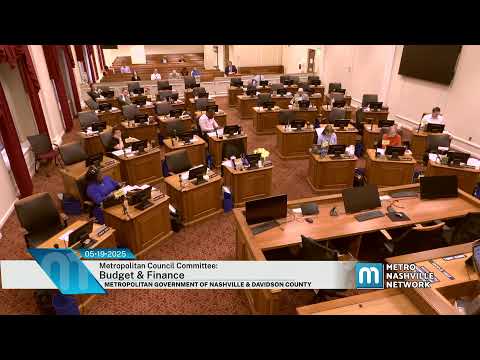
The Budget & Finance Committee approved an economic impact plan for the Rivergate Mile redevelopment and an amendment that requires the developer to disclose evidence presented in any successful property‑tax appeals.
Bob Mendez of the mayor’s office outlined the proposal: the project would redevelop roughly 57 acres around the Rivergate Mall with mixed uses including multifamily housing, townhomes for sale, senior housing, retail, restaurants, sports and entertainment space, medical office, general office and hotel. Metro staff described a tax‑increment financing structure that would allow a maximum of $42,000,000 of new property‑tax revenue over 25 years to be used in support of the project; that revenue stream would enable the developer to borrow roughly $22.5 million now from a third‑party lender to fund infrastructure. Project infrastructure costs are estimated at between $35 million and $40 million, which the developer would contribute toward along with Metro‑funded portions that would transfer to government ownership when completed.
Mendez described the proposed tax split: Metro would retain base taxes (the 2024 tax base) and a portion of debt‑service revenue necessary to cover Metro’s obligations; in years 1–5 the developer would receive 100% of new revenue net of debt service, and in years 6–25 the split would be 75% to the developer and 25% to Metro in addition to the debt‑service piece. Legal language limits Metro’s recourse to the stream of tax payments and contains no pledge of Metro’s general funds.
The committee approved an amendment introduced by Council member Evan Siegel requiring disclosure of evidence presented in tax assessment appeals when that evidence is used to materially lower assessed value; Siegel noted prior cases where appeals lowered assessments and resulted in tax benefits later followed by resale at higher prices. The amendment passed 11-0 in committee.
Council members asked about enforceability of housing commitments tied to Low‑Income Housing Tax Credits (LIHTC) and what would occur if planned land swaps could not be completed; Mendez said the land‑swap failure would render the deal stillborn because the tax stream would not materialize without completed development. He also explained that IDB (Industrial Development Board) rather than MDHA is the vehicle used because the site is not in an MDHA redevelopment district. The committee approved the economic impact plan as amended by an 11-0 vote.
The plan includes expected benefits Metro staff counted conservatively (largely discounting indirect sales‑tax benefits) and identifies up to approximately 800 residential units in the long run, including senior affordable units if LIHTC awards are attained; where LIHTC is not obtained, the developer has pledged to guarantee 10% of units at 80–100% AMI as written in the plan.