Get Full Government Meeting Transcripts, Videos, & Alerts Forever!
Get email alerts on the Transportation topic
No spam. Unsubscribe anytime.
Riverside approves TRAC application to study Woodman‑Harshman corridor after residents raise safety and cost concerns
Summary
City council voted to authorize a Transportation Review Advisory Council (TRAC) application seeking $1.5 million for design and environmental work on the Woodman Gateway project, with a possible local match of up to $400,000; residents urged clearer plans on roundabouts, costs and construction impacts.
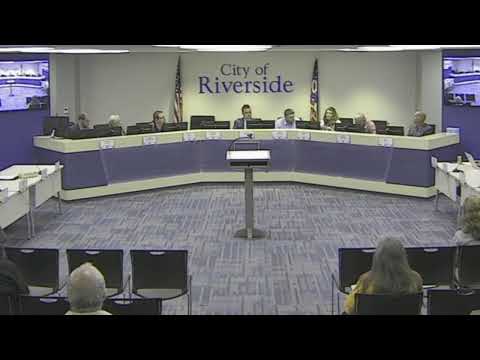
Riverside City Council on May 19 voted to authorize the city to apply to the state Transportation Review Advisory Council (TRAC) for $1,500,000 to fund phase‑2 environmental and design work on the Woodman Gateway project, with the city prepared to provide a local match of up to $400,000 if the award is granted.
The vote came after multiple residents spoke during the meeting’s public comment period urging caution about concepts shown in the project materials — in particular, multiple roundabouts proposed for the Woodman‑Harshman corridor — and asking for clearer cost estimates, traffic impacts and the project timetable.
The application, described in the council packet as necessary to advance environmental engineering and design, would cover testing, environmental analysis and preliminary design steps. Josh, City Manager, told the council “most road grants…are pay to play in the sense that cities have to put up money in order to get any money,” and that the recommended $400,000 match is intended to improve the city’s competitiveness under this year’s scoring criteria.
Why it matters: the Woodman‑Harshman corridor is a busy north‑south artery for the city and adjacent Wright‑Patterson Air Force Base. Council and staff described the work as a multi‑year, multi‑phase effort to slow traffic, address safety and coordinate with regional partners. Residents warned conceptual maps showing multiple roundabouts have caused confusion and concern about safety, increased rear‑end collisions and unknown total costs.
Residents and council remarks
Angel Patterson, a Riverside resident, praised recently opened recreational work at Roar Park but urged the city to provide accident statistics and to consider lower‑cost options before committing funds to roundabouts. “I'm wondering if you have the statistics for accidents there that you can share with us,” she said.
Frida Patterson said she and others believed the plans were “set in stone” and worried about two roundabouts within a quarter mile of one another, asking whether the city had considered lowering the speed limit or installing barriers instead.
Christiana Couch told council “I just don't think I think it's a waste of money,” referring to roundabouts, and recommended reducing speeds as a first step.
Council and staff context
Josh said the corridor work dates to early 2022 and that some concept graphics in public materials were intended to “generate some excitement and get people talking” rather than represent final engineering. He noted at least three contaminated landfills are beneath the curves in question, which will require testing and could significantly affect cost and feasibility: “one of the questions we have to answer by spending this money to do the engineering…is can we even build this without disturbing that contamination?”
City Manager also said the city currently has “a little bit more than $5,000,000 in fund balance” and that, if the TRAC award is made, the $400,000 local match would be addressed in the 2026 budget process and might be mitigated with other sources such as a transportation improvement district, infrastructure loans or Ohio Public Works Commission funds.
Formal action
Council approved resolution 3031 to authorize application to TRAC for $1,500,000 and to provide a local match of up to $400,000 if awarded. The motion to approve the resolution was made by Mr. Denning and seconded by Deputy Mayor Frey. The council vote was recorded as “Aye” and the motion carried.
Next steps and timeline
Staff said the TRAC application follows a deadline the city is trying to meet and that engineering and environmental rounds typically come in multiple phases; if awarded, the city would use the funds to advance environmental design and testing. If the city is awarded the TRAC funds, council will determine how to allocate or identify the local match during the 2026 budgeting process and will return to the community with more detailed briefings as engineering results become available.
Discussion v. decision
Discussion: residents raised concerns about roundabouts, overall cost, construction impacts and whether alternative, lower‑cost measures (speed enforcement, resurfacing, barriers) had been adequately considered.
Direction/assignment: council authorized staff to submit the TRAC application and to pursue matching funds options if awarded; staff committed to further community briefings and a follow‑up presentation in June.
Decision: resolution 3031 approving the TRAC application was adopted.