Get Full Government Meeting Transcripts, Videos, & Alerts Forever!
Get email alerts on the Supportive Learning Environment topic
No spam. Unsubscribe anytime.
Eau Claire district reports gains on student climate survey after school-level changes
Summary
District leaders told the Eau Claire Area Board of Education that a new supportive-learning-environment framework, school-level interventions at Northwoods Elementary and a universal social-emotional screener corresponded with improvements on spring student-climate measures, particularly among students of color.
The Eau Claire Area School District reported measurable improvements on its spring student climate survey after district and building-level efforts to strengthen social and emotional learning.
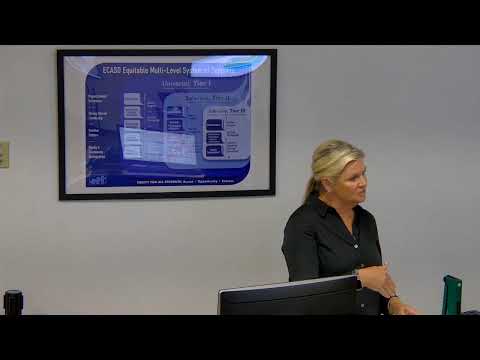
Executive Director Mandy Van Fleet told the Board of Education that the district’s supportive learning environment framework and a set of continuous-improvement strategies corresponded with gains in March survey responses, and that a universal SEL screener (SABERS) was introduced this year to give schools additional, actionable data.
The report matters because Board policy R4 (citizen of a diverse community) uses student-climate measures as a key performance indicator, and the district said improvements — especially among historically marginalized students — can signal better daily experiences and long-term outcomes.
Van Fleet said district results show “encouraging gains” after a disappointing fall report, and she described district-level steps including embedding SEL competencies into curriculum, rolling out a universal SEL screener (SABERS — social, academic, emotional behavior risk screener), and aligning professional learning for adult practices across schools. She noted the SABERS implementation this year could produce additional monitoring data in future reports.
At the school level, Luke Stordahl, principal of Northwoods Elementary, and Grace Hallis, a second-grade teacher at Northwoods, described specific interventions tied to a building goal of improving the student perception that “students treat each other well.” Stordahl said the building identified unstructured times such as recess and transitions as frequent sites of conflict and prioritized active adult supervision and problem‑solving supports at those times.
“We brought everybody in and reset what that looks like,” Stordahl said, describing efforts to train staff to be active facilitators at recess rather than passive supervisors.
Hallis described a student-led recognition program called “Honor’s kindness catchers,” in which a single student each day wears a badge and identifies peers for kind acts. Students write the recipient’s name and the kind act on a ticket that is posted in a special office mailbox so both receiver and giver experience recognition. “Having the kids recognize each other as kindness and positive actions… makes a difference,” Hallis said.
Northwoods also piloted a change for its two fifth-grade sections: instead of a single large SEL meeting, staff reworked the master schedule to create a three-day-per-week, 20-minute advisory in which the grade was divided into six groups of roughly 10 students led by different staff (a fifth-grade teacher, the PE teacher and the librarian). Stordahl said teachers and students reported the small-group advisories were “one of their highlights” and helped students connect with peers.
On the climate numbers Van Fleet presented, the district said middle‑school respondents who said students “respect one another” rose from 55% to 58%; high school responses improved by about 3 percentage points; and the district reported roughly a 15 percentage‑point jump on at least one respect-related measure for high‑school students of color. The district also said elementary responses were up: 72.2% of elementary students reported that classmates treat each other well (an increase the district reported as about 7 percentage points), and students of color showed similar gains.
Van Fleet and Stordahl emphasized that many of the district’s actions focus on adult behaviors: professional learning, PBIS supports, embedding SEL into curriculum units and allocating additional pupil‑services staff. Van Fleet cautioned that the supportive learning environment is a new district-wide framework and that turning a framework into durable, measurable change requires multi-year work, additional measures and time to develop aligned professional learning and monitoring systems.
Board members asked about specific issues raised by community members and staff. Board member Dr. Farrar asked how the district is addressing the early appearance of racial slurs among elementary students and whether curriculum and professional development explicitly address race and slurs. Van Fleet and Christy Watkinson, director of student services, said the district expects staff to address disrespectful language under existing harassment and discipline protocols and that curriculum vendors have added bullying-and-harassment modules to their resources for next year. Watkinson said the district will work with elementary principals to determine whether additional supports are needed.
Board members also asked about the capacity of the student climate survey itself and what other data the district will use. Van Fleet and other staff said the district is adding and aligning measures (including SABERS and other discipline and PBIS fidelity data) and is considering carefully any changes to survey wording so that longitudinal comparisons remain meaningful.
The presentation concluded with district leaders saying the reported improvements reflect “intentional continuous improvement anchored in changing adult practices,” and that the district will continue to monitor results and refine supports and data sources going forward.