Get Full Government Meeting Transcripts, Videos, & Alerts Forever!
Get email alerts on the Interim Zoning Hb1110 topic
No spam. Unsubscribe anytime.
Seattle committee hears divided public comment on interim zoning ordinance tied to HB 1110
Summary
At a May 19 public hearing on Council Bill 120969 implementing House Bill 1110, about 68 registered speakers split between urging quick passage to increase housing supply and warning the interim rules would reduce tree canopy, narrow setbacks and risk displacement. No votes were taken; the committee recessed until an in‑person session at 4 p.m.
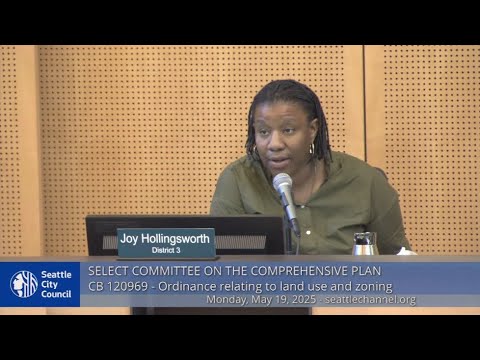
The Seattle City Council Select Committee on the Comprehensive Plan opened a public hearing on Monday, May 19, 2025, on Council Bill 120969, interim zoning legislation to implement House Bill 1110. Chair Joy Hollingsworth said the session would take remote testimony first and that 68 speakers had registered for the morning session. The committee recessed the remote session and will resume in person at 4 p.m.
The hearing drew repeated appeals from housing advocates and real‑estate groups asking the council to pass the interim ordinance quickly to allow more “middle housing” across Seattle, and equally frequent objections from neighborhood and environmental speakers who said the interim bill goes well beyond the state mandate and would harm the city’s tree canopy, increase lot coverage and reduce setbacks.
Proponents said the interim ordinance is a necessary step to increase housing supply and curb sprawl. Deepa Saverajan, local policy manager at Climate Solutions, told the committee, “Climate Solutions strongly supports the recommendations of the Complete Communities Coalition, and we call on council to pass the interim voting ordinance without delay.” Representatives of the Seattle King County Realtors and Washington Realtors urged passage, saying more housing near transit would improve affordability and reduce vehicle miles traveled. Randy Banneker, speaking for the Seattle King County Realtors, said, “The only path to greater housing affordability is to increase our housing supply.” Several speakers urged the council to allow stacked flats, remove minimum lot sizes, add floor‑area‑ratio (FAR) bonuses, and align interim density limits with the proposed permanent legislation.
Opponents said the draft interim ordinance goes beyond HB 1110’s minimum requirements and would strip protections for mature trees, environmentally critical areas (ECAs) and neighborhood character. Andrea Ostrowski, a Green Seattle Partnership volunteer, said she opposed the draft “for three reasons,” beginning with a concern that “the interim legislation will harm trees and reduce green space by increasing lot coverage and reducing setback requirements throughout the entire city.” Multiple speakers asked the council to retain current 20‑foot front and rear setbacks (or adopt the state model code setbacks), to reject proposed increases in lot coverage and the modest 2‑foot height bump in some zones, and to preserve tree protection rules and ECA buffers.
Several witnesses offered detailed, itemized requests. JJ Bishop Burrows, a Madison Valley homeowner, urged expanding a “stacked flat” bonus within a half‑mile of rapid‑ride bus stops, removing a 6,000‑square‑foot lot minimum and allowing at least six units per lot, while insisting on space to preserve or plant exceptional trees. Architect and long‑time practitioner Sean Kemna and the Seattle Planning Commission’s co‑chair Mikaela Daffern both urged rapid passage of an interim ordinance while also recommending alignment of interim density limits with the permanent plan (Daffern suggested a density of one unit per 1,250 square feet as a more consistent metric than an across‑the‑board 4–6 unit allowance).
Speakers from frontline and equity‑focused organizations warned of displacement risks and asked the council to exempt neighborhoods at high risk of displacement from up‑zoning or otherwise prioritize protections. Residents from South Park, Georgetown and the Duwamish Valley urged maintaining canopy and tree protections in communities with higher heat and pollution burdens. The Thornton Creek Alliance and others urged that ECAs retain their normal buffer zones and cautioned that allowing reduced protections in ECAs “could result in permanent loss for wildlife and watershed functions.”
A few commenters pressed the council on technical definitions in the draft ordinance. One speaker asked the council to clarify the definitions of “frequent transit” and “major transit stop,” noting that frequent transit had been used to justify parking reductions and that HB 1110 ties certain allowances to major transit stops. Another speaker requested changes to municipal code language that limits net dwelling area in certain zones, calling for removal of a cumulative definition or raising the square‑foot limit to accommodate family‑sized units.
No formal votes were taken during the morning session. The committee chair confirmed that the council had adopted the meeting agenda without objection at the start, and the hearing concluded with the committee recessing until the 4 p.m. in‑person session to continue public testimony and consider amendments and next steps.
The committee is expected to receive additional public comment in the afternoon and may consider proposed amendments from council members, including ones referenced on the record as coming from Councilmember Kathy Moore and an “Amendment 2” mentioned by testimony. The council has said permanent legislation implementing the comprehensive plan will follow later this year and that further public hearings will be scheduled for the full plan.