Get Full Government Meeting Transcripts, Videos, & Alerts Forever!
Get email alerts on the Solid Waste Finance topic
No spam. Unsubscribe anytime.
Dickson County approves higher landfill tipping fee, authorizes borrowing for equipment
Summary
Commissioners approved raising the county landfill tipping fee to $70 per ton and several capital borrowing measures to reimburse prior expenditures and fund equipment, alongside a lower charge for municipalities; the vote followed staff presentations and a split among commissioners over fairness and potential double taxation.
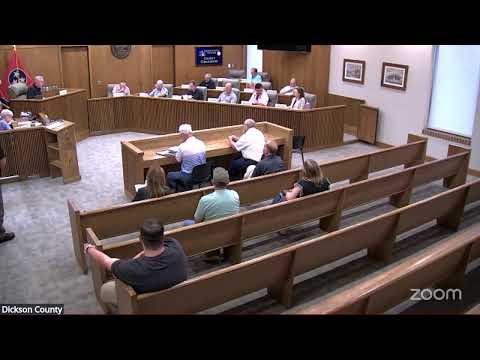
Dickson County commissioners voted to raise the county landfill tipping fee and approved related capital borrowing during their regular commission meeting.
County staff presented a resolution to amend the landfill tipping fee schedule, moving commercial and most county charges to $70 per ton while setting a $35-per-ton rate for municipal deliveries. “What we're looking at is basically, stating that we're moving on your exhibit A, that we're moving to $70 a ton,” said Mr. Hall, a county staff member who presented the fiscal analysis. Commissioners then approved the change by voice vote after a motion by Commissioner Grove and a second by Commissioner McElwain.
The change is intended to address a shortfall in landfill revenue. Mr. Hall estimated the increase would raise county landfill revenue to “around $6,000,000 where we're gaining right now about $5,500,000,” and said “that additional revenue … needs to most of it needs to be set aside for capital projects” at the landfill.
The commission also approved capital outlay notes to reimburse the solid waste sanitation department for budgeted equipment purchases. A separate capital borrowing for highway department equipment was approved in the same consent sequence.
Not all commissioners supported the tipping fee structure. One commissioner said the change could be “double taxation” for city residents who already pay a $10 disposal fee and rely on municipal pickup, and warned that ending municipal collection could force the county to build additional convenience sites at a large cost. Mr. Hall said the fee calculation uses prior-year tonnage and annual U.S. Census population estimates, and staff expect to reassess the formula roughly every five years.
Commissioners discussed operational steps to reduce out-of-county dumping, including better on-site screening and relying on reports from citizens. Mr. Hall noted coordination with the sanitation board and a staff member, Ken Naif, on staffing models to limit costs for on-site enforcement.
The tipping-fee resolution passed on a motion by Commissioner Grove, seconded by Commissioner McElwain. The capital outlay note for the solid waste sanitation department and the highway department were also approved by voice vote.
The commission’s action covers only the county-managed landfill and associated county funds; the resolution distinguishes municipal deliveries and sets a lower municipal rate, and staff said the county will use annual census estimates to update the formula each year.
Looking ahead, staff said the county expects to hold the new fee structure for several years but will monitor tonnage and costs and may reassess as needed.