Get Full Government Meeting Transcripts, Videos, & Alerts Forever!
Get email alerts on the Local Streets Roads Funding Eligibility Cal Smart topic
No spam. Unsubscribe anytime.
California Transportation Commission trains local agencies on RMRA eligibility and CalSMART submissions
Summary
The California Transportation Commission held a virtual training for city and county staff on fiscal-year 2025–26 eligibility rules for Road Maintenance and Rehabilitation Account (RMRA) funds and step-by-step use of the CalSMART portal, emphasizing adopted-resolution requirements, key deadlines and required project details.
Alicia Sequeira, local streets and roads program manager for the California Transportation Commission, led a virtual training for local agency staff on eligibility and reporting rules for Road Maintenance and Rehabilitation Account funds for fiscal year 2025–26, and demonstrated how to submit adopted project lists in the California State Multimodal Application and Reporting Tool (CalSMART).
The session mattered because RMRA is a formulaic, recurring state funding source for local road repairs and agencies must submit an adopted project list and resolution each year to be eligible. Sequeira repeatedly warned of strict deadlines, saying, “If you miss that Sept. 30 deadline, there is nothing that we can do for you.” The commission also stressed that the State Controller’s Office disperses the funds and performs maintenance-of-effort reviews that the commission does not control.
Sequeira summarized the roles: the California Transportation Commission (CTC) reviews proposed project lists and expenditure reports for eligibility and completeness and adopts program reporting guidelines; the State Controller’s Office apportions and distributes RMRA funds. “It is our responsibility to develop and adopt the program reporting guidelines for this particular funding program,” Sequeira said, and the CTC will transmit an adopted list of eligible cities and counties to the State Controller’s Office.
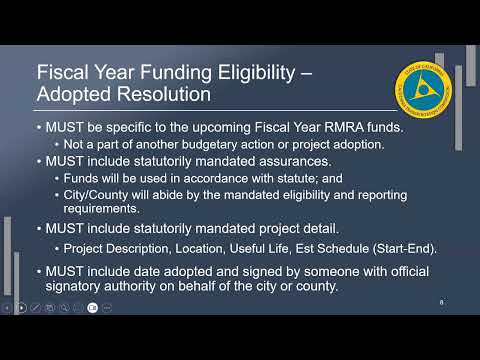
The training walked attendees through the required content of a resolution and project list. For each project, agencies must include a specific project description, location, estimated useful life (high and low), and an estimated start and completion month and year. Sequeira emphasized the project list must be specific to the upcoming fiscal year (FY 2025–26) and must be adopted by resolution signed by an authorized official; unsigned or non‑specific resolutions are routinely returned for correction. She told participants that combining the RMRA resolution into a general budget or CIP adoption often leads to missing required details and noncompliance.
CalSMART demonstraton: Sequeira opened CalSMART and showed how the portal auto‑fills prior‑reported projects, how to relist projects from the most recent expenditure report, and how to enter new projects with required fields. The portal requires agencies to register using individual email accounts; accounts lock after three failed password attempts and must be unlocked by CTC staff. Sequeira recommended agencies submit draft resolutions and project lists to the LSR inbox (lsr@catc.ca.gov) for a courtesy compliance review before formal adoption.
Key deadlines and procedures explained in the training:
- July 1: initial submittal window opens for adopted project lists for the new fiscal year; agencies should have their adopted resolution and project list uploaded to CalSMART by this date.
- Sept. 30: subsequent eligibility submittal cutoff for jurisdictions that miss the July 1 deadline; Sequeira warned that missing Sept. 30 generally forfeits eligibility for that fiscal year.
- Oct.: CTC adoption of subsequent lists and transmission to the State Controller’s Office (controller has a roughly six‑week processing window before dispersals begin in September for the fiscal year cycle described).
- Dec. 1: expenditure reports are due for the fiscal year (reporting of activity and changes to project status occurs during the expenditure reporting period).
Sequeira clarified several recurring questions from attendees: projects do not need to start construction after July 1 to be eligible; multiyear projects and projects that started in prior years may be relisted if upcoming fiscal‑year RMRA funds will be used. If an agency intends to use half or more of the upcoming year’s RMRA apportionment on a continuing project, the CTC advised relisting and readopting that project so the public can see the intended use of funds. Agencies must still submit expenditure reports and report activity even for relisted projects.
The training covered the program’s phase/component categories used by CalSMART (preconstruction, construction, procurement/operational needs) and explained when each applies. Sequeira noted procurement/operational needs may include maintenance equipment, software, or staffing used to deliver local streets and roads work, and the portal includes a field to indicate emergency repair or disaster reimbursement.
Sequeira demonstrated a sample PDF export of a CalSMART submittal that jurisdictions may attach to their resolutions as “Attachment A,” so councils and boards can adopt a resolution that references the CalSMART export and avoids omitting required statutory detail. She also showed a volunteer live submission from the City of Maywood as an example of a complete entry.
The CTC provided several compliance tips: use the LSR funding eligibility checklist in CalSMART’s Help & Resources tab; include a project ID that is retained across submittal and expenditure reporting to avoid duplicate records; do not use CalSMART modules for programs the agency does not administer; and involve finance staff to determine which fiscal pot (prior year accruals versus new apportionment) will fund a project. Sequeira said, “If you do not think you’re gonna have this adopted prior to July 1 … let us know ahead of time and let us work with you.”
The session closed with a reminder that the training recording and slides will be posted after ADA compliance checks and that CTC staff provide two sessions daily during the submittal window. Attendees were instructed to send draft materials and questions to lsr@catc.ca.gov for review.
Ending: This meeting was a technical training and included no formal votes or policy changes; it reiterated existing statutory requirements and administrative procedures local agencies must follow to receive RMRA funding for FY 2025–26.