Get Full Government Meeting Transcripts, Videos, & Alerts Forever!
Get email alerts on the Rmra CalSMART Submittals topic
No spam. Unsubscribe anytime.
California Transportation Commission trains local agencies on RMRA deadlines, CalSMART submissions
Summary
At a CTC webinar, staff reviewed Road Maintenance and Rehabilitation Account (RMRA) eligibility, annual deadlines and how to use CalSMART to submit adopted project lists and expenditure reports.
Alicia Sequeira, local streets and roads program manager at the California Transportation Commission, led a training for city and county staff on how to comply with Road Maintenance and Rehabilitation Account rules and submit project lists and expenditure reports through CalSMART.
Sequeira told attendees the Commission creates program guidelines and reviews proposed project lists and resolutions for completeness and statutory compliance, but does not set apportionments. "We do receive and review your proposed project list. We do not necessarily approve or select your projects. We do not determine the funding that you will receive. All of that is formulaic," she said. She explained that the State Controller's Office apportions and disperses RMRA funds and enforces other local government spending requirements such as maintenance-of-effort determinations.
The training emphasized required annual deadlines and the eligibility consequences of missing them. Jurisdictions must submit an adopted project list and resolution to the Commission by July 1 to be included in the Commission's August adoption period; the Commission must transmit eligible lists to the State Controller no later than August 31. Agencies that miss the July 1 deadline may use a subsequent eligibility window and submit by Sept. 30; funds held for jurisdictions that meet subsequent eligibility are typically paid later in the fall, Sequeira said. The annual expenditure-reporting deadline is Dec. 1.
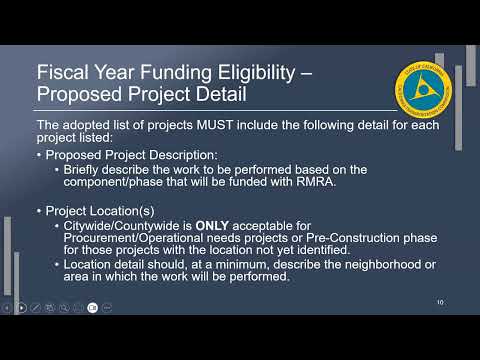
Sequeira walked through required content for a compliant adopted resolution and project list: a statutorily mandated set of assurances; project description (component or phase being funded such as preconstruction or construction); specific location information unless a project is truly procurement/operational (for example, equipment purchases or citywide annual maintenance); an estimated schedule; and an estimated useful life (average/low/high). She warned that missing any required field will render a submission noncompliant and trigger a corrective action and readoption.
CalSMART (California State Multimodal Application and Reporting Tool) is the only accepted channel for submitting proposed project lists, resolutions and expenditure reports, Sequeira said, and she demonstrated account registration, login behavior (accounts lock after three failed password attempts), the intake page and how to relist projects from the most recent expenditure report. She recommended agencies upload draft resolutions for pre‑review and urged jurisdictions to notify the Commission early if they cannot meet the July 1 deadline.
Sequeira also demonstrated practical tips: jurisdictions may attach a generated PDF of their CalSMART project list (for example as "Attachment A") and reference that attachment in the ordinance or resolution to avoid running into CalSMART character limits for locations (CalSMART has a 500‑character location field per entry). She said project entries can be edited only before submission; once a submittal is "submitted for review" the system locks entries and the record becomes pending review by Commission staff.
During Q&A, attendees asked whether projects that include both preconstruction and construction may list locations as citywide before exact segments are known; Sequeira recommended providing the most specific area available and noted procurement/operational projects are the primary permitted use of citywide descriptions. She advised jurisdictions to report current PCI (pavement condition index) values and noted that a PCI above 80 is relevant for certain eligible uses (for example, transit facility work) mentioned in the CalSMART guidance. On funding presentation, she reiterated that RMRA apportionments are formulaic and based on state revenue and formulas (not on a project's cost), so agencies must combine RMRA with other sources if a project cost exceeds the RMRA award.
No formal votes or board actions occurred; the session was a technical training and question-and-answer workshop. Sequeira asked attendees to email draft resolutions and project lists to the LSR inbox (lsr@catc.ca.gov) for pre‑review and noted the Commission posts aggregated project and expenditure data publicly and shares it with the Legislature and the public.
For agencies preparing submissions, the Commission highlighted these immediate steps: confirm or create CalSMART user accounts early; use the Commission's LSR funding eligibility checklist in CalSMART; assemble required resolution language and project detail (description, location, schedule, useful life); consider producing a CalSMART PDF attachment for lengthy location lists; and submit drafts early for Commission staff review to avoid last‑minute corrective actions.