
House adopts Border Enhancement Act after amendment; debate centers on local coordination and oversight
Get AI-powered insights, summaries, and transcripts
Subscribe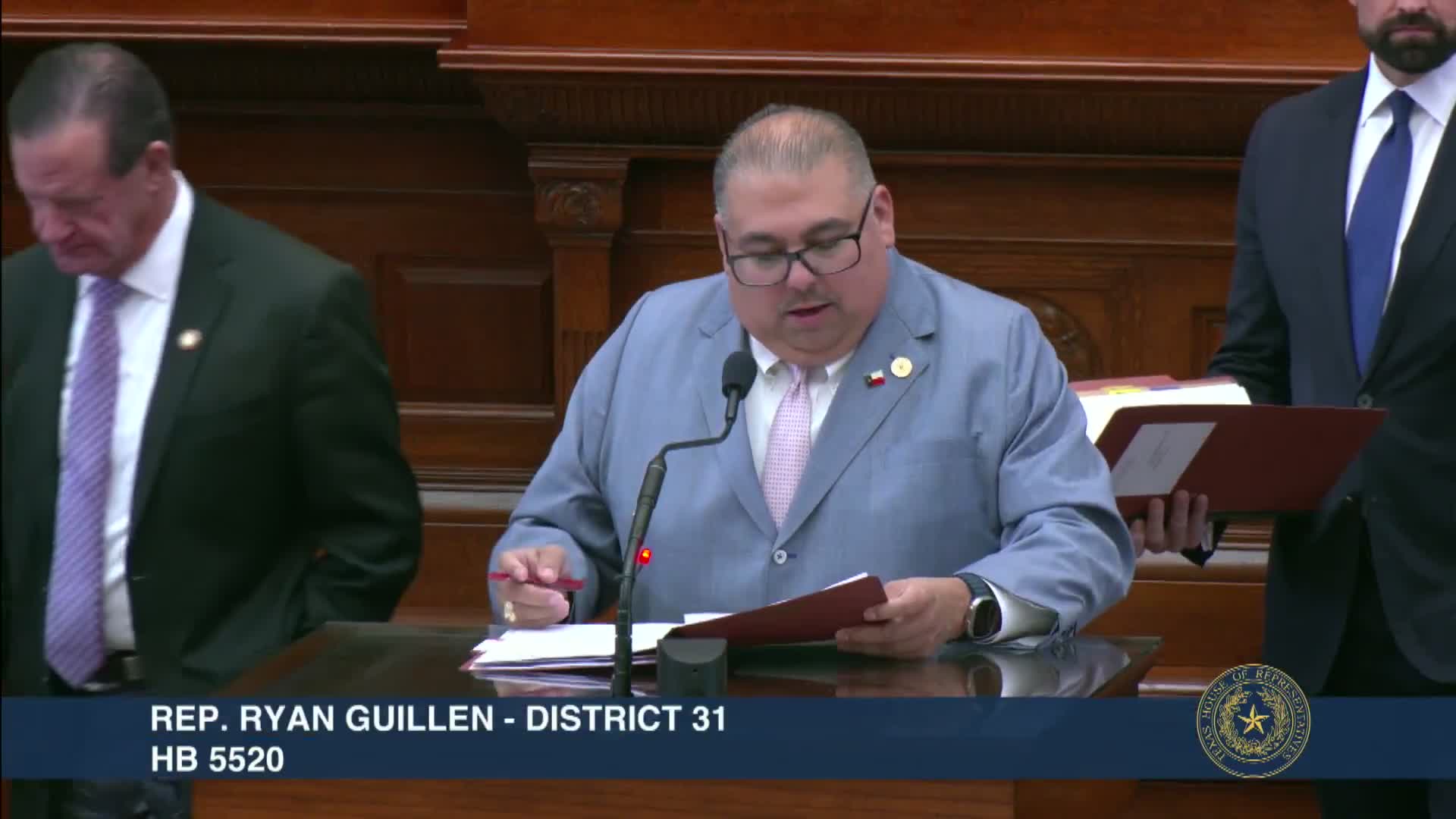
Summary
The House passed HB 55 20, titled the Border Enhancement Act, after floor debate and adoption of an amendment supporters said addressed local concerns.
The House passed HB 55 20, titled the Border Enhancement Act, after floor debate and adoption of an amendment supporters said addressed local concerns.
Representative Cesar Guillen, presenting the bill for Representative Gomes, said the measure "directs the Department of Public Safety to designate a liaison to coordinate with U.S. Customs and Border Protection," establishes a border grant program administered by the governor’s criminal justice division, and creates an education and workforce program to support border communities. (Representative Cesar Guillen)
Why it mattered: The bill targets public-safety and economic needs in Texas border counties by authorizing grant programs, training and a court-support initiative; some members said the measure updates the approach the Legislature took in prior sessions.
Key debate points: Representative Angelica Lopez (D-Cameron) said she represents border counties directly affected and raised concerns that local cities and law enforcement had not been consulted in drafting the bill: "Do you know if any of those state reps were contacted about this bill?... was there any coordination with DPS, the governor's office, or local law enforcement?" (Representative Angelica Lopez)
Representative Cody Patterson offered an amendment that he and supporters said removed language that had driven opposition; Patterson told the House that the change produced support from grassroots border organizations. The amendment was accepted by the bill’s author and adopted on the floor. Representative Guillen closed by summarizing the bill’s elements — liaison, border grant court program, higher‑education grants and public-safety assistance — and urged passage.
Decision and vote: After the amendment was adopted, the bill moved to final passage and the House recorded the result. The transcript shows the measure passed following the recorded vote on the floor that concluded with the clerk announcing the outcome; the bill advanced for enrollment and further processing.
Ending: Supporters said the amendment addressed local concerns and produced a coalition of support; opponents pointed to uneven coordination with local governments and asked for clearer accountability requirements for how new grant money would be spent. The author said the bill was modeled on prior border legislation and intended to coordinate state resources with federal and local partners.