Get Full Government Meeting Transcripts, Videos, & Alerts Forever!
Get email alerts on the Puc Nominations Oversight topic
No spam. Unsubscribe anytime.
PUC nominees outline consumer‑first approach, resiliency plans and new ERCOT oversight before Senate committee
Summary
The Committee on Nominations heard testimony from Public Utility Commission nominees Commissioner Courtney Haltman and Chairman Thomas J. Gleason. Senators questioned the nominees on grid resiliency, system resiliency plans passed by the Legislature, vegetation management, ERCOT oversight and water and telecommunications responsibilities.
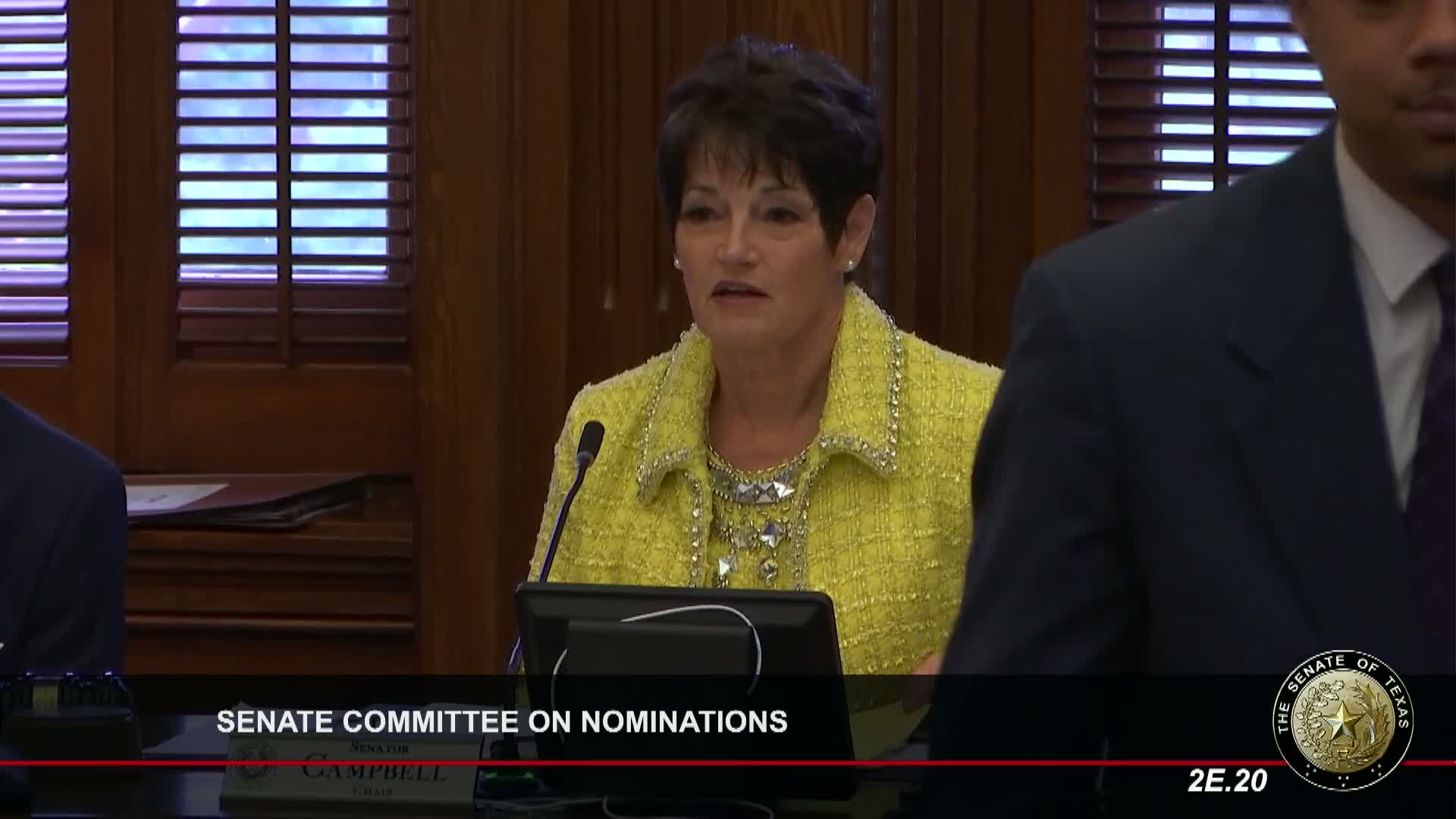
Two nominees to the Public Utility Commission of Texas appeared before the Senate Committee on Nominations and were favorably recommended to the full Senate following questioning about post‑storm reforms, agency transparency, and oversight of ERCOT and utilities.
Commissioner Courtney Haltman (introduced by Senator Eckhart) described her consumer‑first approach, saying, “I always take that at the forefront,” and outlined the commission’s broader responsibilities beyond electricity, including water, wastewater and telecommunications. Haltman told senators that about “60% of the casework our office and agency does is water,” noting that many water utilities are small and require significant staff attention.
Chairman Thomas J. Gleason, who was introduced as the commission’s chairman and described his prior roles in agency operations, said the commission’s mission is “to protect customers, foster competition, and promote high quality infrastructure.” Gleason described continuity of leadership at the agency after recent crises and credited staff with helping the commission regain stability and reduce turnover.
Senators focused questions on measures taken after Winter Storm Uri and hurricanes such as Beryl. Both nominees described the commission’s work on system resiliency plans and on greater oversight of ERCOT. Haltman said the Legislature’s recent resiliency framework allows utilities to come before the PUC with pre‑approved resiliency proposals; the commission has reviewed several such plans. Gleason explained that the PUC now has a stronger check on ERCOT protocol changes and has returned some protocol items for further work to ensure the commission and ERCOT operate with the same information.
Vegetation management and operational spending were a major focus. Senators said reduced vegetation budgets and reliance on outside contractors had magnified damage after storms. Gleason and Haltman said staff now flags reductions in vegetation spend and that the commission will scrutinize vegetation expenditures in rate cases and system resiliency filings so that operations and maintenance are not the first items cut.
The committee also questioned the nominees on transmission planning and cost allocation. Gleason said the commission has taken a cautious, staged approach to extra‑high‑voltage transmission proposals, approving a plan for the Permian Basin but delaying a full statewide adoption while seeking more analysis of costs and benefits. He noted that projected costs for expanded extra‑high‑voltage lines have risen in recent projections and that the commission is working to avoid overbuilding that would unduly burden ratepayers.
Both nominees said the commission has increased transparency and stakeholder engagement since 2021, hired additional staff after Uri, and is completing several administrative items from the agency’s Sunset review such as a centralized case management system and a precedent manual. Gleason pointed to reductions in turnover—from prior years’ 25–30% down to about 10% most recently—as evidence of improved agency stability.
With public testimony closed and no severance requests, the committee voted to favorably recommend the nominees to the full Senate for confirmation.
The full Senate will consider the confirmations and the commission will continue to implement and review resiliency filings, vegetation and maintenance oversight, and ERCOT protocol reviews.