
Rail Belt Reliability Council updates Senate committee on standards, 2026 integrated resource plan timeline
Get AI-powered insights, summaries, and transcripts
Subscribe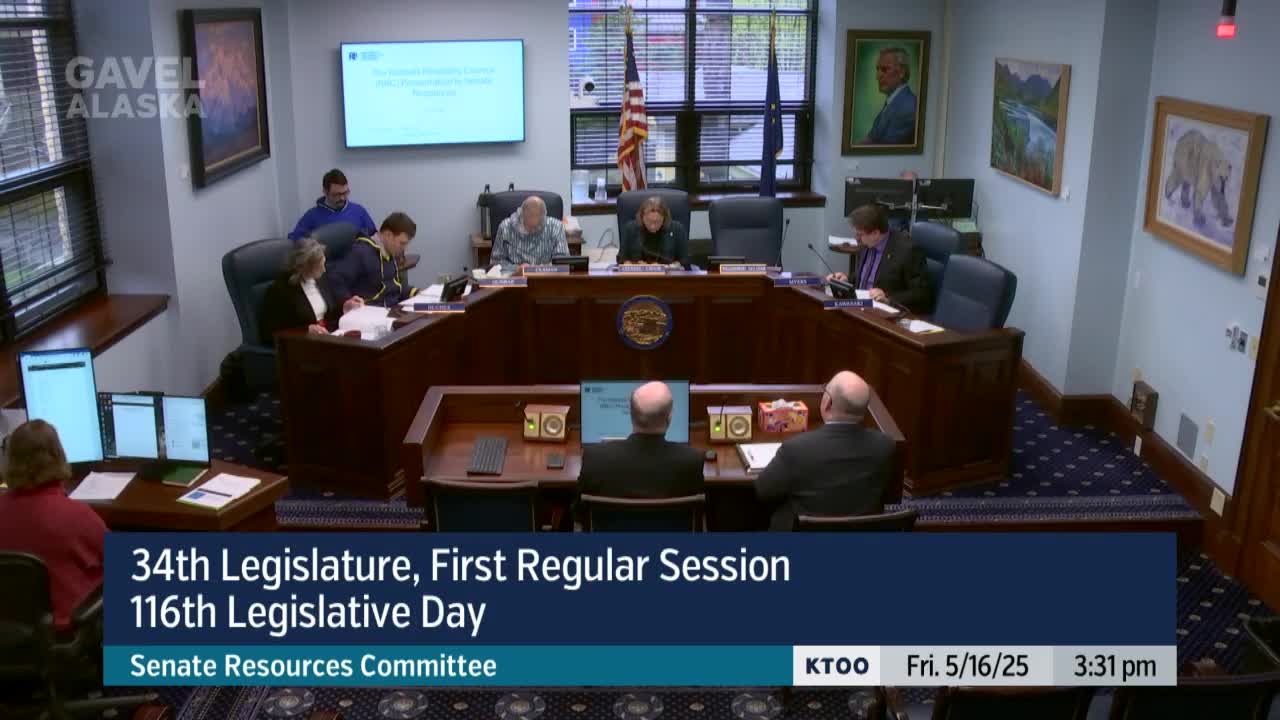
Summary
Juneau — The Rail Belt Reliability Council (RRC) outlined progress on reliability standards and a regional integrated resource plan during a May 16 presentation to the Alaska Senate Resources Committee, saying the council expects a completed IRP in 2026 and will review it every two years.
Juneau — The Rail Belt Reliability Council (RRC) outlined progress on reliability standards and a regional integrated resource plan during a May 16 presentation to the Alaska Senate Resources Committee, saying the council expects a completed IRP in 2026 and will review the plan every two years and reissue a full plan every four years.
The update came from Ed Jenks, chief executive officer of the Rail Belt Reliability Council, and Lou Florence, chair of the RRC board, during the committee meeting chaired by Senator Giesel. Jenks described the RRC’s public, stakeholder-driven process for drafting standards and the IRP, and said the council will submit standards and the IRP to the Regulatory Commission of Alaska (RCA) for approval.
The RRC was created by state legislation (Senate Bill 123) and later certificated under RCA regulations; Jenks told the committee the council’s responsibilities include establishing and enforcing reliability standards and producing an IRP that considers generation, transmission and demand-side measures. "The final plan we produce is one that we can say produces the greatest value to the rail belt," Jenks said.
Why it matters: The RRC’s standards and IRP are designed to coordinate generation and transmission planning across utilities on the Alaska Railbelt — a geographically large but electrically compact grid that runs through Fairbanks, the Anchorage area, the Kenai and Homer. Jenks and Florence told senators a regional plan could reduce duplicate investment and enable more efficient dispatching of generation across utility service territories, but the IRP and standards must be approved by the RCA before they take effect.
Key details and timeline
- Governance and staff: The RRC is a stakeholder organization with a 13-member voting board (12 stakeholder seats and one independent seat) and ex‑officio representation from the RCA and the Regulatory Affairs and Public Advocacy office (RAPA). Jenks said he is the council’s only full‑time employee currently; two staff positions are filled, with plans to increase staffing (one engineer and additional support staff) as standards move toward compliance and enforcement.
- Funding: Jenks told the committee the RRC is funded by an end‑user surcharge on utility bills and described the charge as a very small component of customer bills — he characterized it roughly as "approaching one‑hundredth of the fuel cost" on a bill and said the surcharge is not a major driver of customer bills compared with fuel.
- Standards and RCA review: The RRC has been developing enforceable electric reliability rules (referred to in the RRC process as ER1, ER7, etc.) and has submitted an initial set of standards to the RCA. Jenks said the RCA has a statutory review period of 180 days for tariff revisions and that the standards submitted to date are awaiting the commission’s action. The RRC plans to present six more standards at its June board meeting and expects additional packages in July.
- Integrated Resource Plan (IRP): Jenks said the IRP kickoff will occur in the month after the briefing, with independent technical contracts under development. The board completed a workshop to set objectives for the IRP and will direct technical and working groups to evaluate generation, transmission and demand‑side options with the goal of identifying a plan that delivers "the greatest value to the Railbelt," as required by statute. The RRC expects to finish the IRP in 2026, will review it every two years and must produce a full new plan at least every four years unless the RCA approves a deferral.
- Relationship with the RTO: The RRC’s planning role is distinct from the Railbelt Transmission Organization (RTO). Jenks and Florence explained that the RTO, formed by transmission owners (Golden Valley, Matanuska Electric Association, Chugach Electric, City of Seward, Homer Electric and the Alaska Energy Authority), is organizing a regional tariff to remove wheeling charges that now impede efficient transfers of power across the Railbelt. The RRC provides stakeholder‑driven planning and standards development; the RTO’s tariff work is intended to enable the economic transactions identified in a regional IRP.
- Examples and reliability issues: Jenks cited a past event (February 2004) in which loss of a transmission line and system oscillations led to automatic second‑stage load shed in the central region; he used that example to illustrate why enforceable standards and region‑wide modeling are necessary to identify contingencies and prevent generation trips and cascading outages.
Senators’ questions and next steps
Committee members pressed for details about how the IRP will change utility planning and project approvals. Jenks said individual utilities will continue local transmission and resource planning for near‑term needs, but those projects will be evaluated in the context of a regional IRP so planners can assess whether a given local upgrade should be sized or timed differently to align with system‑wide objectives. He noted that projects included in the IRP may have an easier path to RCA approval, because statute and practice give the commission context about need and value.
Senators also asked about the RCA’s review timeline, commission authority over project approvals, and how the RRC will interact with project developers and the RCA in cases where a project aligns with the IRP. Jenks said the RCA retains approval authority and the RRC can participate in RCA proceedings.
What the council asserted and what it did not decide
Discussion items: Jenks and Florence described planning, standards development, staffing and the RRC’s stakeholder process. They outlined the IRP schedule, the planned cadence for reviews, and the list of standards to be produced.
Direction/assignments: The RRC has scheduled working groups and technical advisory council activity and intends to present additional standards to its board in June and July and to kick off the IRP’s working groups in the month following the committee briefing.
Formal action: No committee votes or formal actions were taken during the briefing. No RCA decisions were issued at the meeting.
Ending
Jenks and Florence told senators that the RRC’s stakeholder process is active and that the council is submitting standards to the RCA while preparing independent technical work and working‑group processes for the IRP. The Senate Resources Committee said it expects updates and invited the RTO to brief the committee at a future date.