
Louisiana Supreme Court Justice outlines 200 years of the state civil code to civic‑education commission
Get AI-powered insights, summaries, and transcripts
Subscribe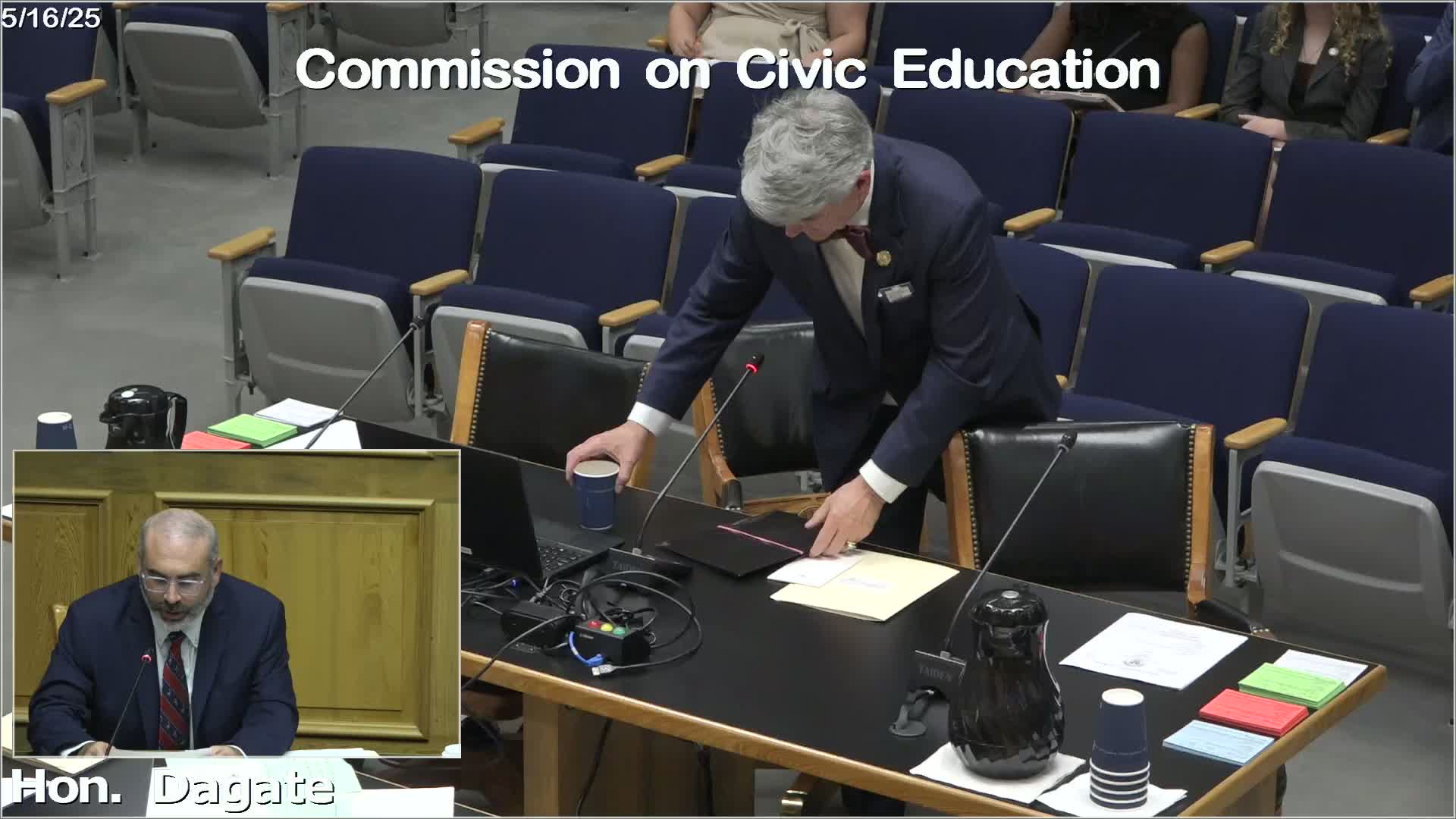
Summary
Louisiana Supreme Court Associate Justice J. McCallum told the Commission on Civic Education that the state's civil code, promulgated in 1825 and drawing on earlier codes, remains the primary source of law in Louisiana and discussed Moreau Le Laye’s role in its origins.
Justice J. McCallum, an associate justice of the Louisiana Supreme Court, gave a historical overview of Louisiana’s civil law tradition and the two‑century history of the state’s civil code during a presentation to the Louisiana Commission on Civic Education.
McCallum traced the code’s roots to a 1808 civil code and the later code promulgated in 1825, noting those early compilations established Louisiana as a civil‑law jurisdiction distinct from the common‑law systems of neighboring states. He described the redactors’ effort to adapt French, Spanish and Roman sources to local conditions and highlighted the work of Louis Casimir Moreau Le Laye, who helped compile the early code. "In Louisiana, the very first place you go to find the law is to the civil code and to the written laws of our state," McCallum told the commission.
Why it matters: McCallum framed the civil code as the primary legal source in Louisiana and said that lawmakers — and therefore civic education — play a central role in defining state law. He emphasized that judges apply the legislature’s written laws to cases rather than relying first on prior judicial decisions, a contrast with common‑law jurisdictions.
McCallum discussed historical population changes after the Saint‑Domingue (Haiti) refugee influx, Moreau Le Laye’s multilingual background and legal practice, and how the 1808 code and later 1825 project shaped Louisiana law. He said many provisions of the 1808 code were incorporated into later codes with few changes and praised the redactors’ concise drafting style.
Commissioners and students in the audience asked brief questions after the talk; Representative Chuck Owen asked a historical follow‑up about the Neutral Strip and self‑government in parts of the state.
The presentation closed with McCallum offering small keepsakes to the commission and thanking members for their attention to the state’s legal heritage.