
House committee hears testimony on HB 193 to create Alaska paid parental leave funded from UI contributions
Get AI-powered insights, summaries, and transcripts
Subscribe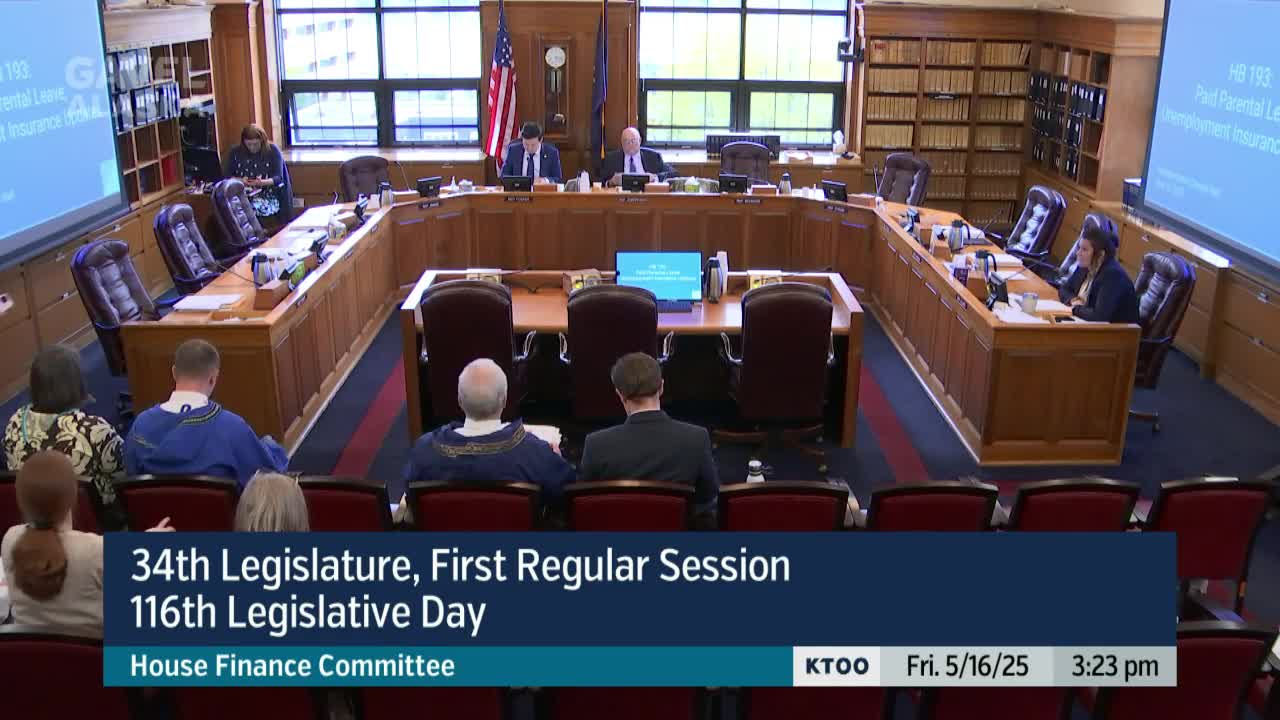
Summary
Lawmakers and witnesses debated House Bill 193, which would create a paid parental leave program (8–26 weeks) funded by redirecting portions of existing unemployment insurance contributions into a new special fund; department actuaries presented stress tests and cost ranges, and the committee set the bill aside for further work.
Representative Carolyn Hall, sponsor of House Bill 193, told the House Finance Committee on May 16 that HB 193 would create a paid parental leave plan and update Alaska's unemployment insurance (UI) program.
The measure, Hall said, would allow the Department of Labor and Workforce Development to set paid parental leave between eight and 26 weeks, provide an accelerated option that pays double the benefit for half the time, and establish a separate paid parental leave fund financed by new “special” employee and employer contributions rather than the state general fund.
The bill also proposes increasing the maximum weekly benefit cap for UI-style payments to $817, indexing dependent benefits (raising the dependent allowance from $23 to $72), and raising the taxable wage base to $85,000. The department would conduct actuarial reviews of the new paid parental leave fund every two years, Hall said.
Paloma Harbor, director of the Division of Employment and Training Services at the Department of Labor and Workforce Development, and Lennon (Lennon) Weller, the department economist and UI actuary, gave the committee an overview of the financing and solvency analysis. Weller said the department ran stress-test scenarios modeled on deep recessions—“three times what we’re currently experiencing in benefit costs”—and showed that while reserve ratios would drop, the UI financing system includes mechanisms (employer tax-rate adjustments and a snapback feature) to restore solvency over time.
Weller said the department currently measures reserve ratio as the trust fund balance as a percentage of wages covered by the program and that Alaska’s reserve ratio was about 4.7% going into 2025; the statutory long-term target is roughly one-third of wages (33.3%). Weller told the committee the stress test showed peak single‑year benefit costs in an extreme scenario could reach about $350 million; in ordinary years the bill’s changes would not immediately exhaust the fund, he said.
Under the bill’s financing plan explained by Hall and staff, the employee contribution would be redirected in part (0.15 percentage point of taxable wages) from UI to the new paid parental leave fund. The bill also authorizes the department, based on actuarial analysis, to collect a new employer special contribution (example figures discussed were 0.20% for the paid parental leave fund and 0.10% for STEP in some scenarios), and to reduce or restore employer UI rates as needed (a “snapback”) if fund solvency is threatened.
Witnesses urged different emphases. Trevor Storrs, chief executive officer of the Children’s Trust, described paid family and medical leave as “primary prevention,” arguing it improves child and maternal health outcomes and reduces reliance on public assistance. “Paid family medical leave is an investment in Alaska’s families, children, and communities,” Storrs told the committee. Paloma Harbor and Weller provided technical responses on eligibility, actuarial assumptions and how benefits would be calculated; Weller said the department ran alternate cost estimates that ranged from roughly $12 million up to about $46.8 million in more likely scenarios for typical usage and about $175 million in an extreme full‑take (26‐week, near‑universal take) parental‑leave scenario for a single year.
Public testimony included Julie Cleeton, chair of the Alaska Public Health Association policy committee, who urged passage and cited public‑health research linking paid leave to reduced preterm births and improved maternal mental health. Mike Lawrence Wessel called HB 193 a “no” on fiscal and policy grounds and warned diverting contributions could complicate future UI payouts; he urged the committee to reject the bill.
Committee members asked detailed operational questions about eligibility (the bill would use a UI‑style base‑period wage test, with a $2,500 minimum earnings threshold in the base period), how weeks would be set (the department would set maximum weeks annually based on fund health), coordination with employer short‑term disability and PTO, how the program would treat both parents, and tax‑withholding mechanics. Staff said the department issues 1099‑G forms for UI payments and that the tax treatment and withholding logistics for the new benefit will require further review.
Representatives pressed the Department of Labor for actuarial tables, take‑rate assumptions and the stress‑test model; department staff said they would share the analysis. Several members expressed concern about small businesses’ ability to cope with long absences and about how the benefit would be coordinated with existing short‑term disability and employer policies.
After extended discussion and three fiscal notes presented by the Department of Labor and Administration, the committee set HB 193 aside for additional work and materials. Committee staff and department officials will provide the requested actuarial tables and updated fiscal material when the bill returns to committee.
Ending: Committee members and witnesses agreed more actuarial detail, clarified regulatory mechanics (tax withholding, coordination with private disability/PTO and employer contributions), and an updated fiscal note are needed before the committee resumes consideration; HB 193 was set aside to allow that follow‑up.