
House committee advances bill limiting interchange fees after raising bank-asset exemption to $20 billion
Get AI-powered insights, summaries, and transcripts
Subscribe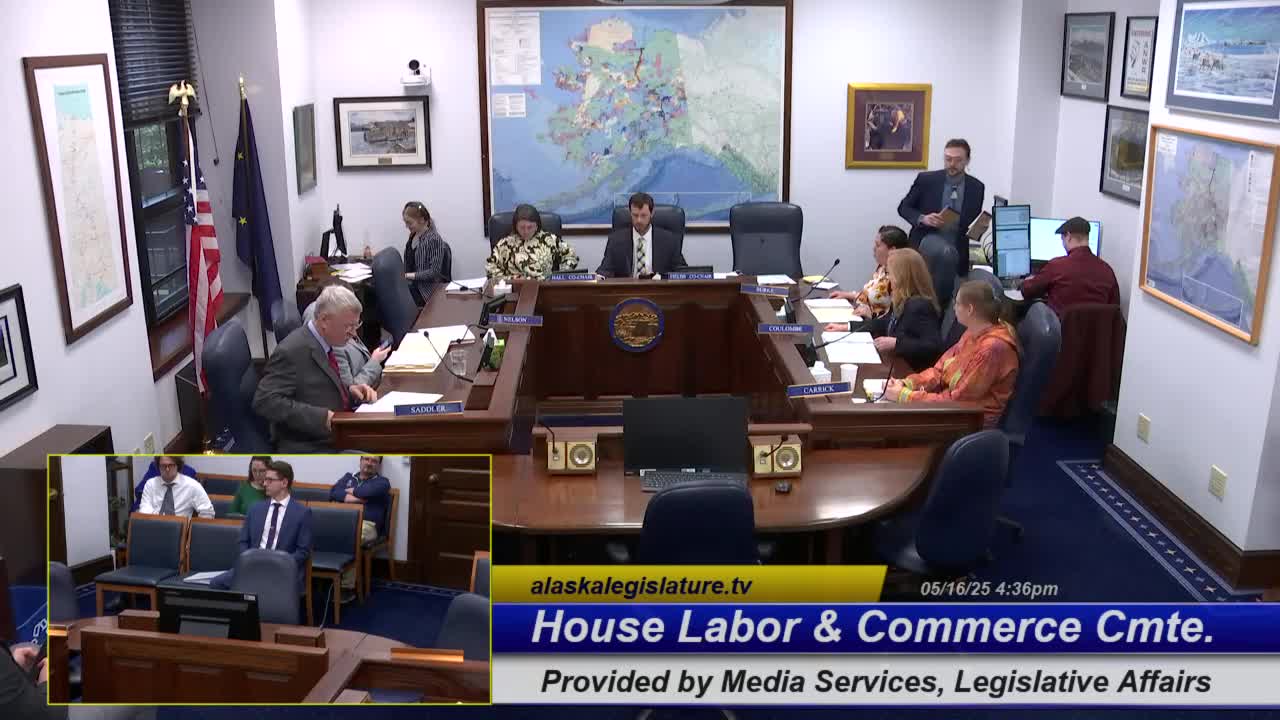
Summary
The House Labor and Commerce Committee reported Senate Bill 79 out of committee after adopting an amendment that raises the bank-asset exemption from $10 billion to $20 billion; state banking regulator warned of implementation, compliance and consumer-protection risks if the law is enacted without further review.
The House Labor and Commerce Committee voted 4-3 to report Senate Bill 79 out of committee on a conceptual amendment that raises a bank-asset exemption threshold to $20,000,000,000.
The committee acted after testimony and an amendment intended to protect smaller Alaska financial institutions from unintended consequences of new limits on interchange fees that the bill targets. Senator Bjorkman said the change is “designed … to make sure that our state banks will not have a force that pushes them toward federally chartering,” and that the amendment seeks to preserve state-collected fees and assessments.
The bill’s backers say it is aimed at reducing interchange fees that can cut into restaurant and service-worker revenues. Senator Bjorkman told the committee the legislation would “save money for our local businesses and local wait staff who are currently having their revenue eaten into by these interchange fees.” The amendment the committee adopted moved the asset threshold up from $10 billion to $20 billion after members said the original number risked capturing midsize Alaska institutions.
But the Division of Corporations, Banking and Securities raised multiple concerns about implementation and enforcement. Director Schmidt told the committee he is “concerned” about the operational requirements the bill would impose on the global payment ecosystem, including the need for payment processors and thousands of card-issuing banks worldwide to accept new data elements. He said publicly available estimates indicate “320 credit card transactions in Alaska per minute,” and warned that statutory penalties could produce large exposures if processors or issuers misapply the rule. Schmidt also said state-chartered banks such as Northrim, Denali State Bank, Mount McKinley State Bank and First Bank “all would fall below a $10,000,000,000 threshold.”
Members pressed for clarity about which institutions would fall under the exemption. Committee discussion cited a figure of about $12 billion in assets for one large Alaska credit union; legislators and witnesses acknowledged some uncertainty about exact asset sizes and said a $20 billion cutoff would avoid unintentionally capturing local banks.
Representative Paul moved to report the bill out of committee as amended and with accompanying fiscal notes; the roll call recorded four yes votes (Burke, Kerrick, Hall, Fields) and three no votes (Sadler, Nelson, Colom). The committee authorized Legislative Legal to make technical and conforming changes.
The committee also discussed testimony from national trade groups and from online witnesses representing the National Restaurant Association. Dan Swanson and Brandon Ducker of the National Restaurant Association joined the committee online, according to the record.
The committee did not finalize an implementation timeline; members asked staff and regulators to follow up on the fiscal note and on operational questions raised by Director Schmidt. The bill will move forward from committee with the $20 billion threshold in place and with requests for additional fiscal and implementation detail.