
Ann Arbor building appeals board tables stair-variance request for fraternity house for 60 days
Get AI-powered insights, summaries, and transcripts
Subscribe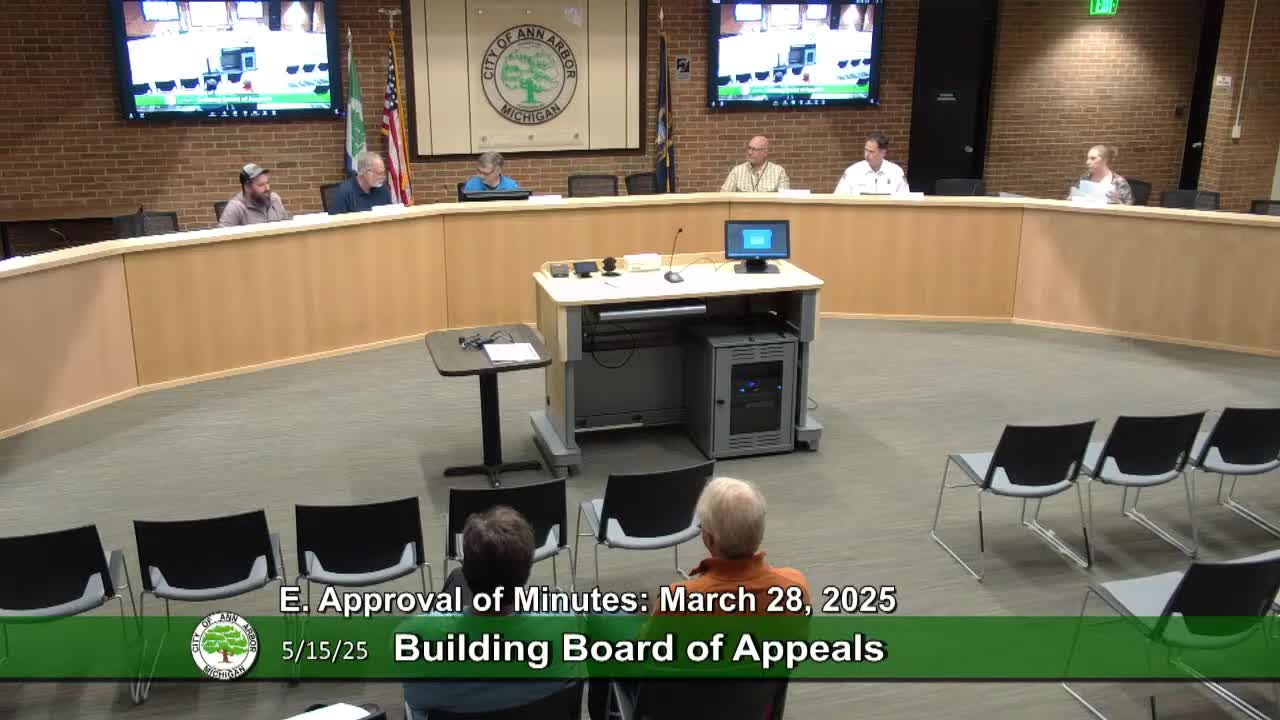
Summary
The Ann Arbor City Building Board of Appeals on May 15, 2025 voted to table an appeal by the owner of a multi‑story rental property seeking relief from tread depth and riser-height requirements so the applicant can supply additional structural drawings, an occupancy load for the basement recreation room and a revised plan for review.
The Ann Arbor City Building Board of Appeals on May 15, 2025 voted to table for 60 days an appeal (BBA 25007) by the owner of a multi‑story rental property seeking variances from stair riser and tread-depth requirements.
The appeal concerns the main stair connecting the building’s first floor and basement, used for frequent events and daily traffic. The applicant and architect proposed a narrower tread and a slightly increased riser to create a wider, less steep stair profile in the only available footprint; board members and staff said they need more documentation before granting a variance.
The proposed changes are meant to replace an existing, steep stair with risers the architect described as “8 and 5 sixteenths with a 9 inch tread,” and to install a new stair with a 7 1/4‑inch riser and a 10‑inch tread plus a 3/4‑inch nosing. Architect Dwight Hendricks said the request includes “just 1 quarter of an inch, of height variance from the 7 to 7 and a quarter riser” so the design can fit within the building’s fixed structural elements and improve safety.
Why it matters: the stair serves a basement recreation area used for large gatherings. Staff and board members flagged related issues—egress paths, handrail terminations, fire‑rating continuity of doors in the stair path, and the occupancy classification for the basement—that could change whether the design requires more extensive revisions or additional code work.
Board members and staff pressed the applicant to provide information the board said is necessary for inspection and a final determination. Staff asked for structural drawings showing the locations of beams and columns; a clear plan showing handrail extents; a proposed occupant load for the basement recreation room; and confirmation of how the stair and doors affect any required fire rating or rated corridor. One staff member summarized the procedural consequence: if the applicant substantially reconfigures the plan, “we would need a new plan review” and those noncompliant elements would be identified through that review and, if necessary, returned to the board.
Discussion details
- Existing condition and proposed change: Dwight Hendricks said the existing stair is “extremely steep” and slippery, with metal nosing over concrete. He said the building is heavily built with steel beams and recent HVAC work that prevent creating a code‑compliant landing in the only available space. He explained the proposed stair would use a 7 1/4‑inch riser and 10‑inch treads (plus nosing) and argued that change would markedly improve safety over the existing configuration.
- Structural constraints: Multiple speakers noted a main carrying beam and HVAC ductwork that prevent moving or reconfiguring the stair run in the available footprint. Board members and staff repeatedly asked for structural drawings showing beam locations so reviewers and inspectors can evaluate what changes are feasible.
- Handrails and guards: Staff flagged that the proposed layout might require handrail extensions or guard adjustments that themselves would need variances. One reviewer warned that approving a limited variance now could produce field inspection failures later if handrail terminations or clearances are not resolved on the approved plan.
- Fire rating and doors: Staff and the applicant discussed whether the stair and the door at the top of the stair are part of a fire‑rated path. Staff asked whether removing or altering the door would create additional fire‑rating or egress issues. A participant noted older, existing doors may contain wired glass and be nonconforming; staff said those historical conditions complicate the analysis and that the submitted plan should clarify rating and smoke‑and‑egress paths.
- Occupancy and use: The applicant and a representative who manages the facility said the basement is used for social events and that University of Michigan fraternity practice (as cited by the representative) favors one door in/one door out to control access for events. Staff and board members cited code thresholds for assembly use; a planner noted that spaces over 49 occupants are typically treated as assembly occupancy, which carries different egress and door‑count implications. The applicant was asked to propose a specific occupant load for the basement as part of the resubmittal.
Board action and next steps
The board voted to table the appeal for 60 days so the applicant can provide updated plans and documentation. The motion to table passed on an affirmative voice vote reported as 3–0. The board requested the applicant submit:
- Structural drawings showing beam and column locations that constrain stair geometry; - A clarified proposed plan that shows handrail/guardrail details and how handrails will terminate relative to the last tread; - A proposed occupant load for the basement recreation/assembly space and any calculations supporting that number; - Clarification of which doors and stair elements are intended to be fire rated and how those rated assemblies connect to the approved egress path.
Staff told the applicant that the changes discussed likely require a new plan review; if so, plan review findings would identify additional noncompliant elements and the applicant could then return to the board with a revised variance request if needed. Staff also offered to perform a quick review once the applicant submits revised drawings and noted the board’s next scheduled meeting falls on Juneteenth and may be canceled, so a later meeting in July could be the next available full hearing date unless the applicant requests a special meeting.
The board’s tabled action leaves the variance unresolved; no variance was granted at the May 15 meeting. If the applicant submits a plan that is fully code compliant, the board noted no variance would be necessary and the project could be approved through plan review without returning to the board.
Quotes
“We’re basically asking for just 1 quarter of an inch, of height variance from the 7 to 7 and a quarter riser,” architect Dwight Hendricks said, describing the limited adjustment that would allow the proposed stair geometry.
“If the variance is approved, we just need something to go by,” a staff reviewer said, noting that inspectors require an approved plan that shows the changes to be inspected in the field.
Outcome
Motion to table the appeal for 60 days: passed, vote tally 3–0 (yeas recorded by board members Paul Darling, Kevin Cox and Bob Hart). The applicant will return with the requested documentation or may petition for a special meeting if the applicant can complete the revised plan review earlier.