Get Full Government Meeting Transcripts, Videos, & Alerts Forever!
Get email alerts on the Caltrain Electrification Funding topic
No spam. Unsubscribe anytime.
Caltrain electrification boosts ridership but agency warns of a $75 million operating gap
Summary
Caltrain’s electrification and increased off‑peak service have drawn riders back to the corridor, but the Peninsula Rail Joint Powers Board says long‑term operating revenue remains inadequate. Executive Director Michelle Bouchard told the California Transportation Commission that Caltrain faces a projected average annual deficit of roughly $75
Caltrain’s electrification and service increases have produced sustained ridership gains, but the rail operator told the California Transportation Commission that operating revenues remain insufficient to cover long‑term costs.
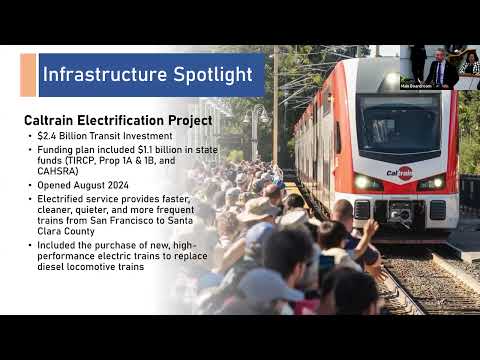
Michelle Bouchard, executive director of the Peninsula Corridor Joint Powers Board (Caltrain), told commissioners the agency has “almost reached the million‑rider mark every single month” after launching electrified trains and moving to half‑hour service on many off‑peak runs. She said the railroad’s customer experience improvements—Wi‑Fi, power outlets, and faster service—have driven growth, especially on off‑peak and weekend trips.
But Bouchard said the agency projects an average annual operating shortfall of about $75 million over the coming decade under current funding assumptions. Caltrain historically relied on fares for a large share of operating costs; the pandemic lowered farebox recovery and pushed transit systems to seek new revenue sources.
Caltrain described several strategies to stabilize finances: local and regional funding partnerships, fare policy changes, commercialization of non‑fare assets (real estate, fiber, energy storage), and cost containment tied to operational efficiencies from electrification. Bouchard said those revenue diversification efforts will not eliminate the shortfall by themselves and that regional contributions will likely be needed to maintain frequent service.
On safety and capital work, Caltrain highlighted its grade‑crossing program and a pilot use of an AI‑based sensor system to detect risky vehicle behavior and target low‑cost countermeasures. Bouchard said targeted installations of bollards and markers have eliminated dangerous incidents at pilot crossings and that full grade separation remains expensive: “we are seeing pricing coming in at, you know, just sub $500 million” for large separations, requiring careful assessment of constructability and funding.
Commissioners praised the electrification project and the agency’s outreach. Past Chair Gardino, who took the morning tour, called Caltrain’s upgrades “a great investment” and said the corridor’s performance and development around stations were visible results of the investment.
Caltrain reported an 82% favorability rating in recent polling of riders and residents along the corridor, a metric the agency said it hopes to leverage if regional funding measures are pursued.
No formal commission action was required; the item was informational. Caltrain told the commission it will continue to pursue regional partnerships, revenue diversification and community outreach to support operations and future capital work.