
Committee advances ordinance tightening rules for vacant and abandoned properties
Get AI-powered insights, summaries, and transcripts
Subscribe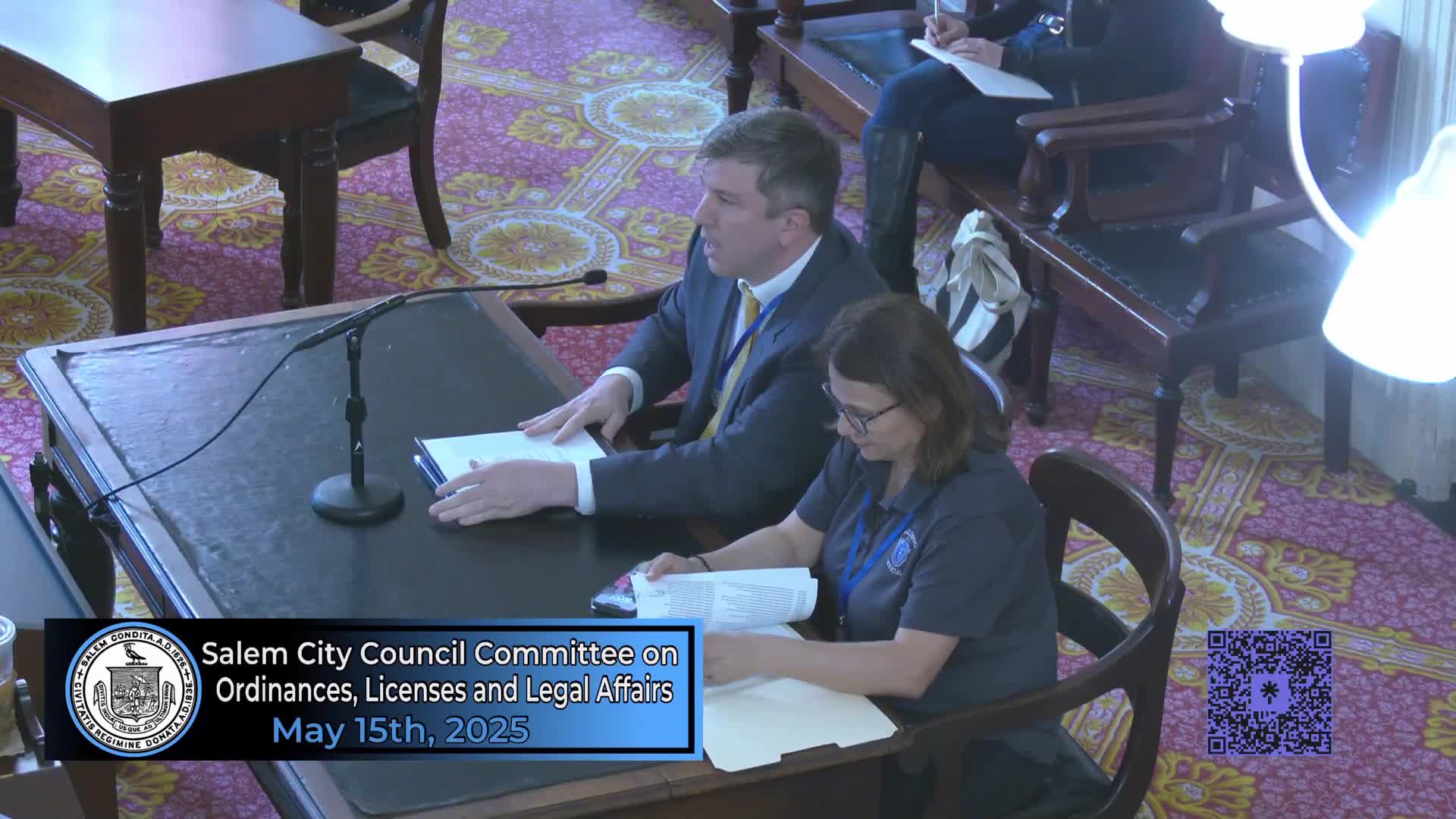
Summary
Salem City’s Committee of the Whole voted May 15 to send a revised ordinance to the full council that expands registration and enforcement for vacant and abandoned properties, including a $300 per‑day fine for failure to maintain a registered property.
Salem City’s Committee of the Whole voted May 15 to send a revised ordinance to the full council that expands the city’s tools for addressing long‑term vacant and abandoned properties, including a new registration requirement, posted contact information, and daily fines for failures to maintain properties.
The ordinance is intended to target properties “that aren’t being maintained that are a nuisance and a blight to the neighborhood,” Assistant City Solicitor James Welak told the committee, adding the draft now defines “vacant” and focuses on properties that are unoccupied and not the subject of an active building permit. “The target of this ordinance is those properties aren’t being maintained that are a nuisance and a blight to the neighborhood,” Welak said.
Why it matters: Committee members said abandoned and vacant properties have required repeated department responses — police, health, fire and building inspectors — and that the city currently lacks a centralized way to track calls, inspections and owners. The revised ordinance would require owners or local agents of vacant properties to register annually, post a contact person on the property, update contact information, and respond to city communications within prescribed timeframes. Failure to maintain a property as required would be punishable by a $300 fine per day.
Key provisions and how they changed • Definition of “vacant”: The draft adds a definition stating vacant means a property “that is not legally occupied and is not the subject of an active building permit.” Committee members clarified an active building permit generally expires after 180 days unless extended for ongoing work.
• Scope of covered properties: The ordinance removes an earlier trigger tied to the start of foreclosure and instead covers properties that have been vacant or that show signs of abandonment such as broken windows or unsecured doors for more than 45 days. The language applies to residential and commercial properties.
• Registration and contact posting: Owners of vacant properties must register and provide a local contact (property manager or agent) whose information must be posted at the property so inspectors and first responders can identify who to contact. The registration may become a municipal lien if unpaid.
• Enforcement and penalties: The draft sets enforcement language in section 12‑71 and removes the phrase “up to” from the $300/day fine language so the violation is described as punishable by a fine of $300 per day for each continuing offense.
What staff and councilors said James Welak, Assistant City Solicitor, said the change away from a foreclosure trigger narrows focus to properties that are truly vacant or a blight, including foreclosed houses that are nonetheless occupied during foreclosure. Vula Devarulis (city staff) and a City staff member identified as Bill presented a cost analysis that estimated staff time per property might range from about 5 to 40 hours per year depending on calls and compliance and that the city currently charges $300 annually (a rate the proposed ordinance increases).
Councilors asked about appeals, police notification, city‑owned properties and receivership. Welak said appeals would go to the municipal hearing officer under Chapter 40U and that the ordinance would help with receivership proceedings by making it easier to document last known contacts for owners. Staff said the city uses a monthly “problem properties” meeting among departments to coordinate responses and that proposed registration software would allow police officers in patrol cars to see whether an address is registered as abandoned when they respond.
Public comment and next steps Multiple councilors and a public commenter urged care with exemptions for institutional uses such as churches and former school buildings; the ordinance’s definition includes nonresidential properties and committee members discussed how condemned or formerly institutional properties (for example, St. Anne’s School was mentioned during discussion) would be treated where windows or doors are broken or a building is otherwise vacant for more than 45 days.
On a motion by Councilor Cohen, seconded by Councilor Morsolla, the committee voted to forward the redlined ordinance with the amendments discussed (including removal of the phrase “up to” in the fine provision) with a positive recommendation to the full council. The committee carried the matter to the council for final action.
The council will consider the ordinance on the council floor; the committee noted that the revisions are meant to be an additional tool alongside existing building‑code enforcement and receivership processes.