Get Full Government Meeting Transcripts, Videos, & Alerts Forever!
Get email alerts on the Public Health topic
No spam. Unsubscribe anytime.
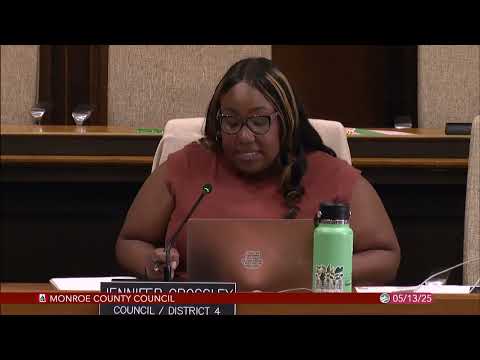
Monroe County Council tables health department request for fourth disease-intervention specialist amid contract uncertainty
Summary
Monroe County Council on Tuesday delayed approving a fourth disease intervention specialist (DIS) after health department staff said the state’s March award letter for an extra $58,835 was not an executed contract and the county auditor advised waiting for a formal amendment before appropriating funds.
Monroe County Council on Tuesday delayed approving a fourth disease intervention specialist (DIS) position requested by the Monroe County Health Department, citing the absence of an executed state contract backing the additional federal funding.
The council’s action followed months of shifting grant guidance and a March award letter from the Indiana Department of Health (IDOH) notifying the county it was eligible for an additional $58,835 to support a fourth DIS. Health Department representatives said they have a signed contract covering three grant-funded DIS positions but not yet the amendment that would add the fourth position and that IDOH does not expect to issue amendments until the state’s fiscal year opens July 1.
Why it matters: Disease intervention staff perform case investigation and contact tracing for sexually transmitted infections and other reportable diseases. The county’s request touches funding that mixes state- and federally‑sourced public‑health grants and requires clear contract authority before the county changes payroll or appropriates new recurring salary costs.
County health director Lori Kelly told the council the department already has an executed IDOH contract for $289,000‑plus covering three DIS positions and that the March award letter would add $58,835 for a fourth position. “We have received an executed contract for the budget that we submitted that was approved,” Kelly said, and “when we received this contract, the first move was to move that employee to the contract so that he could begin assisting with the entire district.” Kelly said the department would prefer to hire if the money is guaranteed, but acknowledged the award letter “is not a contract.”
Councilors raised two consistent concerns: the auditor’s best‑practice guidance to avoid appropriating funds until the county holds a fully executed contract, and the recent statewide budget and health‑fund changes that have reduced predictability in public‑health funding. At the meeting Auditor’s Office staff reiterated the recommendation that the county not appropriate or hire against awarded amounts until a fully executed contract is in hand, citing Monroe County code procedures for contract‑backed appropriations.
“What we need is it in a contract,” Councilor Peter Iverson said. “A letter is helpful and gives us a lot of information, but it is not a guarantee of funding. We need it in a contract.”
Council action and next steps: Councilor Iverson moved to table the Health Department’s request indefinitely (the motion was seconded). A roll‑call vote resulted in the council tabling the request; the motion carried 4–3. Related budget items were handled separately: council later voted to table a deappropriation tied to the same set of positions (motion passed 5–2), while approving two other personnel and account‑line swaps the department requested to comply with recent Indiana program rules.
Health department context and practical effect: Kelly and other staff explained that hiring and training a DIS can take three to six months and that the department has used a mix of state Health First Indiana (HFI) and federal CDC‑funded STD program dollars. Staff said HFI funding is intended to support Monroe County‑specific services and is already budgeted; the additional $58,835 described in the IDOH award letter is federal STD funding administered through the state. The department told council it could, if authorized by council, use HFI funds temporarily to hire the fourth position and then “backfill” those HFI dollars with the federal grant once a contract was executed and funds were received.
Councilors emphasized the limits of local authority and the need for written contract terms before changing county payroll or obligating ongoing salary lines, and asked staff to return with an executed amendment or other definitive contract documentation. The council directed staff to return with the contract and related clarifications at a future meeting before taking final appropriation action.
Ending: The council’s tabling leaves the Health Department able to plan and interview candidates but prevents the county from permanently changing payroll lines or appropriating the federal award until IDOH provides an executed contract or the council otherwise authorizes use of existing HFI funds with a plan to reconcile once the contract arrives.