Get Full Government Meeting Transcripts, Videos, & Alerts Forever!
Get email alerts on the Capital Projects Sustainability topic
No spam. Unsubscribe anytime.
Lafayette outlines sustainability upgrades for three aging city facilities; council to decide May 27
Summary
City of Lafayette staff on the evening presented conceptual, sustainability-focused plans for three capital projects — the Bob Burger Recreation Center, a proposed Civic Center and the city Service Center — and told residents the city will bring compiled public feedback and poll results to City Council on May 27 for a decision about whether to pursue financing or a ballot measure.
City of Lafayette staff on the evening presented conceptual, sustainability-focused plans for three capital projects — the Bob Burger Recreation Center, a proposed Civic Center and the city Service Center — and told residents the city will bring compiled public feedback and poll results to City Council on May 27 for a decision about whether to pursue financing or a ballot measure.
The presentation, led by city staff and sustainability staff, emphasized that the three sites are largely at the end of their useful lives and that rebuilding or renovating them presents opportunities to reduce greenhouse-gas emissions, lower energy and water use, and improve resilience. “We chose these 3 projects because, while we have a lot of different assets that will be needing to evaluate, these 3 are largely at the end of their lifespan and are very public facing and serve the majority of our residents,” said Megan, a city staff member who presented the designs.
City staff provided high-level cost and timeline estimates: the proposed work on the recreation center and the Civic Center together is roughly $34 million, the Service Center was estimated at just over $6 million, and staff reported an estimated annual debt-service figure of about $5.9 million if all projects move forward. If voters approve funding, staff said the Service Center design would take about six to nine months and the recreation and civic center designs would each take about 12 to 18 months, with further community engagement during the design phase.
Bob Burger Recreation Center: condition and options The presentation described the Bob Burger Recreation Center (BBRC) as roughly 46,000 square feet with annual site energy use reported at about 1.2 million kilowatt-hours (figure given as approximate). The facility currently has roughly 70,000 kWh of on-site solar thermal production used for pool water heating and additional solar subscriptions through third‑party solar gardens. Heating and cooling now rely on gas rooftop systems and aging boilers; staff said the natatorium and building envelope show the deficiencies common to a 1980s building, including leaky windows and roofing junctions. Staff noted a major pool leak last summer that required a roughly six‑month closure and removal of concrete to repair the aquatic system.
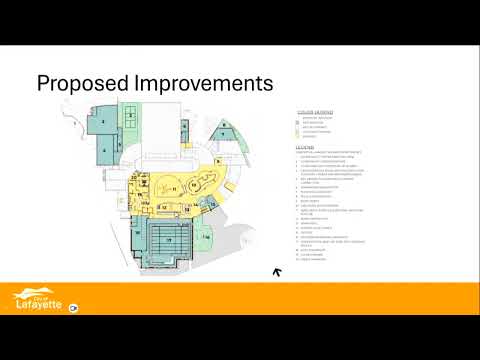
Concept sketches presented include an approximately 30% expansion, rebuilding the aquatic center (new lap pool, reconfigured leisure pool and lazy river, therapeutic area), a consolidated mechanical room, new locker rooms, additional fitness and community spaces, rooftop outdoor fitness, and an indoor hot tub retained in the concept. The city said these plans are schematic only and will require detailed engineering, further community input and trade‑off analysis.
City Hall / proposed Civic Center Staff showed a conceptual Civic Center site north of South Public Road near the RTD park-and-ride and described a new council chamber sized for a community of about 30,000 residents, municipal court space moved from the police station, and public-facing offices for planning, permitting and other services. The existing City Hall was described as under 20,000 square feet with an annual energy use figure given at about 45,000 kilowatt-hours and a roughly 20‑year‑old gas rooftop unit; staff said parts of the building still lack LED lighting and have unsealed, single‑glazed windows.
Service Center: operations, hazards and electrification needs The Service Center — home to public works, parks operations and fleet maintenance — was described as roughly 36,000 square feet with reported annual energy use around 166,000 kWh and currently no on‑site renewable energy. Staff said the site lacks enough electrical capacity for current needs, which would have to be upgraded before major electrification (for example, electric fleet vehicles) could be added. The existing building is largely uninsulated, operates 24/7 in parts, and staff reported burst pipes and winter vulnerability; the schematic plan includes enlarged bays, improved building envelope, consolidated offices, showers and centralized staff spaces.
Sustainability measures under consideration Staff tied the projects to Lafayette’s Climate Action Plan and to adopted codes and standards. They said Lafayette has adopted the 2021 International Energy Conservation Code (IECC) and local electric‑ready/solar‑ready code language designed to make new buildings easier to electrify. Staff described a portfolio of options to be evaluated during design: on‑site solar versus subscription purchases, geothermal heat‑pump systems at new builds, electrification of heating and pool systems where feasible, high‑performance envelopes and LED lighting and controls, regenerative pool filtration and backwash reductions, water reclamation at the Service Center, xeriscaping and nature‑based stormwater solutions (bioswales and rain gardens), and material sourcing and demolition‑waste diversion following LEED best practices. A sustainability intern working with ICLEI is conducting a resilience‑hub study that includes the BBRC among six candidate locations.
Tradeoffs, public concerns and next steps Meeting attendees raised tradeoffs staff will have to weigh: preserving the BBRC’s outdoor hot tub and the facility’s relatively low fees compared with other regional centers; the loss of open green space where a Civic Center might sit; concerns about added impervious surface and heat‑island effects; and questions about who will pay for operations and whether user fees will rise. Staff said the city is conducting a parks, recreation and golf fee study and that no specific fee increases are currently proposed as a condition of construction. The presenter also cited examples from other jurisdictions of up to 30–40% reductions in electrical costs after installing modern pool pumps and recirculation systems.
Staff outlined the immediate process: the city completed community polling and an open survey (survey stated to be open until the day after the meeting); staff will compile feedback and present results to City Council on May 27. Council will decide whether to move forward, pause or select particular projects; if Council authorizes a ballot measure and voters approve, funding would allow the city to start detailed design and the community engagement described above. Questions about microgrid operation, larger-scale backup generation and specific solar procurement options were noted as topics that will be resolved in later technical design phases or by subject experts.
For more information and to submit comments, staff provided a survey link and an email: communications@lafayetteco.gov.gov.