Get Full Government Meeting Transcripts, Videos, & Alerts Forever!
Get email alerts on the School Construction Neary Nheri topic
No spam. Unsubscribe anytime.
Neary committee weighs surveys, public forums and alternate plans after failed school vote
Summary
The Town of Southborough Neary Building Committee reviewed the recent special town meeting and ballot results, clarified Massachusetts School Building Authority rules and proposed a mix of surveys, public forums and costed alternate options while reminding residents the town must notify the MSBA within 10 business days.
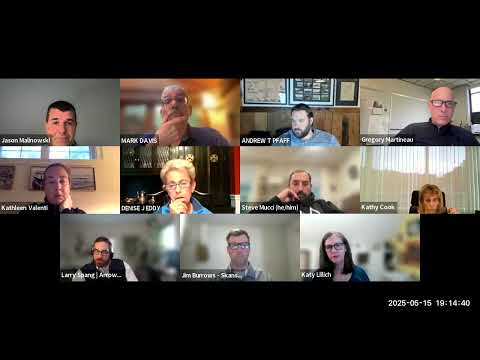
Neary Building Committee Chair Jason, speaking at the committee’s May 15 meeting, said the panel will not make a final decision but will develop recommendations for elected boards after the recent special town meeting and subsequent ballot vote on the proposed Neary (NHERI) school project.
The committee focused on next steps for the Town of Southborough now that voters rejected the town’s MSBA-funded schematic plan, and members emphasized the legal and scheduling limits imposed by the Massachusetts School Building Authority (MSBA). “Any iteration or alteration to the plan that they have approved … would take us back to the statement of interest phase,” Jason said, adding the committee remains inside the MSBA’s 120-day window and must send a formal letter within 10 business days reporting the vote and a plan for next steps.
Why this matters: The MSBA funding and process shape what the town can do next. If Southborough alters the approved project’s site, size or scope it would need to re-enter the MSBA application process and likely forfeit MSBA participation in certain pre-construction phases, committee members said. The MSBA award discussed on the call was described as roughly $35,000,000 of state participation.
At the meeting the committee and members of the public sketched a path forward focused on three immediate tasks: (1) clarify whether the Neary/NHERI site remains acceptable to enough voters to support a future project, (2) develop a short community outreach plan to gather input on preferred alternatives, and (3) cost out a small menu of realistic options — including renovation, phased repairs or alternative sites — so residents can compare “apples to apples.”
Committee members debated formats for gathering input. Several members supported a concise survey to quickly test whether the Neary site is a ‘‘nonstarter’’ regardless of scope. “I’m very much in favor of a very simple survey to start simply related to the site,” one committee member said. Other members and residents urged in-person forums and more extensive, costed alternatives before asking voters to consider another article on the warrant.
Public commenters at the meeting reinforced the committee’s priorities: many said voters declined the proposal because of the project’s overall cost and concerns about taxation, not the educational vision. “Something must and will be done. I don't think people fully grasp that doing nothing at Neary is not an option,” said Gina Glazimitzky, a parent who spoke during public comment. Other residents urged clearer, more accessible messaging about what each option would mean for taxes and for students’ learning environments.
The committee also heard technical clarifications from project team representatives: (1) MSBA staff told the town that any change to address, size, or scope would restart the MSBA process; (2) MSBA staff indicated the town could, in principle, present a locally funded alternative in parallel with an MSBA-funded proposal subject to MSBA legal review of the warrant language; and (3) extensions to the MSBA 120-day submission requirement are possible but handled on a case-by-case basis and the staff on the call did not have authority to grant extensions.
Members discussed specific outreach and decision designs: a phased approach (initial survey, community forums, then a fully costed menu), ranked-choice ballots at a pair of information forums followed by a special town meeting, and a plan to involve other town boards — particularly the Select Board and School Committee — sooner rather than later. Several committee members and residents suggested recruiting community ambassadors to broaden outreach and urged plain-language explanations of educational features and their cost implications.
Formal committee actions on May 15 were limited to administrative votes: the panel approved April 5 and May 5 meeting minutes by a 6–0 roll-call vote and later voted to adjourn. The committee did not vote on a single next-step plan but agreed to bring a consolidated summary to the Select Board and invite the School Committee to Tuesday’s Select Board discussion.
Looking ahead, the committee outlined immediate next steps: draft and test a short site-focused survey and prepare a consolidated summary to present to the Select Board and School Committee; determine whether to request an MSBA extension if more time is needed; and advance a small set of fully costed alternatives to present to voters for a future decision.
The committee’s discussion emphasized process limits and transparency: several members warned that any future proposal that changes site or scope will likely require restarting the MSBA application and that accurate, comparative cost information — including the town’s net tax impact — will be essential for any successful outreach and subsequent vote.