
Capitola council reviews balanced draft budget, flags CalPERS costs and reserve gap
Get AI-powered insights, summaries, and transcripts
Subscribe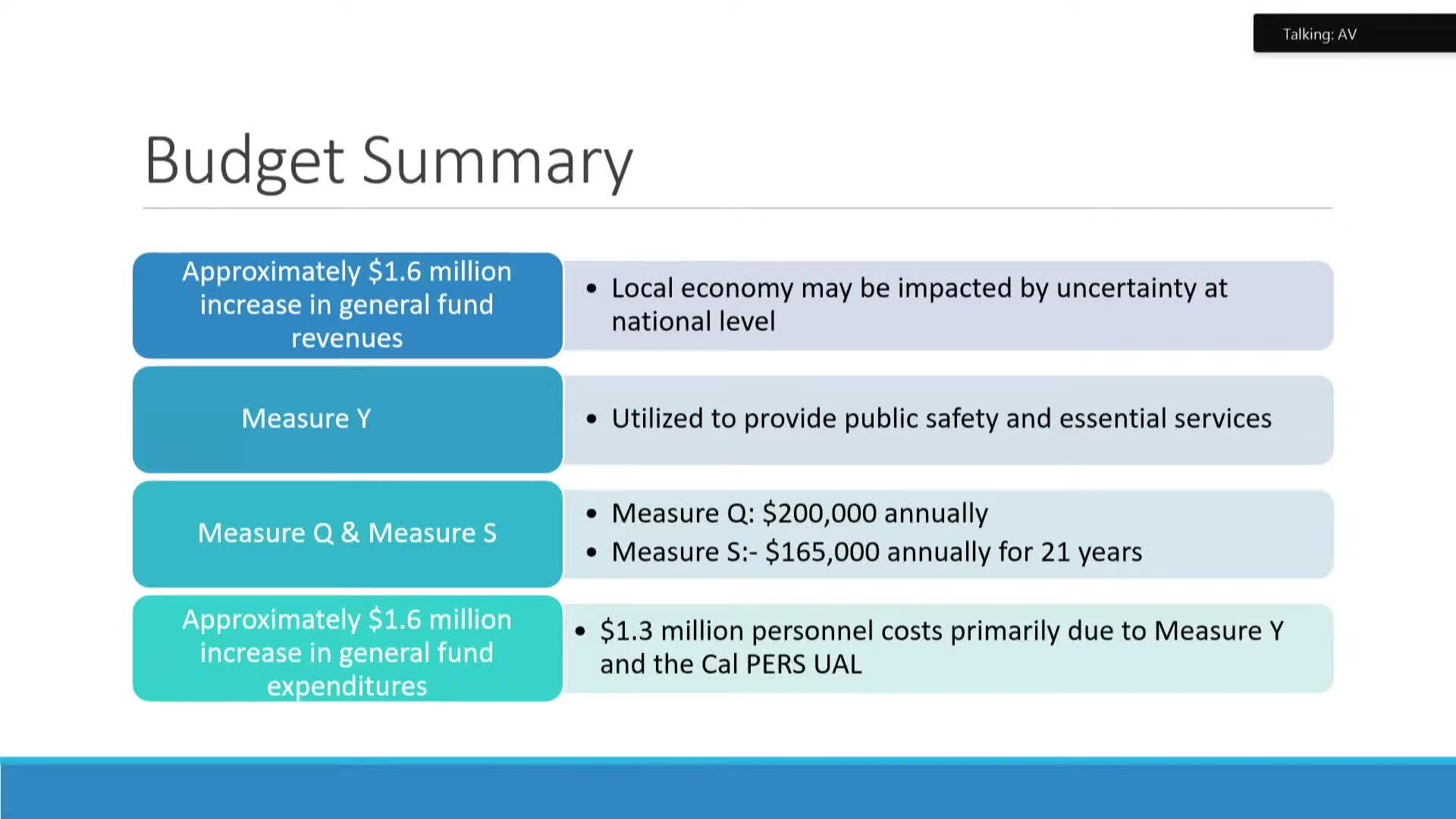
Summary
City staff presented a structurally balanced draft general fund budget that uses new local tax measures but projects reserve shortfalls and rising CalPERS pension costs, prompting requests for follow-up analysis and regular reporting.
Capitola City Council members on Thursday heard a presentation on the proposed fiscal year budget that staff said is structurally balanced for the next one to two years but faces significant medium‑term pressures from pension costs and reliance on sales and transient occupancy taxes.
Jamie, a staff presenter, told the council the draft budget anticipates about $1,600,000 in additional general fund revenues and incorporates revenues from Measure Y plus two smaller ballot measures. The presentation shows about $1,600,000 in increased general fund expenditures, with roughly $1,300,000 of that tied to personnel costs and the city’s unfunded actuarial liability to CalPERS.
The nut of the presentation: the budget balances this year but projected reserves fall below target in the out years if current assumptions hold. Staff said the city still expects to seek approximately $800,000 in storm damage reimbursements from FEMA and Cal OES that could be used to rebuild reserves if recovered.
Councilors pressed staff for more detail on the CalPERS projections and reserve recovery plans. “We are about 18 months behind on when we know the actuarial payment,” Jamie said in describing the timing of CalPERS actuarial reports. Council members asked for a clearer, single‑line presentation of the city’s CalPERS unfunded actuarial liability (UAL) and for staff to separate recurring personnel costs from the UAL so changes year‑to‑year are transparent.
Staff also proposed a modest, $20,000‑a‑year parametric earthquake insurance policy to provide quick cash after an earthquake rather than waiting for reimbursement claims. Jamie described the policy as a pilot approach being pursued jointly with several nearby cities to provide immediate liquidity if the ground motion trigger is met.
Other budget notes included: the inclusion of Measure Y revenue targeted to public safety and essential services; Measure Q estimated at $200,000 annually “in perpetuity” and Measure S at $165,000 annually for 21 years, both restricted for specified uses; continuing dependence on Bradley‑Burns sales tax; and a reserve contingency that is projected to be below target at fiscal year end unless reimbursements or new revenues materialize.
Council direction and next steps: Councilors asked staff to return with more granular exhibits before the next hearings — including a breakdown of UAL impact, a list of expenditures that have fully offsetting revenues, and a twice‑yearly reporting proposal for Measure Y spending. Staff said the next budget hearing is scheduled May 29 and the typical budget adoption target remains in June.