
Oklahoma County ADA briefs planning commission on Open Meetings, conflicts and member duties
Get AI-powered insights, summaries, and transcripts
Subscribe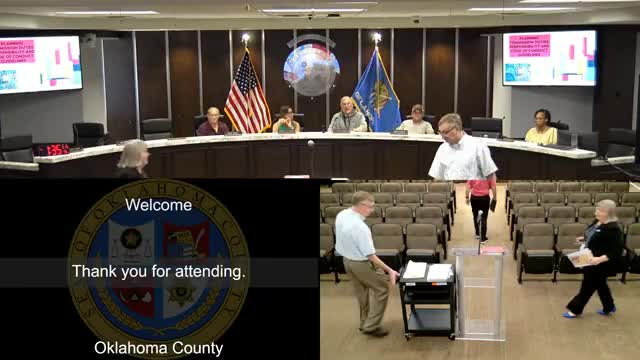
Summary
ADA Enders delivered an extended presentation to the Oklahoma County Planning Commission on statutory duties, Open Meetings Act compliance, conflict-of-interest rules, decorum, and when the DA's office can provide legal opinions and representation.
ADA Enders, Assistant District Attorney, briefed the Oklahoma County Planning Commission on the legal duties and limits that govern commissioners, focusing on Open Meetings Act rules, conflict-of-interest avoidance, decorum and when to seek written legal opinions.
Enders told commissioners that their decisions should be based on the county master plan and applicable zoning and subdivision regulations and urged consistency: "As long as you follow the law as consistently as possible, your goal is to be as consistent as possible with the public." She described the DA's role as legal advisor — able to answer legal questions and assist with wordsmithing — but not as the decision-maker for planning or policy.
Enders reviewed practical meeting rules: agenda items must be clearly posted in advance, new business should be limited to matters that could not have been posted earlier, and public comments should be kept on-topic and time-limited where the commission's bylaws permit. She said the commission may adopt a bylaw or resolution to set a public-speaking time limit and recommended doing so in writing to reduce litigation risk.
On quorum and voting, Enders explained that while a quorum of the commission is four members, county practice requires a majority of the full board for some actions; she advised caution when only four commissioners are present because a 3–1 split may not constitute a majority of the full board. She warned that off-agenda deliberations or willful Open Meetings Act violations can void actions and, in rare cases, may expose members to civil or criminal penalties.
Enders also covered ethics and conflicts: members should recuse themselves for personal financial interest, close family relationships, or other clear conflicts. She described the county's indemnification practice: actions taken within the scope of duties typically receive legal representation from the DA's office; actions taken outside that scope may not.
She invited commissioners to request written legal assessments through staff when a researched opinion is needed and reminded the commission that executive sessions must be posted with statutory basis and are rarely appropriate for this advisory body.
The presentation was delivered without a vote; commissioners asked procedural questions and discussed options for adopting time limits, deferral practices and when to request written DA opinions.