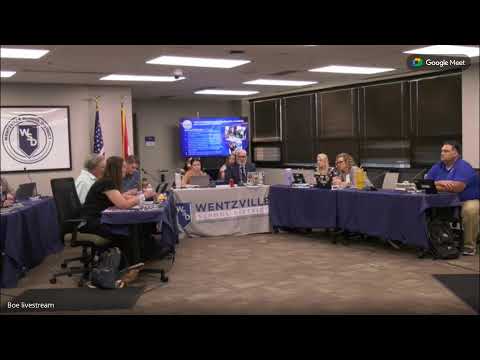
Wentzville R‑IV board hears plan to use district funds for emergency school repairs after Prop L failed
Loading...
Summary
District staff told the Wentzville R‑IV Board of Education on May 15 that plumbing, roofing and HVAC repairs estimated at $3–4 million across several legacy buildings will be treated as emergencies this summer, with operating funds to be transferred to capital to pay for the work after Prop L did not pass.
WENTZVILLE, Mo. — District staff told the Wentzville R‑IV Board of Education on May 15 that immediate plumbing, roofing and HVAC work at several older schools will be funded from the district’s operating balance after the district’s Prop L proposal failed to pass.
The district presented a short “hot list” of urgent projects at Heritage, Winslow, Holt and other legacy buildings and said the work cannot wait a year: “We're a little bit right now behind the 8 ball because it pushed everything back about a month by doing this,” one staff member said. The presentation said some repairs will be done under an emergency procurement and others will be bid out as usual.
Why it matters: administrators warned that deferred maintenance risks classroom disruptions and, for at least one building, potential closure if plumbing backups recur. The district said it can cover the immediate work by transferring operating funds into the capital projects account but that doing so will reduce the district’s fund balance percentage by roughly 1 percentage point per $2.6 million transferred.
District facilities staff outlined the scope for this summer: targeted tuckpointing to stop active leaks, replacement of failing rooftop HVAC units, and major plumbing replacements in locker-room and kitchen lines at Holt and Heritage that staff said cannot be repaired with liners and therefore require full replacement. “The pipes are completely deteriorated. We're past the point where you can put a liner in there and take care of it,” a staff member said when describing camera inspections of sanitary lines.
On cost, the district’s finance staff said their projection for the identified pieces across all affected buildings is “somewhere in the $3 to $4 million” range. Finance staff said the district’s current budget position would allow a transfer from operating to capital to cover those costs and that the expected reduction in fund-balance percentage would be in the neighborhood of 1 to 2 percent of total expenses.
Administrators said some emergency plumbing work must be done this summer while buildings are empty because projects would otherwise require closing parts of a school for weeks. “You would literally have to close the school in order to do that,” a staff member said of the Holt locker‑room plumbing work.
Board members and staff also discussed longer-term planning. Facilities staff said they have a multi‑year maintenance and replacement plan and are preparing to bring an outside RFP to evaluate district facilities over 5–10 years so capital needs can be scheduled. The district also reported roughly $10 million of additional deferred maintenance identified for summer 2026 work.
On future ballot measures, board members said the summer repairs would be coordinated with any future capital-proposal planning so work done now would not be wasted if a later bond or levy passes. “What we're talking about it, it tees right in,” a staff member said, adding that the work performed now would remain part of any later renovation plans rather than being torn out.
No formal vote was recorded on the emergency repairs during the May 15 meeting; the presentation was described as an update and staff said they will return to the board with additional recommendations in August or September.
What’s next: staff said they will proceed with emergency procurement where necessary, transfer funds from operating to capital to pay for the immediate work, and return to the board with a plan for subsequent phases and any proposed future ballot measures.