Get Full Government Meeting Transcripts, Videos, & Alerts Forever!
Get email alerts on the Human Resources topic
No spam. Unsubscribe anytime.
Atlanta HR reports completion of Phase 1 pay adjustments, readies Phase 2 and wellness expansion for FY 2026
Summary
Interim HR Commissioner Calvin Blackburn told the finance committee that phase 1 of the class‑and‑compensation implementation is complete, the city converted thousands of employees to a defined‑benefit pension plan, and HR plans phase 2 of pay changes in January 2026 alongside expanded wellness and investigation timeliness goals.
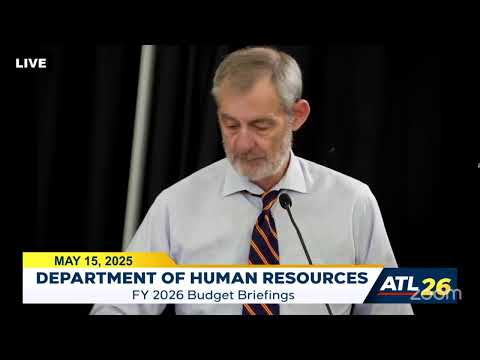
Interim Commissioner Calvin Blackburn for the Department of Human Resources told the finance committee on Oct. 11 that HR completed implementation of Phase 1 salary adjustments from the class‑and‑compensation study and has launched several workforce and wellness initiatives, while planning Phase 2 of pay adjustments for Jan. 1, 2026.
"In order to get this across the line, remember this began in 2022 with an RFP," Blackburn said, describing the outreach, testing and data‑entry work his team performed to implement compensation changes for thousands of employees. He said HR sent roughly 8,000 personalized compensation letters and held dozens of orientation and focus sessions to explain changes to employees and stakeholders.
Why it matters: The compensation adjustments and pension changes affect take‑home pay, recruitment and retention across city departments. HR told the committee the transition to a defined‑benefit pension plan replaced the 2011 hybrid plan for approximately 4,600 employees and that Phase 2 of pay changes is scheduled for January 2026.
Key accomplishments and near‑term work
- Phase 1 implementation and quality control: Blackburn described a large operational effort to enter and validate compensation changes for every affected employee. He told the committee that errors occurred but that HR's "best understanding" is the implementation affected 5% or fewer employees; the team worked to correct over‑ and under‑payments as they were discovered.
- Benefits and open enrollment: HR reported that 2,600 employees submitted open‑enrollment elections and nearly 1,000 attended DHR showcases during the open‑enrollment period.
- Pension change: HR has transitioned eligible employees to a defined‑benefit pension plan; Blackburn said roughly 4,600 employees moved from the 2011 hybrid DB/DC structure.
- Employee wellness and behavioral health: Dr. Carla Moore and HR's wellness team provided expanded services to public safety personnel, including precinct and station visits, group therapy topics and an inaugural wellness fair at the public‑safety training center. Blackburn highlighted roughly 400 wellness visits and increased psychoeducation reaching more than 2,800 public‑safety personnel in several venues.
- Investigations backlog and timeliness: HR said it cleared older investigative cases from 2022–2023 and set a FY 2026 goal to reduce investigation completion time to about 100 days.
Budget and headcount
- FY 2026 request: HR proposed a general‑fund budget of $10,376,684 for FY 2026. The department said about 91% of its general‑fund budget is personnel costs and that the FY 2026 increase reflects conversions of extra‑help roles to full‑time authorized positions and the operational impacts of implementing the compensation program.
- Authorized positions: Earlier slides named 69 authorized positions, but HR clarified during Q&A that the correct FY 2026 authorized headcount is 77, with 49 filled and 28 vacant; the department plans to abolish five vacant positions through the personnel‑paper process and said most remaining vacancies are unfunded or will be retained only if mission critical.
Council reaction and follow‑ups
Councilmembers praised HR's heavy lift on class‑and‑comp implementation and asked for clearer, up‑to‑date vacancies and funded/unfunded breakdowns before final personnel papers. Several councilmembers asked for more real‑time budget tracking and monthly reporting options so council can respond more quickly to midyear fiscal changes.
Discussion vs. decision
Discussion: Committee members discussed the implementation complexity of the class‑and‑comp study, error rates and the role of HR in communicating with employees. Direction: HR committed to provide personnel paper clarifications and promised to continue improving payroll and investigation timeliness. Formal action: None recorded during the presentation.
Ending
HR concluded by asking the committee to endorse the FY 2026 request and to support continued funding for pension and compensation implementation, employee wellness programs and efforts to reduce investigative timeliness.