Get Full Government Meeting Transcripts, Videos, & Alerts Forever!
Get email alerts on the City Budget topic
No spam. Unsubscribe anytime.
Mayor presents FY26 executive proposal emphasizing public safety, youth programs and housing while cutting office spending 8% from FY25 projections
Summary
Mayor Dickens and executive staff told the council the FY26 executive offices proposal reduces spending 8% from FY25 projections, keeps a focus on public safety and youth programs, and pursues a whole‑of‑government “group project” approach to affordable housing, infrastructure and workforce initiatives.
Mayor Dickens and senior members of the mayor’s executive team presented the proposed FY26 executive offices budget to the Atlanta City Council, saying the administration will continue a “group project” approach to public safety, youth services, housing and infrastructure while presenting an FY26 executive offices plan that is 8% below FY25 projections.
The mayor opened the presentation by describing a multi‑year agenda of recovering from COVID disruptions, addressing violent crime and investing in city infrastructure. "This is a group project," the mayor said, framing a whole‑of‑government effort that the administration said drives its priorities.
Chiefs and senior staff presented outcomes the administration cited as justification for continued investment. Andre Burks, chief operating officer and other senior staff reported falling violent‑crime metrics compared with 2022 and described a range of new or expanded public‑safety tools: a centralized emergency operations approach, a new public‑safety training center, expansion of diversion programs (a center for diversion services operated with Fulton County and Grady Hospital), and a CARES (nonpolicing response) unit. The administration said homicides and certain violent crimes have declined since 2022; staff provided different headline percentages during the hearing and characterized the trend as significant.
The mayor’s team also highlighted a continued focus on youth workforce programs and affordable housing. The administration reported placing about 14,000 youth in workforce programs since 2022 and said it has achieved roughly 11,000 of a 20,000‑unit affordable‑housing goal set by the administration. Officials described investments in parks, public works and infrastructure, and summarized transportation initiatives including the Move Atlanta and Renew Atlanta bond programs. Staff warned that those capital programs have not yet fully spent the intended bond proceeds and said some project delivery has proven slower than planned.
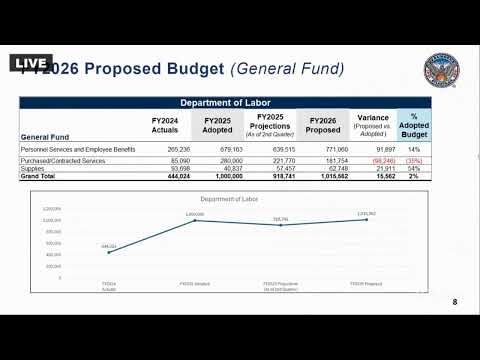
On fiscal particulars, Chief of Staff Odie Donald said the FY26 executive‑offices proposal is roughly 8% lower than FY25 projections and below FY24 actuals. The administration reported an authorized general‑fund employee count in the executive offices near 234 (249 total positions when non‑general‑fund contract‑compliance roles are included), described a vacancy review process and said an internal effort to reduce overtime has produced recent declines in overtime expenses in several departments. Donald said the FY26 proposal includes reduced contract services and a modest net personnel reduction while preserving programmatic capacity.
Council members pressed for details. Councilmember Shipman and others asked for a breakdown of the 63 vacancies the mayor’s office cited and requested more detail on how the FY26 run rate would be achieved at the start of the fiscal year. Councilmembers asked whether planned reductions would be fully implemented by the beginning of FY26 and sought clarification on where future headcount reductions would occur if the administration must meet more severe cuts.
Other topics included planning for the 2026 World Cup (the administration said staff and partners including Showcase Atlanta and public‑safety mutual‑aid planning are under way), the city’s revenue mix and the potential impact of federal funding cuts. Administration officials urged continued coordination with state partners and said some federal agencies (EDA, HUD, DOT) are experiencing slower processing that can affect local projects. The mayor and staff encouraged council engagement on potential revenue options to sustain a growing city with a relatively small residential tax base compared with the broader metro area.
No formal votes were taken. Council members asked for supplemental materials: vacancy and position‑by‑fund breakdowns, a more detailed overtime plan and progress metrics for bond‑funded capital programs.