Get Full Government Meeting Transcripts, Videos, & Alerts Forever!
Get email alerts on the Welcoming City Resolution topic
No spam. Unsubscribe anytime.
Committee backs welcoming-city resolution, urges short-term legal aid for unaccompanied children
Summary
The Select Committee recommended adoption of a "Welcoming City" resolution aimed at supporting immigrant and refugee communities and asked city staff to pursue budget discussions about emergency funding to maintain legal services for unaccompanied children; the committee vote was 5-0 to send the resolution to full council on May 27.
The Select Committee on Federal Administration and Policy Change voted May 16 to recommend adoption of a "Welcoming City" resolution designed to affirm Seattle—s support for immigrant and refugee communities and to direct staff work on legal capacity and monitoring federal actions.
The resolution, introduced by Committee Chair Alexis Mercedes Rink, asks the city attorney—s office to continue complying with the Court Open to All Act, to develop specialized immigration subject-matter capacity, and for the council to consider budgetary measures that would reduce harm to immigrant-serving departments. The committee voted 5-0 to forward the measure to the full City Council with the committee—s recommendation.
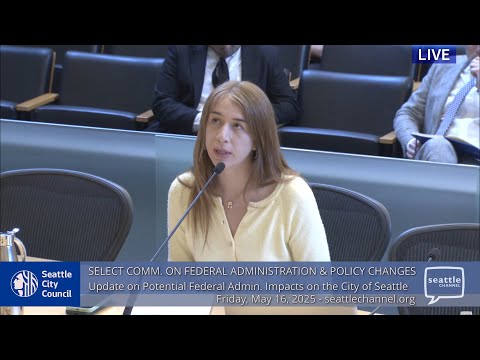
Speakers from immigrant-advocacy organizations detailed an urgent need for legal services for unaccompanied immigrant children. "Data shows that immigration judges are almost 100 times more likely to grant legal relief for unaccompanied children with legal counsel than those without," said Jessica Castellanos, managing director of Kids in Need of Defense's Seattle office. Castellanos described a closure of KIND staff nationwide that has left many children without counsel and said the Seattle immigration court had more than 1,800 pending child cases on file, the majority unrepresented.
Tim Wharton Hertz, directing attorney at the Northwest Immigrant Rights Project, said his organization lost over $2 million in funding and had been "cobbling together" representation for clients. He and other witnesses urged the committee to signal city support and to prioritize continuity of legal representation for children and other at-risk immigrants. Cindy Leo, vice president of U.S. state and local policy at Kids in Need of Defense, said the attacks on immigrant legal services were an "attempt to tear our community apart" and emphasized wider civil-rights consequences.
Chair Rink said the city must balance fiscal constraints with the urgency of maintaining critical services. The draft resolution before the committee originally included a firm $300,000 emergency funding commitment; the version recommended out of committee instead requests that the council "have a discussion during the budget process" about $300,000 in emergency funding so the matter is considered in the formal budget cycle rather than as an out-of-cycle appropriation.
Advocates told the committee that at least 55 Seattle cases remained funded in the current transition because of existing city support; they said additional emergency funding would allow the city to preserve ongoing representation while larger funding decisions are made. Chair Rink and several councilmembers framed the vote as both a policy statement of city values and a practical step to secure continuity of services during a period of federal funding disruption.
Councilmember Alexis Mercedes Rink moved to recommend adoption of Resolution 32168; the motion was seconded and passed on a 5-0 roll call (Yes: Hollingsworth, Kettle, Strauss, Solomon, Rink). The committee clerk recorded the recommendation and the measure is scheduled for the May 27 full City Council meeting.
Those who testified urged the council to consider an amendment that would move the $300,000 emergency funding discussion to immediate budget consideration; Chair Rink explained the committee—s preference to treat the dollar figure as a budget deliberation item rather than to appropriate funds via resolution. OIR and presenters offered to provide follow-up materials and to help the council identify the 55 cases and other children who would be affected by funding decisions.