Get Full Government Meeting Transcripts, Videos, & Alerts Forever!
Get email alerts on the Federal Budget And Grants topic
No spam. Unsubscribe anytime.
Seattle briefing: federal executive orders, budget reconciliation and grant risks could hit local aid
Summary
City Office of Intergovernmental Relations briefed the Select Committee on likely federal changes — including executive orders targeting sanctuary jurisdictions, a budget reconciliation package with large proposed cuts to SNAP and Medicaid, and the risk to multiple federal grants — and outlined Seattle projects seeking appropriations.
The Seattle Office of Intergovernmental Relations told the City Council—s Select Committee on Federal Administration and Policy Change on May 16 that a wave of federal policy and budget moves could jeopardize grants and programs local residents rely on.
The briefing covered three immediate areas of concern: enforcement-focused executive orders the administration has issued on sanctuary jurisdictions, the ongoing FY2026 appropriations process and a high-risk budget reconciliation package in Congress, and the potential rescission or alteration of federal grant funds that support Seattle programs.
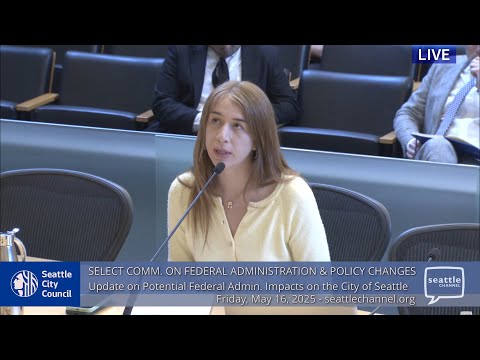
OIR Federal Affairs Director Anne Maher introduced the report and said the office was tracking agency actions and congressional debates closely. "As mentioned my name is Anne Maher and I'm a federal affairs a federal affairs director here at our office of intergovernmental relations," she told the committee. Leslie Polner, a federal lobbyist joining from Washington, D.C., said of the early weeks of the administration: "It has been, a really challenging time here in Washington, particularly with the first hundred days." Polner and OIR staff walked the committee through executive orders, court developments and the potential local effects.
Key federal actions and legal developments described to the committee included: the administration's early executive orders such as one on sanctuary jurisdictions and another the briefing described as "unleashing American energy," and a follow-up April 28 order that directed the attorney general to publish a list of jurisdictions alleged to "obstruct the enforcement of federal immigration laws." Polner said a federal judge ruled on May 9 that the administration's efforts to withhold funding for 16 jurisdictions were "likely unconstitutional." OIR said it was watching for the administration's published list and for further litigation.
On the appropriations front, OIR outlined items in the president's skinny budget and the congressional appropriations process. The office recapped Seattle's community project funding requests: Third Avenue revitalization ($3,750,000), Elliott Bay Seawall phase two ($3,000,000), Columbia City branch seismic retrofit (about $5,000,000), Lake City Community Center with an affordable-housing component, a Post Overdose Response Team expansion (a mayoral priority), and Fort Lawton redevelopment as a delegation priority.
Councilmembers asked whether projects would survive the appropriations process; OIR staff cautioned that Congress and committees remain unsettled on many items and that the president's budget is a starting point, not a final outcome.
On budget reconciliation, OIR and Polner summarized provisions circulating in committee markups that could have broad local effects if enacted. Their account included proposed changes they described as large cuts to social safety-net programs: Polner cited committee language that would reduce SNAP by roughly $290 billion (about a 30% cut) and described major proposed changes to Medicaid including new work and reporting requirements and increased cost-sharing. Polner also said Energy and Commerce markups would rescind some Inflation Reduction Act and EPA funding, while Ways and Means retained municipal bond tax-exempt status but altered energy and housing tax credits. The presenters warned the package was politically fraught and still subject to change in the Senate.
OIR staff also flagged several grant and program risks for Seattle departments: possible rescissions or changes to HOME, CDBG, LIHEAP, BRIC (Building Resilience Infrastructure and Communities), DOT neighborhood access and equity grants, and EPA clean and drinking water programs. They said City Light, Seattle Public Utilities, SDOT and the Office of Housing were coordinating with OIR and national associations to advocate for continued funding and to track formula pass-throughs. On LIHEAP specifically, staff said funding appeared to remain in place but that changes to federal personnel and grants administration had created uncertainty; OIR said it would follow up with a more detailed update.
Councilmembers pressed OIR on likely local impacts of SNAP and Medicaid changes, on coordination with jurisdictions across Washington state, and on the city—s ability to track pass-through dollars to departmental budgets. Councilmember Kettle asked whether OIR was coordinating with the Association of Washington Cities and with jurisdictions in more conservative areas to broaden advocacy; OIR responded that it was conducting bipartisan outreach through delegations and national associations and has been in contact with Representative Newhouse's office because of his role on the Agriculture Committee.
The presentation also reiterated that surface transportation reauthorization (2026) will be consequential for Seattle and that the city is working with SDOT and the delegation to protect programs created by the Bipartisan Infrastructure Law. OIR said it was tracking tariff impacts and macroeconomic volatility that can affect city revenue forecasts.
The briefing concluded with OIR offering to provide the committee more detailed, department-level risk assessments and to follow up on specific questions about LIHEAP staffing and the potential effect of any rescissions.
Councilmember Alexis Mercedes Rink, chair of the committee, thanked OIR and said the committee would continue to monitor and receive updates as appropriations and reconciliation work moves forward.