Get Full Government Meeting Transcripts, Videos, & Alerts Forever!
Get email alerts on the Capital Program topic
No spam. Unsubscribe anytime.
Planning department outlines FY26 capital program; utilities and sidewalks get large shares
Summary
Baltimore City Department of Planning presented the six‑year Capital Improvement Program and FY26 capital year that emphasizes utility spending, an expanded sidewalk and resurfacing program, and funding to move several park and recreation projects to construction.
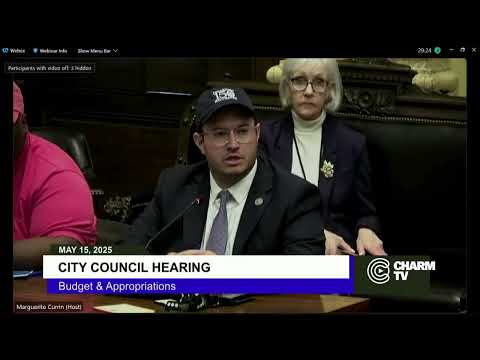
Sarah Parnellum of the Baltimore City Department of Planning told the Budget and Appropriations Committee that the Planning Commission’s recommended six‑year Capital Improvement Program (FY26–31) and the FY26 capital year emphasize utility investments and have larger-than‑typical local discretionary allocations in FY26.
By city charter the Planning Commission submits the six‑year program to the Board of Estimates; the first year becomes the capital ordinance before the council. Parnellum emphasized the definition of capital under Board of Estimates policy and outlined the multi‑agency review process used to assemble the program: agencies submit requests in the fall, present to the Planning Commission in January, staff prepare recommendations, and the Planning Commission votes in March.
She said utilities remain the largest share of the capital budget (water, wastewater and stormwater funds) and account for a substantial portion of the FY26 program; those utility funds are restricted to utility uses. The FY26 program also includes a larger local investment in sidewalks ($12 million) and partial funding for ADA consent‑decree sidewalk work, a more than $40 million resurfacing program, and an expanded solid‑waste investment that includes Phase 1 and Phase 2 of a future east‑side transfer station (administrative improvements and a compost facility).
Parnellum listed FY26 project highlights that include the local match and state funding for impact investment areas, final funding increments to allow award of several Recreation & Parks contracts (Robert C. Marshall Field, C.C. Jackson Park expansion, City Springs Park improvements, Easterwood Park improvements, Bocek Athletic Center and Cab Calloway Legend Square Park), and design funds for Lillian Jones Recreation Center. She also noted acquisition funding for the Highlandtown–Greektown Greenway Trail segment and ongoing planning for larger items in later years such as a Northeast police district station, broadband upgrades, courthouse HVAC replacement, demolition of surplus school buildings, and the final phase of the East Side transfer station.
Why this matters: the six‑year CIP and FY26 capital year allocate constrained local discretionary capital alongside restricted federal, state and utility funds. The planning department asked the council to consider advocacy on restoring higher highway user revenues that boost transportation investments and noted that many non‑utility projects still depend on limited discretionary local funds.