Get Full Government Meeting Transcripts, Videos, & Alerts Forever!
Get email alerts on the Arpa Spend topic
No spam. Unsubscribe anytime.
Mayor’s recovery office reports $641.2 million in ARPA obligations; opioid restitution grants moving slowly
Summary
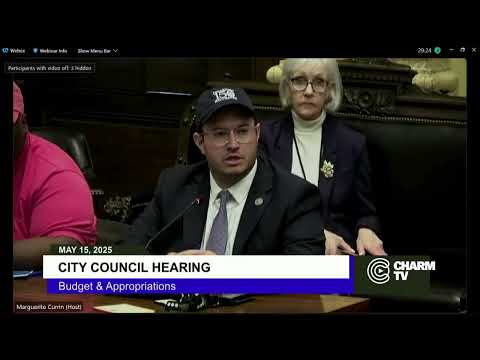
Acting Chief Recovery Officer Elizabeth Tatum told the Baltimore City Council Budget and Appropriations Committee that the city had obligated $641,170,126 in ARPA funds and expended $434.9 million as of March, and she outlined slower‑than‑expected spending at several agencies and early steps on opioid restitution grants.
Acting Chief Recovery Officer Elizabeth Tatum told the Baltimore City Council Budget and Appropriations Committee on a quarterly briefing that Baltimore City has fully obligated $641,170,126 in American Rescue Plan Act (ARPA) funds and had expended $434,900,000 as of March.
Tatum said the recovery office is tracking agency-level spend rates and focusing on agreements where expenditure is under 50 percent. "We have fully obligated $641,000,000 It's $641,170,126 That's all been obligated as of December 31 and then as of the March we've expended $434,900,000," she said. She told the committee the presentation covered expenditures through March and noted April numbers would be available at the May 28 budget hearing.
The office highlighted projects across city agencies with slower spend patterns. Examples cited by Tatum included a $3.7 million Department of Finance city-services agreement executed in December 2024 (about half expected to be spent in the next six months), a $36 million portfolio for the Department of General Services (three projects under 50 percent, including $3.4 million for fire-facility upgrades, an $11.8 million City Hall roof replacement with $6.85 million from ARPA, and $10.8 million for HVAC at six libraries), and a $13.1 million Department of Transportation agreement where $12 million is allocated to construct 1,600 ADA ramps (Tatum said about 40 percent of those ramps were complete and about 18 percent of sidewalks slated for repair had been finished after a contract bid protest delayed start).
Recreation and Parks was shown with a $58.4 million ARPA obligation and 39.7 percent spent; Tatum said pools and three recreation centers are under construction, and cited specific schedules: Coldstream pool projected to open in June 2025, and the Greater Model Pool expected to be completed by fall 2025. She said ARPA provided $6.6 million for the new Elijah Cummings recreation center, with about 12 percent of those design funds already spent.
Tatum also reviewed grants and quasi‑governmental partners: quasi‑government and nonprofit portfolio spend stood at 84.6 percent, while Visit Baltimore’s $4 million tourism and convention incentive grant — awarded December 2024 — had reached roughly the 50 percent threshold in the first disbursement cycle. Enoch Pratt Free Library’s $4.4 million grant was described as ‘‘a little under half’’ spent and tied in part to related library HVAC work.
On the opioid restitution fund — an appropriation separate from ARPA — Tatum said the office had budgeted $270,000 for administration in FY25 and spent about 11.4 percent of that, and that $10 million in named‑entity grants had one disbursement to date (1.7 percent spent). She described the grant process and technical assistance: "...site visits, detailed budget reviews ... qualitative feedback on grant applications," and said the recovery office is coordinating performance measures with the Baltimore City Mayor’s Office of Behavioral Health (BCMoore) to standardize outcome reporting across grantees.
Council members pressed the administration for more detail. Councilman Isaac "Yitzi" Schleifer asked for a copy of the equity rubric used in ARPA grant review and for the office’s equity analysis; Tatum said she would provide the scoring rubric, the Treasury report questions the office answers, and a description of the University of Baltimore spend analysis the office is running. Council President Cohen and Deputy City Administrator Shamaya Kearney discussed the pace and priorities for opioid restitution disbursements and confirmed the city had roughly $87 million allocated to named entities overall and about $87 million planned to be disbursed to named entities across multiple years, but that the amount actually disbursed in FY25 would be provided as a follow‑up.
Committee members also questioned staffing supported by ARPA. Tatum said 92 staff were charged to ARPA as of March; some positions have transitioned to the general fund while others will be cut or shift to other grant funding, and specifics would vary by agency. She agreed to provide an agency‑by‑agency list of ARPA‑funded positions and a separate list showing which would transition to the general fund, which would remain on grant funding, and which were expected to move to other federal grants.
Why this matters: the briefing laid out where federally sourced ARPA dollars have been committed and where expenditure lags could create carryforward or implementation risk. Committee members asked for supporting materials and follow‑ups (equity rubric, FY25 disbursement totals for opioid restitution, and a staffing list) that the recovery office committed to provide.
Tatum closed by reiterating public reporting avenues and dashboards for ARPA spend and said the office will continue to provide monthly reports to City Council and quarterly reports to Treasury.