Get Full Government Meeting Transcripts, Videos, & Alerts Forever!
Get email alerts on the Water Quality topic
No spam. Unsubscribe anytime.
Charlotte County advances ‘1 Charlotte 1 Water’ plan; seeks funding and public comment
Summary
County staff presented an inaugural water-plan draft Oct. 21 that lays out monitoring, restoration planning and community outreach; public review runs through Nov. 21 and state appropriations will fund initial monitoring and modeling work.
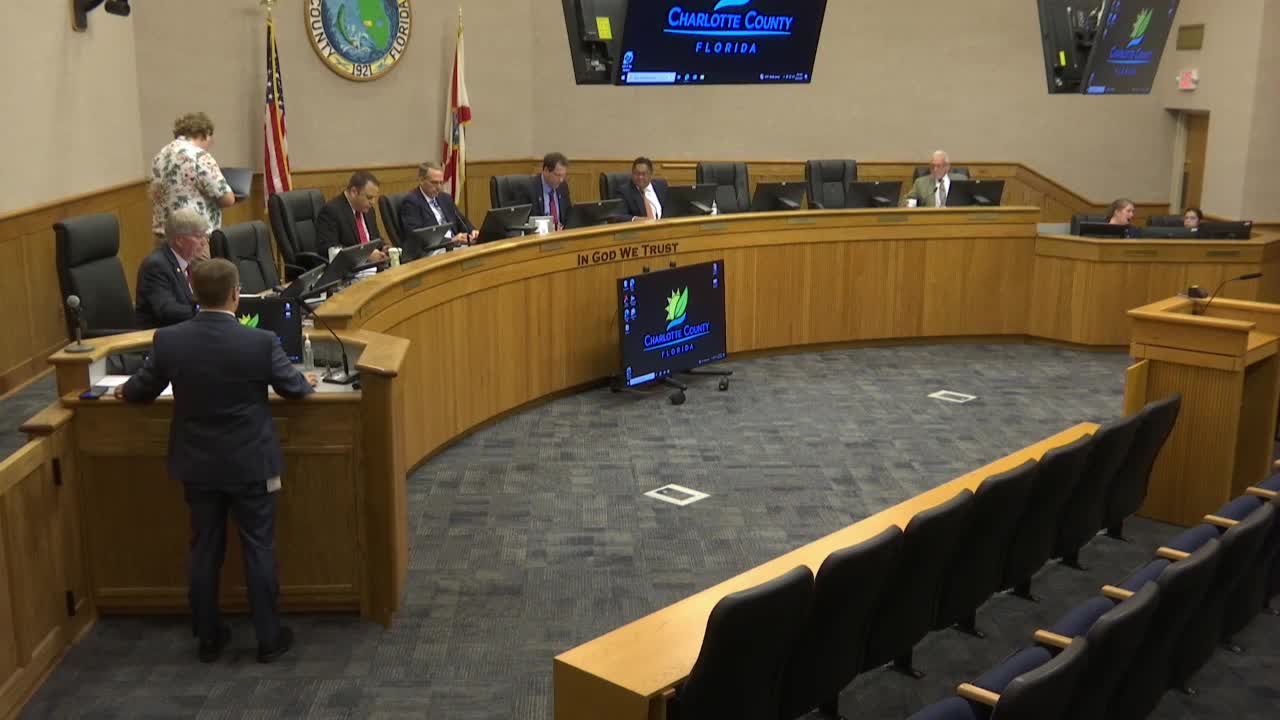
Brandon Moody, water quality resilience manager for Charlotte County, presented the draft "1 Charlotte 1 Water" plan at the Board of County Commissioners workshop on Oct. 21, 2025, saying the county is preparing to submit a final version for the board's acceptance after a public review period that closes Nov. 21.
Moody said the plan is built around four primary focus areas—monitoring, stormwater, drinking and wastewater, and planning and policy—and couples quantitative metrics with policy metrics so county staff and partners can measure progress year to year. "We've created these two suites, these quantitative metrics and these policy metrics that we're gonna use to kinda measure ourselves against year in and year out," Moody said.
The plan is intended as a living document to supplement existing department activities, not to replace them. Moody told commissioners that the county has already used state appropriations included in the FY26 budget to fund key initial work: pollutant-loading models and so-called reasonable assurance plans for impaired waters, a water-elevation monitoring network to support flood-risk and discharge modeling, and expanded sampling for micronutrients and metals.
Why it matters: Charlotte County sits at the downstream end of a complex watershed that includes contributions from the Peace River, Myakka River and other systems; board members and staff repeatedly said upstream flows complicate local restoration. Moody described the county's aim to show that it is acting to reduce local sources while using data and regional cooperation to press upstream jurisdictions and the state to address their contributions.
Major components and near-term actions - Reasonable assurance plans: Moody said consultants recommended prioritizing Lehi Bay for nutrient work as a near-term target because it is relatively accessible, while cooperation with Sarasota County would be required for portions of Lemon Bay. He said funding to begin those plans is in the FY26 budget and work will start after the county accepts the plan. - Monitoring and modeling: The county will expand monitoring and build pollutant‑loading and flow models. Moody said the county has funding to begin a water‑elevation monitoring network and has already purchased and sited several tide and water-level gauges. - Micronutrient sampling: Moody described a planned survey of “micronutrients” (including metals) across the harbor and bay to help explain algal blooms that are not fully explained by nitrogen and phosphorus alone; he said the sampling program has an estimated price tag the county has negotiated with partners to cover all locations each quarter during key seasons. - Outreach and stewardship: The plan calls for stronger public education, a pond-stewardship program modeled on efforts in Sarasota and Lee counties, and a multi-stakeholder steering committee that will advise county staff. - Pilot and baseline projects already under way: a 600‑plant freshwater eelgrass pilot in a Como Waterway canal, muck and sediment plugs collected by interns to identify dredging hot spots, and a citizen-led bacterial monitoring pilot in Punta Gorda Isles and Alligator Creek.
Feedback from public and partners Moody said county staff have held public meetings and engaged advocacy groups; the most-supported ideas included continued conservation efforts, expanded education and a volunteer pond-monitoring program. Opposition or weak support emerged for a county mitigation bank and for incentive payments to private property owners to treat shoreline invasive species; staff said those concepts were dropped or reworked after feedback.
On regional coordination, Moody and commissioners discussed the limits of local authority. Commissioner Constance said the county should monitor upstream at watershed boundaries so the county can demonstrate where pollutants originate: "Pick a point on the Myakka, and you start sampling the upstream runoff…showing that we're not contributing," she said. Moody noted the state expects cooperative, multi-jurisdictional assurance plans for large systems such as Charlotte Harbor.
Scientific and technical notes - Drivers of blooms: County staff cautioned that addressing only nitrogen and phosphorus may be insufficient to restore seagrass because other constituents (including metals and micronutrients) and changing water temperatures affect algal dynamics. Moody said the county is finalizing an MOU to broaden sampling for micronutrients and metals. - Existing studies and partners: Florida Gulf Coast University (FGCU) completed model work for the Peace River basin that points to high nitrogen loading from urban areas with septic systems and to legacy phosphorus from older reclaimed phosphate-mining lands. Moody said the county will work to integrate additional permit-mandated monitoring data (for example, data Mosaic collects) into basin analyses. - Local pilot results: Citizens’ sampling in Punta Gorda Isles and Alligator Creek showed stormwater (and a strong bird fecal signature) dominated bacterial spikes, Moody said — a finding that can shape what local investments the county pursues versus what remains a problem caused by factors the county cannot control.
Costs and funding Moody said the county has state appropriations committed to equipment, modeling and monitoring, and will rely on partnerships (for example with SWFWMD, Swiftmud and FGCU) to reduce consultant costs. He also said tourism- and state-funded programs and grant mechanisms could be a way to incentivize neighboring jurisdictions to join basin-scale projects such as septic‑to‑sewer conversions.
Board reaction and next steps Commissioners pressed for clear benchmarks tied to ecological outcomes (for example, seagrass coverage and numeric water-quality targets) and requested ongoing, understandable public reporting such as a one‑page “report card.” Moody said the public comment period runs through Nov. 21; staff will compile surveys and feedback and return to the board prior to formally submitting the plan for acceptance and launching the steering committee and contract work.
"This is something that's going to evolve and change over time," Moody said. "We now have the funding to start working on [the reasonable assurance plans], so we'll get started on those right away upon acceptance."