Get Full Government Meeting Transcripts, Videos, & Alerts Forever!
Get email alerts on the Sidewalks topic
No spam. Unsubscribe anytime.
Public Works hears feasibility study on shifting scattered-site sidewalk work in-house; officials estimate added positions and a long backlog
Summary
DPW presented a feasibility memo saying in-house sidewalk crews could be more efficient but would require six new positions and added operating costs; officials estimated a roughly 12-year timeline to chip away at the backlog at current funding levels.
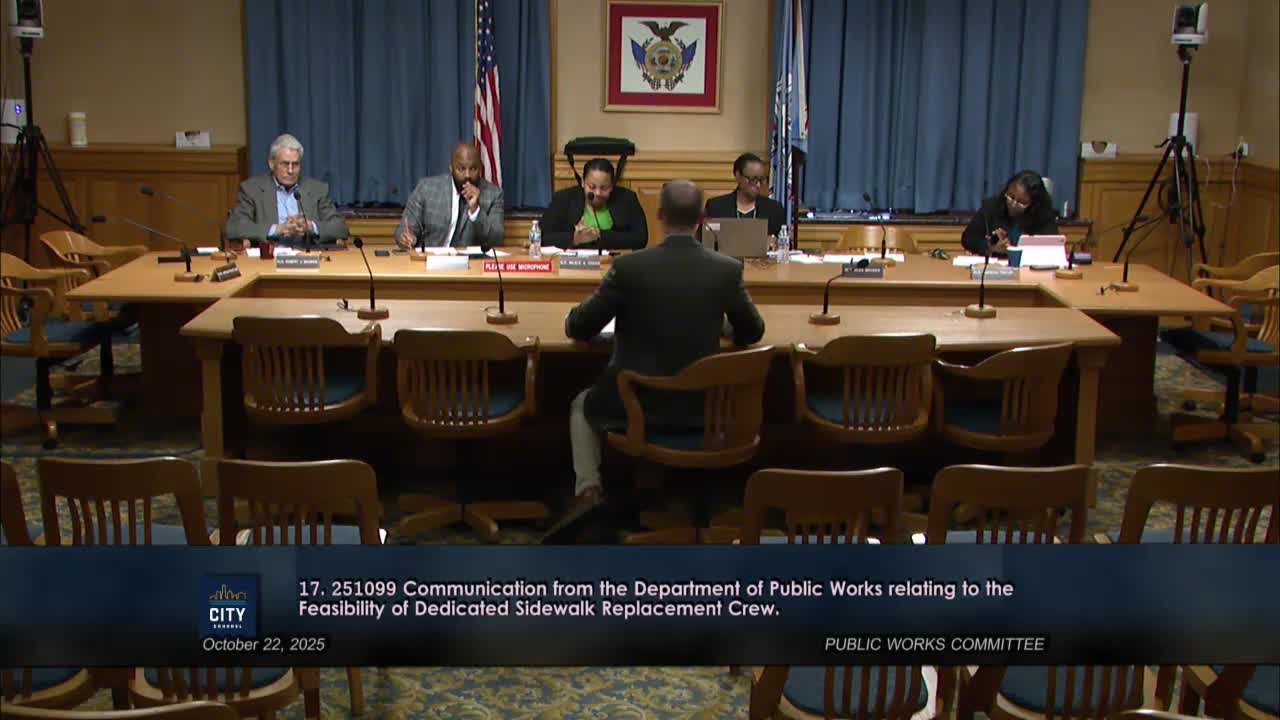
The Milwaukee Public Works Committee received a staff report on the feasibility of performing scattered-site sidewalk replacement in-house, with Department of Public Works staff saying the approach could be more efficient but would require new positions, fleet investment and additional operating budget authority.
Kevin Muse, city engineer, told the committee the department’s memo estimated that in-house work would reduce per-property costs by avoiding contractor mobilization for scattered sites, but that the city would need authority for six additional positions (cement finishers, infrastructure repair workers and a crew leader) and startup fleet costs. Muse said the estimate is conservative and that actual productivity might be higher, but warned the added staff create an ongoing operating (O&M) cost that is not covered in the 2026 budget.
Committee members asked for details about the current backlog and funding. Muse said the city currently spends roughly $1 million annually on the scattered-site sidewalk program and that the total capital program for sidewalks is approximately $1,875,000, with about $1,000,000 allocated to scattered-site repairs. Under existing funding, Muse said the city likely could not eliminate the backlog and estimated a 12-year timeline to keep pace with demand and gradually reduce the backlog.
The committee discussed ordinance and cost-share rules for sidewalk replacement: Muse said the city’s ordinance generally assesses about 50% of the sidewalk replacement cost to property owners unless the damage is caused by a city tree, in which case the city covers the full cost. Muse said the department’s estimate takes those rules into account and assumes some capital reallocation to support staff costs when staff are assigned to capital pours.
Committee members and staff also noted potential cross-training and year-round deployment benefits: when weather prevents concrete pours, crews could perform utility-cut restorations and other enterprise-funded repairs, which could reduce net levy impacts if coordinated with enterprise accounts.
No formal action was required; the committee accepted the communication and did not object to placing the item in file for follow-up and potential ordinance or budget consideration.