Get Full Government Meeting Transcripts, Videos, & Alerts Forever!
Get email alerts on the Budget topic
No spam. Unsubscribe anytime.
Summit County manager outlines roughly $100 million FY2026 budget, highlights emergency-services sales tax revenue
Summary
County Manager Shane Scott presented the county manager's recommended FY2026 projects and a high-level budget overview: a roughly $100 million spending plan driven in part by a full year of emergency-services sales tax revenue; council scheduled detailed revenue and tax-projection sessions over coming weeks.
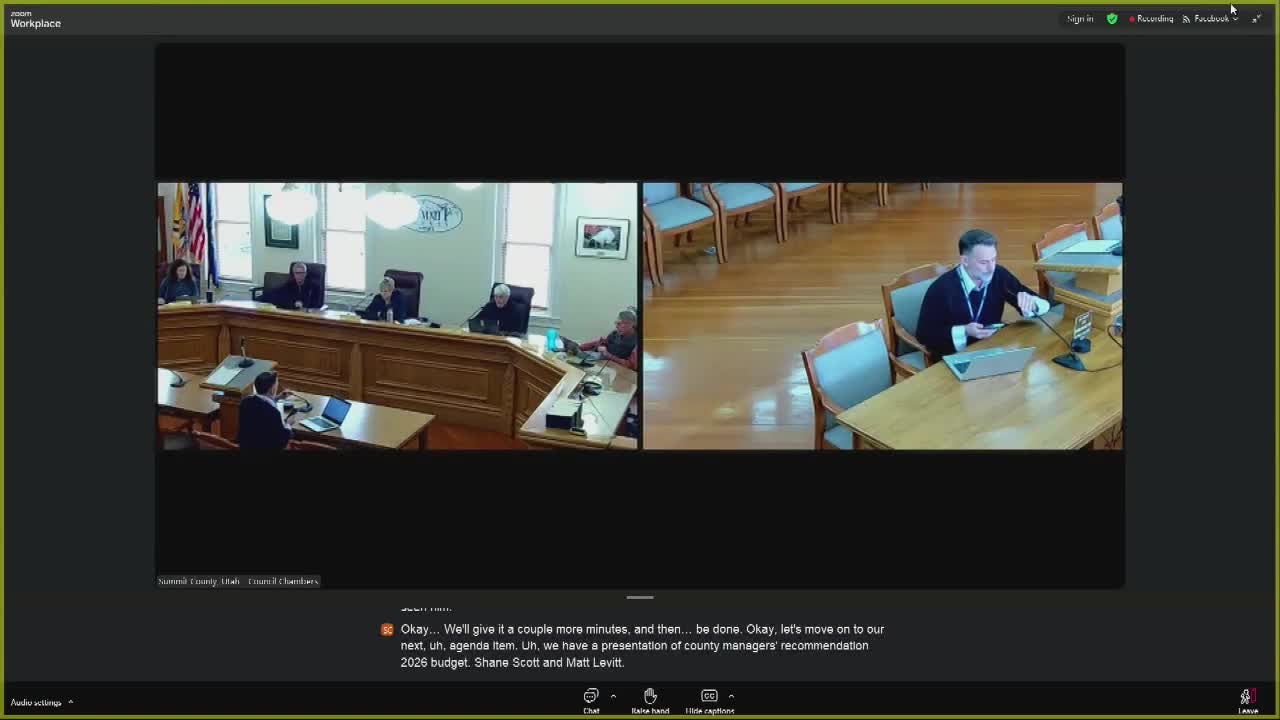
Summit County Manager Shane Scott and Finance Director Matt Levitt presented the county manager's recommended FY2026 project and a high-level budget overview during the Council's Oct. 15 meeting.
Scott described the draft budget as roughly $100 million, about $10 million higher than the current year, largely because this is the first full year the county will collect the emergency-services sales tax adopted last year. The manager said the general fund is presented at about $56.6 million, the municipal services fund at $35.4 million and assessing/collecting at $7.8 million. Scott also highlighted ongoing efforts tied to a recent compensation study and a facilities master plan; departments went through a “peak performance” exercise to identify efficiencies before new staffing or technologies were approved.
Key budget points discussed by council and staff included: - The $100 million headline number and that approximately $6.5 million is the actual-plus-forecast to date for emergency-services sales tax receipts (staff previously forecasted a slightly higher total). - Of 16 full-time position requests, eight were recommended in the current draft. - A set of capital and consulting needs: an estimated $3.5 million in courthouse capital projects and an increase in consulting-like legal services noted by staff. - The schedule for detailed future budget work: revenues and tax projections next week, personnel and position discussions on later agendas and adoption targeted for Dec. 10, with an outreach public hearing planned in the basin and another at the Colville adoption meeting.
Councilmembers asked for follow-up materials, including a detailed line-item breakdown and additional explanation of assumptions used in revenue forecasting. Scott told the council the budget committee had worked through nearly 900 pages of requests and condensed recommendations for council consideration. The council did not take a final vote on the budget at the Oct. 15 meeting; staff will return to council for a series of workshops and hearings leading to a December adoption vote.