Get Full Government Meeting Transcripts, Videos, & Alerts Forever!
Get email alerts on the Traffic Calming topic
No spam. Unsubscribe anytime.
Residents press city for traffic calming after repeated crashes on Davenport-Dutton corridor
Summary
Residents and the mayor petitioned the Traffic & Parking Committee to study traffic calming at Davenport, Electric and Dutton streets after repeated property damage and high speeds; the committee voted to hold the petition and asked the city to conduct engineering studies and pursue traffic-calming options.
The Traffic and Parking Committee of the Worcester City Council on Oct. 15 held a petition from Mayor Joseph M. Petty asking the city to review traffic-calming measures on Dutton and Davenport streets and at Davenport and Electric Street, ordering staff to study “always stop” control and other engineering countermeasures.
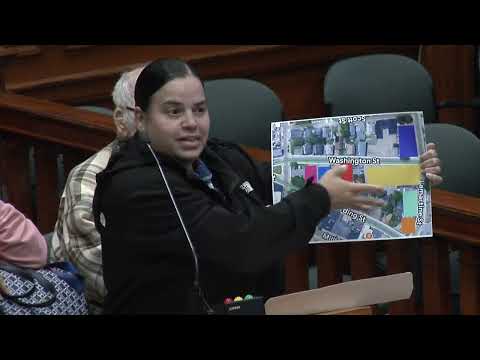
The committee’s vice chair, Councilor Christian King, said the petition aimed “to improve traffic calming measures and prevent further property damage due to speeding.” Neighbors described repeated damage to a corner property and frequent high-speed cut-through traffic.
Resident William McCarthy, whose family has lived near the intersections for more than 60 years, told the committee that delivery trucks and other vehicles now use Davenport as a cut-through to reach Route 290 and the Pike, and that “there is an unprecedented amount of children and pets in this neighborhood.” Resident Timothy O’Hare described vehicles “flying down the street” and said some drivers fail to stop at existing signs. Anne Bunkoski said she regularly sees buses and cars “zip through that stop sign.”
Lieutenant Timothy Walsh of the Worcester Police Department said officers recently deployed a speed monitor in the corridor and gathered enforcement data; the department will continue targeted enforcement while engineering work proceeds. “We were up there maybe last month for about 2 or 3 weeks,” Walsh said, and the traffic division will forward collected data to the transportation department.
Stephen Raleigh, commissioner of Transportation and Mobility, told the committee the petition’s scope had expanded beyond the initially advertised locations and recommended a comprehensive engineering study. He said an “always stop control” (a four-way stop study) requires an engineering study to make the findings needed for approval, and that the department will look at other traffic-calming opportunities, including speed cushions. Raleigh estimated the engineering report could take roughly two to three months to complete.
After hearing testimony and recommendations, the committee voted to hold the petition so Transportation and Mobility can collect additional data, conduct the required engineering study for any all-way stop control, and assess other traffic-calming measures. The committee recorded continued short-term police enforcement in the corridor and asked staff to include morning commute observations in addition to afternoon data already gathered.
The committee also asked the transportation department to explore possible low-cost interim improvements (lane markings, stop bars) and to return with a timeline and recommended measures. Councilors present approved the motion to hold by roll call.
The committee did not adopt any permanent change at the meeting; it directed staff to return with studies and recommendations for future committee action.