Task force votes to site Jonesboro E‑911 real‑time crime center on Washington Avenue
Loading...
Summary
The City of Jonesboro Capital Improvement Bond Task Force voted to place the new E‑911 real‑time crime center on the Washington Street property, citing an estimated $1,034,000 lifecycle savings and downtown redevelopment benefits. The decision drew concern from police leaders and some residents over operational efficiency and drainage risks.
The City of Jonesboro Capital Improvement Bond Task Force voted to locate the new E‑911 real‑time crime center and associated police administration on the Washington Street property, a move supporters said would save the city money and reinforce downtown government presence.
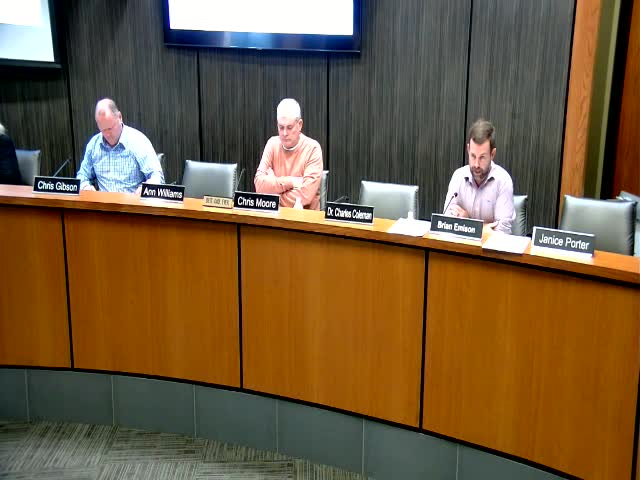
The vote followed a motion to select the Washington Street site made and discussed during the task force meeting; the motion was seconded and carried on a roll call that recorded aye votes from Hafner, Street, Gibson and Councilman Moore. The task force meeting record shows five members were present earlier in the session but the roll call recorded these four ayes and the motion was declared approved.
Task force members framed the choice primarily as a financial and downtown‑planning decision. Councilman Moore said phase 1 on Washington Street would save taxpayers about $654,000 and that by the completion of phase 2 the city engineer's estimate put total savings at about $1,034,000. "This alone would be enough for me to vote for the Washington Street property," Councilman Moore said, adding the savings could be redirected to officers and equipment.
Moore also argued the downtown site would keep government facilities centralized and support festivals and businesses that rely on nearby parking lots. He told the task force that Washington is city‑owned and that keeping a motor pool at the existing Caraway Road location would preserve asset redundancy in case of a natural disaster.
Opponents and several public commenters emphasized operational efficiency and long‑term police needs. Mr. Street, speaking for the Caraway Road option, said centralizing police operations in a single location fosters better interdepartmental communication and improves emergency coordination. "A centralized command structure improves coordinated coordination during emergencies," Street said.
Lieutenant McDaniel, administrator of the Real Time Crime Center, and Chief Rick Elliott both addressed the committee during public comment. Lieutenant McDaniel said the human element and the day‑to‑day flow of investigators, records staff and civilian employees are central to the center's effectiveness and cautioned that splitting related units could "fundamentally damage the efficiency of public safety." Chief Elliott said consolidating functions later (phase 2) could raise long‑term costs and that moving evidence and investigative functions between sites would reduce efficiency.
City Engineer Craig Lott spoke to drainage and flood concerns for the Washington site. Lott said the city's estimate includes work to avoid making existing drainage worse and cited an included measure of a triple run of 42‑inch pipe under the parking lot to provide additional storage. Lott said the estimate for drainage improvements shown on project documents was about $350,000 and that the city's cost model did not assume fixing the entire basin, only what was necessary so new construction would not increase flooding.
The mayor's written statement, read into the record at the start of the meeting, said administration staff had provided development cost estimates, property offer paperwork and an economic impact analysis to inform the task force and stated the mayor supported whatever recommendation the task force made. The mayor's letter also clarified that bond proceeds can be drawn upon to purchase property but a separate council resolution is required to approve any land purchase agreement.
Public commenters were split. Some residents urged choosing Washington to invest in downtown redevelopment and to preserve festival parking; others, including active‑duty police supporters, advocated for Caraway Road, citing operational continuity and uncertain downstream costs if construction forced relocation of evidence and investigative functions.
The task force motion selected the Washington Street property for the E‑911 real‑time crime center. The clerk recorded aye votes from Hafner, Street, Gibson and Councilman Moore; the recorded roll call in the meeting transcript shows those four ayes and the chair declared the motion passed. The task force did not adopt a land‑purchase contract at the meeting; members and staff noted any purchase using bond proceeds still requires a separate council resolution to finalize a land purchase agreement.
The task force adjourned after the vote; the item will move to full council for any required purchasing resolution and further project planning.