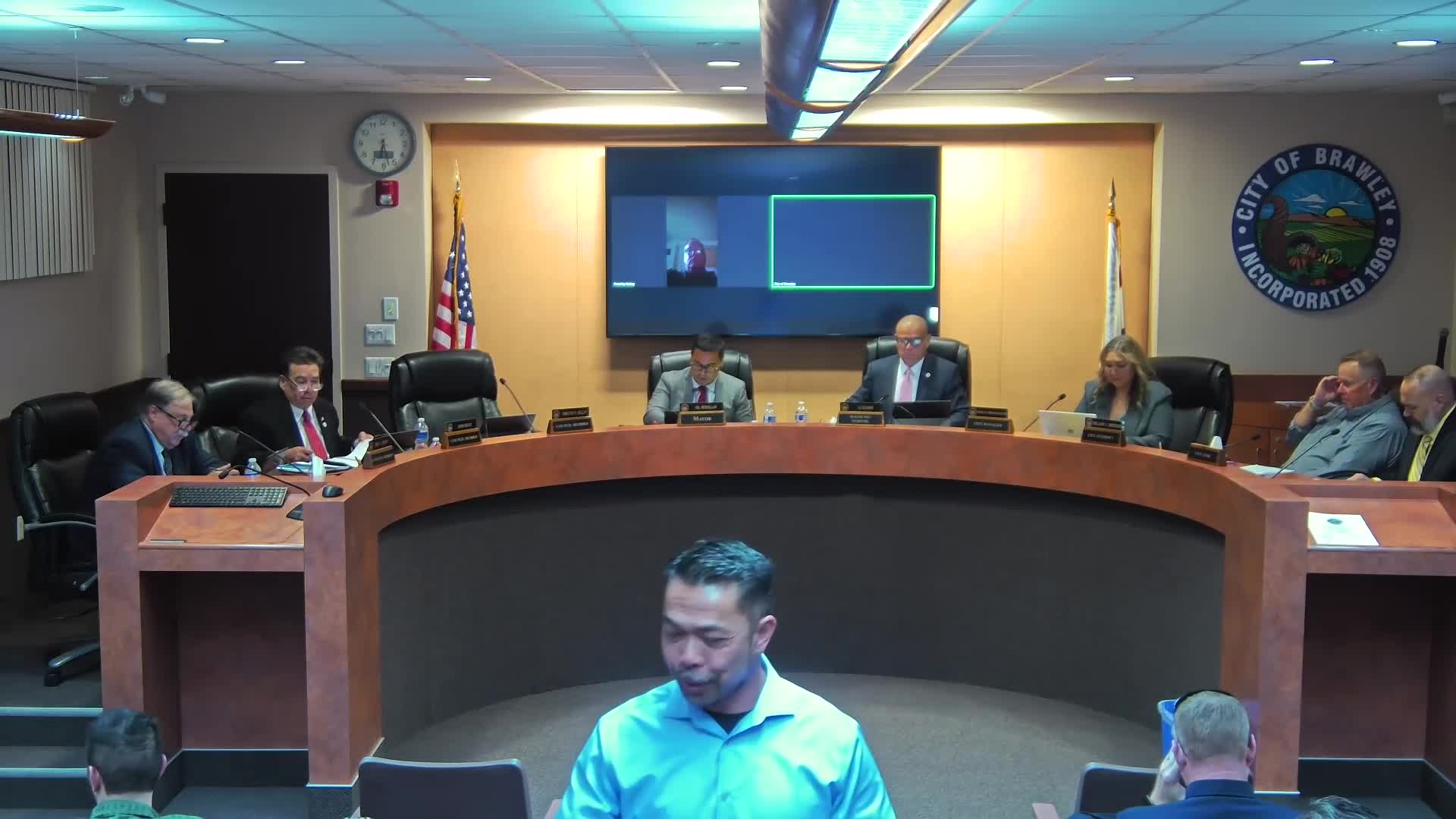
Brawley council approves first reading of ordinance to register vacant properties
Loading...
Summary
The Brawley City Council voted unanimously on Oct. 21 to introduce and give first reading to an ordinance establishing a vacant-property registration and updated maintenance standards to address abandoned and unsafe buildings.
The Brawley City Council on Oct. 21 voted unanimously to introduce and give first reading to an ordinance amending Chapter 16A of the Brawley Municipal Code to create a system for registering vacant properties and strengthen maintenance standards.
Council members and staff said the measure is intended to reduce public-safety and health risks tied to vacant and abandoned buildings and to improve city communications with out-of-area owners.
Special Projects Manager Denise Garcia told the council the ordinance responds to requests from the council and aims “to reduce the negative impacts that the vacant buildings pose to the public and mainly the, health and safety, of the city and of the residents here in the city of Brawley.” Garcia described site visits and noted staff has abated several properties after making owner contact.
Council and staff outlined how the ordinance would change enforcement and owner notification. Garcia said nonemergency abatement typically begins with a 15‑day notice and staff will work with owners who show progress: “it's usually given 15 days, and, we start working with the property owner from that point. Whether he can accomplish it within the 15 days or if he needs more time, we'll work around it.”
Council discussion ranged from procedural questions to broader policy changes. Councilmember Grama urged separating vacant properties (those with identifiable owners) from truly abandoned properties (owners cannot be located) and recommended different treatments for residential and commercial parcels, saying commercial owners should be required to submit annual plans and potentially face higher registration fees. “First of all, the title of the ordinance, I believe, should be, and the whole effort somewhat bifurcated to, address vacant properties and then abandoned properties,” Grama said.
Staff and the city attorney described options for dealing with occupied-but-unsanitary structures, including health-and-safety code receiverships that can lead to demolition, sale or rehabilitation; such receiverships require litigation guarantees and can be costly. Fire and code-enforcement concerns were raised during the discussion: Fire Chief York confirmed the fire marshal and executive staff have reviewed the issue and warned that occupied, unsafe structures create both criminal and public-health risks.
Several residents and property owners spoke during public comment in support of the ordinance, citing recent fires and ongoing blight. Maria Carrillo, a neighbor of a recently burned house on Wesley Street, said the ordinance could prevent future fires and “save lives.” Property owner Maria Pagnado urged the council to include provisions for preventing recurring nuisance on properties that are repeatedly cleaned and then re‑deteriorate and asked that the city plan outreach to notify owners after the ordinance is adopted.
City staff said the draft ordinance was prepared with outside counsel and can be refined after the first reading. Councilmembers urged prompt action so code enforcement can begin consistent work on problem properties; the council voted unanimously to introduce the ordinance on first reading and move it forward for additional review and public outreach.
The ordinance is set to return for further hearings and possible amendments before final adoption; staff signaled plans for community engagement and owner notification if the council proceeds.