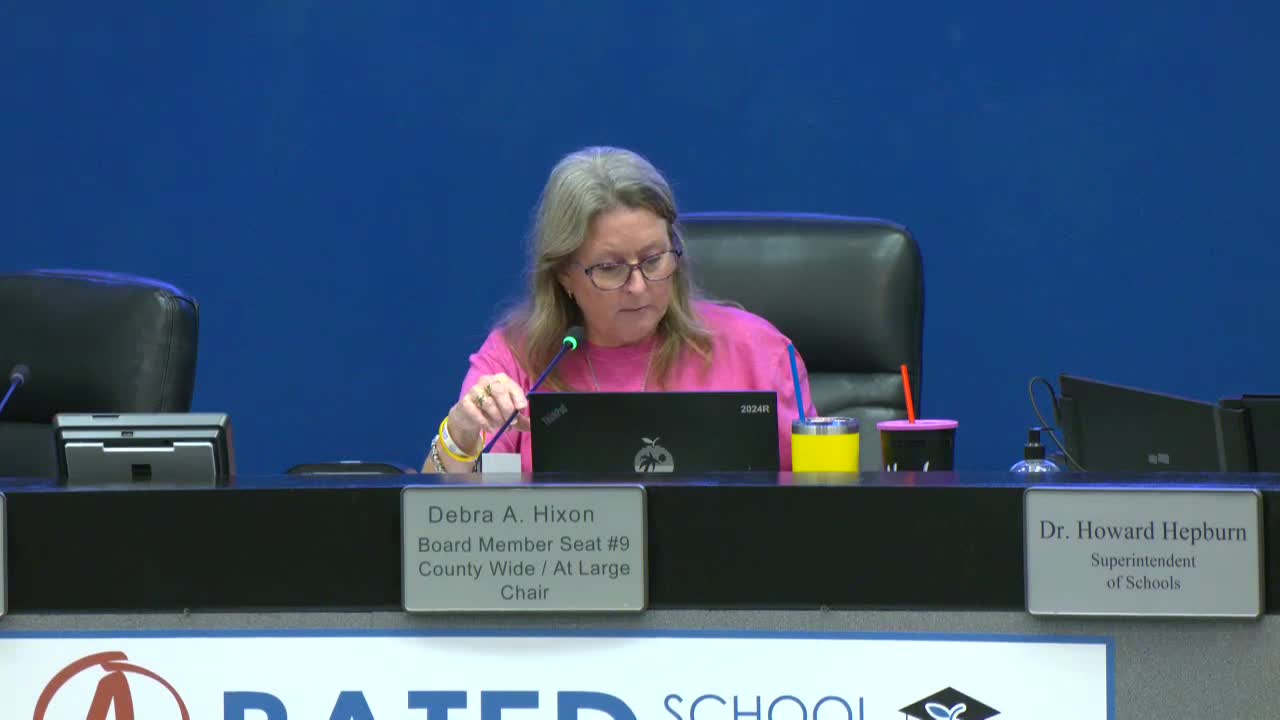
Broward district releases facility condition assessment; estimates 10-year needs over $10 billion
Loading...
Summary
District staff and outside engineers presented a facility condition assessment (FCA) covering 41 schools, describing a living asset database and a 10‑year projected project cost the team said is likely to exceed $10,000,000,000. Board members pressed for clarity on rankings, timelines, and how the FCA will feed a master plan and bond decisions.
Broward County Public Schools officials and outside engineers on Tuesday presented a districtwide facility condition assessment intended to produce a shared, data‑driven picture of school buildings' physical needs and to feed long‑range capital planning.
The FCA provides a line‑by‑line inventory of more than 120,000 assets and assigns condition ratings and corrective‑action costs for each item. "A facility condition assessment is a data driven evaluation of the buildings building and infrastructure. It's a systematic inspection and analysis based on the systems, the components, their age configuration, their exposure, their usage and their performance," said Bill Champion of Bureau Veritas during the presentation.
The assessment is structured to produce a facility condition index (FCI) for each building. Presenters explained the FCI is the ratio of deferred maintenance cost to replacement cost, expressed as a percentage: a lower FCI means better condition; industry colors (green/yellow/orange/red) indicate increasing levels of deterioration and urgency. District consultants said the FCA will be kept as a living database, with individual school reports to be completed by the end of the calendar year and quarterly updates to the board.
Why it matters: district staff and consultants said the FCA will be the primary technical input into a master plan and any future capital program, including potential bond proposals. "The 10 year projected project cost for the 41 schools in the presentation is about 150 preliminary report results are indicating that the 10 year projected project cost is likely for the District is likely to be over $10,000,000,000," Ashley Carpenter of Atkins said during the presentation.
What the FCA found and how it will be used - The FCA assigns condition ratings (excellent, good, fair, poor, failed) to building systems and sites, and ties cost estimates to each corrective action. Consultants stressed that Bureau Veritas' raw deficiency costs are a starting point; the district's construction teams add ancillary scope, soft costs and escalation when projects are scoped and designed. - The assessment team said it produces both a one‑year and a 10‑year view. Presenters noted many campuses that are currently serviceable move quickly into higher FCI categories over the 5‑ and 10‑year windows unless capital is applied. - The district intends to migrate the FCA data into Maximo as part of a 2026 Maximo reboot and to use the FCA data to guide the long‑range master planner and project prioritization.
Board questions and public comment Board members asked multiple questions about how FCI percentages translate into specific interventions, why some schools with similar FCIs receive different funding projections, and how the FCA will interact with the district's "redefining" effort (the process that evaluates repurposing or consolidation of some schools). Superintendent Dr. Vickie Hepburn and staff said the FCA is being compiled as an objective technical input and that a master planner will help shape community outreach and prioritization.
Public commenter Felicia Schumann urged clearer, consistent links between FCI bands and district actions so the public can see why some schools would be prioritized over others. "We need a transparent matrix that links FCI scores to specific interventions, so our communities know what to expect and why," Schumann said.
Next steps and context - Staff said all individual school FCA reports will be submitted by the end of the calendar year and that quarterly updates will come to the board. The district expects to complete supplemental structural and roofing analyses and to finalize cost estimates tailored to Broward County in 2026. - Superintendent Hepburn and staff said the FCA will be one principal input for a long‑range master planner the district intends to hire via an RFQ; the district estimated a three‑year engagement for the master planner and said the planner will coordinate community outreach and project prioritization. - The presentation referenced the district's 2014 needs assessment and described the current FCA as more data‑rich and engineered (120,000 asset data points, consultants said).
What wasn’t decided: The FCA presentation did not commit the board to any specific projects or a bond timeline. Board members pressed for clearer public materials (an executive summary and guidance matrix) to explain how FCA scores would map to interventions and to avoid public misinterpretation that a $10 billion figure implies full replacement of every facility.
Ending note: District staff repeated that the FCA is a living dataset and that the board will receive periodic updates as projects are scoped, costed and completed.